
As occupational therapists, educators, and parents, we are constantly tracking growth and celebrating milestones. Yet, translating broad developmental goals into daily, actionable steps can be challenging. A structured, comprehensive list of skills is an essential tool for creating clarity and purpose in our work. It transforms abstract concepts like “improving fine motor skills” into a clear roadmap of observable abilities. This guide will walk you through the process of creating and using a practical skills list to support learners in a targeted, effective way.
Step 1: Identify the Core Developmental Domains
Before you can list individual skills, you need a framework. Start by identifying the broad developmental domains that are relevant to your learners. This high-level organization prevents the list from becoming an overwhelming collection of unrelated items. Think of these domains as the main chapters of your skills guide. For pediatric therapists, special education teachers, or parents, these categories often provide a foundation for assessment and intervention planning.
Common developmental domains include:
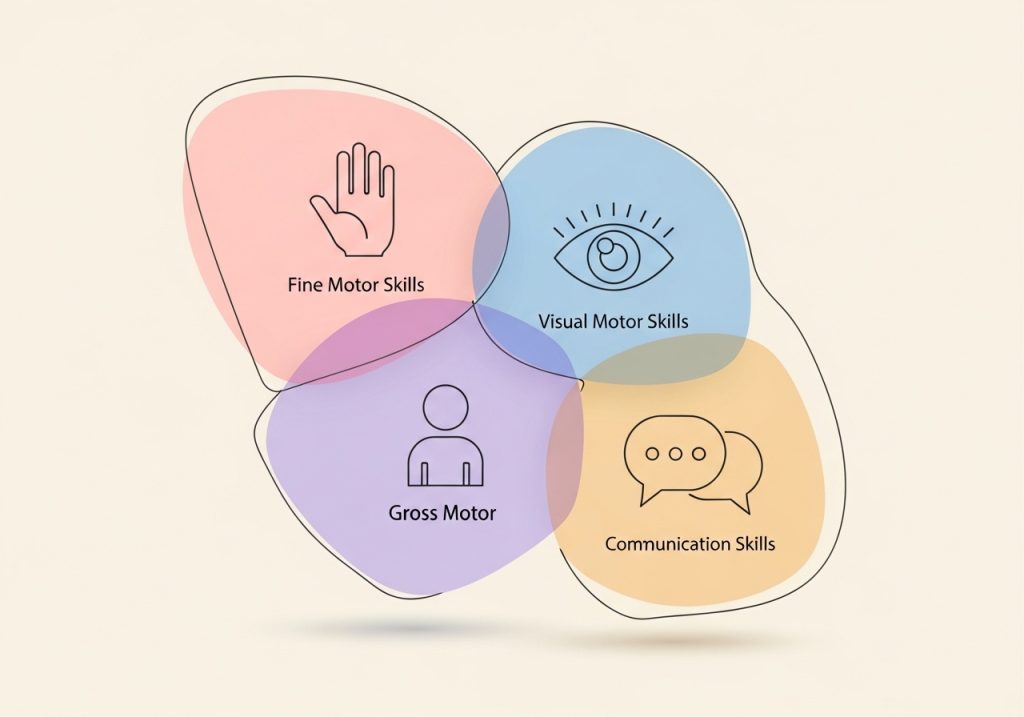
- Fine Motor Skills: The coordination of small muscles in the hands and fingers. This includes grasping, writing, cutting, and manipulating small objects.
- Gross Motor Skills: The use of large muscle groups for movement. This covers skills like walking, running, jumping, and balance.
- Visual Motor Integration: The ability to coordinate visual information with motor movements. Examples include copying shapes, catching a ball, and navigating obstacles.
- Sensory Processing: The way the nervous system receives and interprets sensory messages from the body and environment.
- Self-Care (Activities of Daily Living): The fundamental skills required to independently care for oneself, such as dressing, feeding, and personal hygiene.
- Social-Emotional Skills: The ability to understand and manage emotions, build positive relationships, and make responsible decisions.
- Executive Functioning: The mental processes that enable us to plan, focus attention, remember instructions, and manage multiple tasks.
Choosing your domains first helps ensure your final list is balanced and comprehensive, covering all critical areas of a child’s development.
Step 2: Break Down Domains into Specific, Observable Skills
Once you have your core domains, the next step is to break them down into specific, observable skills. This is the most crucial part of the process. A vague goal like “improve handwriting” is difficult to measure. A specific skill like “forms all uppercase letters correctly” is concrete and easy to assess. Your goal is to create statements that anyone could observe and agree upon whether the learner has demonstrated the skill or not.
Let’s use the “Fine Motor Skills” domain as an example. You could break it down into the following specific skills:
- Holds a pencil with a functional three-finger grasp.
- Cuts along a straight line with scissors.
- Squeezes a glue bottle with controlled pressure.
- Strings small beads onto a shoelace.
- Buttons a shirt independently.
- Uses a fork to pierce and lift food.
Similarly, for the “Social-Emotional Skills” domain, you might list skills like:
- Identifies basic emotions (happy, sad, angry) in self and others.
- Takes turns during a structured game.
- Uses words to express needs or wants.
- Follows a two-step direction from an adult.
When you break down complex abilities into smaller parts, you create a clear path for teaching and intervention. This level of detail is also essential for fostering a child’s ability to advocate for themselves, as they begin to understand their own strengths and areas for growth.
Step 3: Organize Your Complete List of Skills
With your domains identified and broken down, it’s time to organize your complete list of skills into a usable format. The best format depends on how you plan to use it. The key is to make it easy to read, update, and share with others, such as team members or parents. A disorganized list will be difficult to use consistently.
Consider these popular formats:
- Checklists: A simple checklist format is excellent for quick observations and tracking progress over time. You can create columns for dates and mark skills as “emerging,” “in progress,” or “mastered.” This is perfect for printing and using in a classroom or therapy session.
- Spreadsheets: Digital spreadsheets (like Google Sheets or Microsoft Excel) are highly versatile. You can easily sort and filter skills by domain, track progress for multiple learners, and share the document with collaborators. You can also add notes and link to relevant resources.
- Tables: A simple table in a word processing document can organize skills by domain. This format is straightforward to create and can be easily incorporated into reports or student plans.
Whichever format you choose, ensure it is logically structured. Group all skills under their respective domain headings. This organization makes it simple to locate specific skills and get a holistic view of a learner’s abilities within a particular area.
Step 4: Apply the List for Assessment and Goal Setting
Your skills list is now a powerful tool for informal assessment. By observing a learner and comparing their abilities against the list, you can quickly identify both their strengths and the specific areas where they need support. This process is more targeted than general observation because it gives you a precise framework for what to look for.
To use the list for assessment:
- Observe the learner in different settings and during various activities (e.g., structured tasks, free play).
- Use your list as a guide to note which skills are consistently demonstrated and which are emerging or absent.
- Document your findings. Use a simple coding system, like a checkmark for mastered, a plus/minus for emerging, and a minus for not yet demonstrated.
Once you have this data, you can use it to set meaningful, individualized goals. For example, if your assessment shows a child can cut a straight line but struggles with curves, a logical next goal would be “Cuts along a curved line with 90% accuracy.” This data-informed approach ensures that goals are appropriate for the learner’s current developmental stage and sets them up for success.

Step 5: Integrate the Skills into Planning and Intervention
A list of skills should not just be a static document for assessment. Its real value comes from its daily application in planning interventions and activities. With specific skills identified as goals, you can now intentionally design or select activities that target those exact abilities. This transforms your planning from general to precise.
For example, if a learner’s goal is “to use a pincer grasp to pick up small objects,” you can plan activities such as:
- Picking up pom-poms with tweezers.
- Placing pegs into a pegboard.
- Peeling stickers and placing them on paper.
- Playing with therapy putty to find hidden beads.
Connecting each activity to a specific skill on your list ensures that every moment is purposeful. It also makes it easier to explain the “why” behind an activity to parents, colleagues, and the learners themselves. When you plan effective activities around targeted skills, you create a direct line between your intervention and the learner’s progress. You can also use this approach to implement problem-solving activities that build cognitive and executive functioning abilities from your list.
Creating and maintaining a list of skills requires an initial investment of time, but the benefits are significant. It provides a clear, consistent framework for assessment, goal setting, and intervention planning. By breaking down complex development into manageable parts, you can provide more targeted support and clearly communicate progress to everyone on the learner’s team. Start by outlining one or two domains, and build your list over time. It will quickly become one of the most valuable tools in your professional toolkit.
Ready to put these ideas into practice? Finding the right activities to target specific skills can be time-consuming. The Inspiring OT offers a wide range of practical, evidence-informed resources designed by an experienced occupational therapist. From fine motor task cards to self-regulation worksheets, our low-prep printables make it easy to support skill development in therapy, the classroom, or at home. Explore our collection to find engaging tools that align perfectly with the skills on your list.
Leave a Reply