
Letter recognition is a foundational skill for literacy. Before a child can learn to read, they must be able to distinguish letters from one another, identify their names, and eventually connect them to sounds. For many children, this process happens naturally through exposure. For others, it requires targeted practice and creative approaches. As occupational therapists, educators, and parents, we can use our knowledge of child development to make learning letters a positive and effective experience. Finding the right letter recognition activities is not just about memorization; it is about building a solid base for all future learning.
Why Multi-Sensory Approaches Are Key for Letter Learning
Children learn best when they can engage multiple senses at once. A multi-sensory approach to letter recognition moves beyond simple flashcards. It involves connecting the visual appearance of a letter with how it feels to touch, how it sounds when spoken, and the movements required to form it. This method helps create stronger, more lasting neural pathways in the brain. When a child builds the letter ‘A’ with playdough, they are using their tactile sense to understand its shape, their motor skills to construct it, and their visual system to confirm its appearance. This deepens their understanding far more than just looking at the letter on a page.
This integrated learning process helps children of all abilities, especially those who struggle with traditional learning methods. By providing information through different sensory channels, you give the brain more opportunities to process and store it. A kinesthetic learner might remember the letter ‘J’ by jumping along its shape on the floor, while a tactile learner might remember the letter ‘S’ by tracing it in sand. This approach makes learning more accessible and inclusive.
Engaging Letter Recognition Activities for Skill Building
The best activities are often those that do not feel like work. By integrating letter practice into play, you can motivate children and build important underlying skills at the same time. These activities can be used in therapy sessions, classroom centers, or at home. They are designed to support not only letter identification but also the fine motor, visual motor, and gross motor skills that are essential for academic success.
Tactile and Fine Motor Ideas
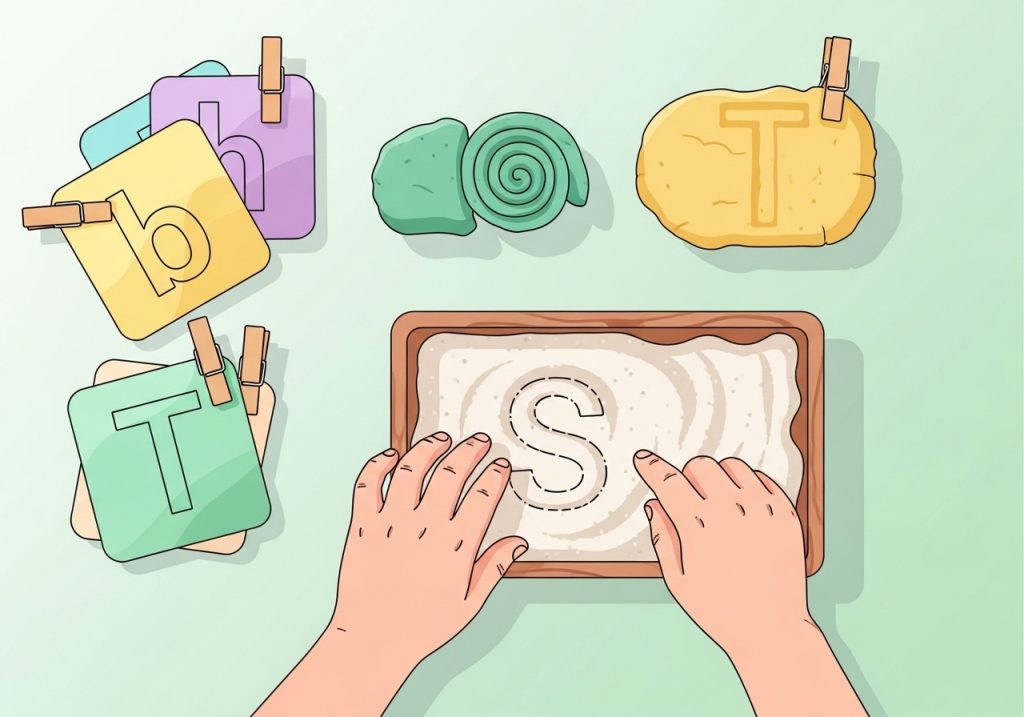
- Sensory Writing Trays: Fill a shallow tray with sand, salt, or shaving cream. Encourage the child to use their finger to trace letters in the material. This provides direct tactile feedback about letter formation and stroke sequence. The resistance of the material helps build finger strength and awareness.
- Dough and Clay Letters: Rolling and shaping playdough or clay into letters is an excellent way to build hand strength and learn the components of each letter (e.g., a straight line and a curve for the letter ‘P’). This bilateral coordination activity strengthens the small muscles needed for a functional pencil grasp.
- Building Block Letters: Use small blocks, pom-poms, or pipe cleaners to construct letters. This activity enhances fine motor precision and spatial awareness. The child has to plan how to arrange the pieces to form the correct letter shape, which supports visual-motor integration.
Visual Motor and Handwriting Prep
- Letter Matching Games: Create simple matching games with uppercase and lowercase letters using cards or bottle caps. This builds visual discrimination skills, which are critical for telling the difference between letters like ‘b’ and ‘d’. As children develop, these activities build foundational fine motor and visual skills that they will use in later grades.
- Dot Marker Letters: Use dot markers or bingo daubers to fill in bubble letters. This activity promotes a proper grasp and develops hand-eye coordination. It gives children a fun way to practice controlling their hand movements within a defined space, a key pre-writing skill.
- Search and Find Puzzles: Hide letters within a picture or create a simple I-Spy game where the child has to find all instances of a specific letter on a page. This improves visual scanning and figure-ground perception, helping a child locate information on a busy worksheet or in a book.
Gross Motor and Movement-Based Ideas
- Alphabet Scavenger Hunt: Hide letter cards around a room or outdoor space and have the child find them. You can call out the letter name or a sound for them to locate. This whole-body movement gets children active and helps solidify learning through experience.
- Letter Hopscotch: Draw a hopscotch grid with letters instead of numbers. As the child jumps on each letter, they say its name or sound. This activity works on balance, motor planning, and letter identification simultaneously. It is also a great way to incorporate learning into your morning meeting activities.
- Beanbag Toss: Place letter cards on the floor and have the child toss a beanbag onto a target letter you call out. This combines letter identification with motor planning and coordination. It is a simple game that provides many opportunities for repetition.
How to Adapt Activities for Diverse Learners
Every child learns differently, and the key to success is modification. An activity can be simplified or made more complex to meet a learner’s specific needs. For a child who is just beginning, introduce only a few letters at a time, focusing on those that are visually distinct (like ‘O’, ‘L’, and ‘T’). Use large, high-contrast materials to help with visual tracking. For a child with fine motor challenges, adapt tools by adding a pencil grip or using larger materials like pool noodles cut into pieces for letter building. The goal is to provide the ‘just-right challenge’ where the child feels successful but is also building new skills.
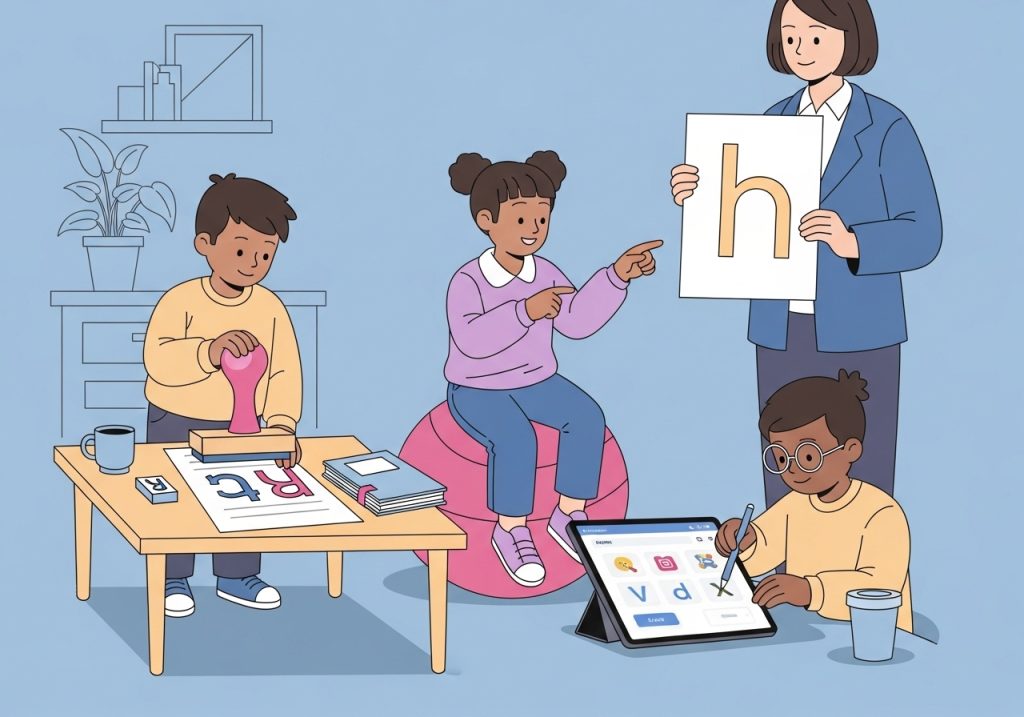
To increase the challenge for more advanced learners, you can introduce lowercase letters, ask the child to identify the letter’s sound, or have them think of a word that starts with that letter. This bridges the gap between simple recognition and pre-reading. Connecting letters to sounds is a critical next step, and you can support this development by exploring other essential phonemic awareness activities. The ability to grade an activity up or down ensures that every learner remains engaged and appropriately challenged.
Using Printable Resources to Support Learning
While hands-on, sensory-based activities are vital, printable resources and worksheets offer a valuable way to provide structured practice and repetition. Well-designed printables can isolate specific skills, such as tracing a letter’s formation, discriminating it from similar letters, or matching its uppercase and lowercase forms. They are a low-prep tool that busy professionals and parents can use to reinforce concepts taught in a more hands-on way.
Printable activities allow you to easily track progress and provide consistent practice from one session to the next. They can be used to target specific areas of difficulty and offer a clear starting point for skill building at home or in the classroom. When chosen carefully, worksheets are not just busywork. They are targeted tools that support the generalization of skills. A child who learns the shape of ‘B’ with playdough can then practice identifying it on a worksheet, strengthening their ability to recognize it in different contexts.
The most effective approach to teaching letter recognition combines different methods to meet a child’s unique learning style. By integrating hands-on play with structured printable resources, you can create a well-rounded and engaging foundation for literacy. This balanced strategy ensures that children receive the sensory input they need to understand concepts deeply, along with the focused practice required to achieve mastery.
Ready to put these strategies into practice? Finding high-quality, developmentally appropriate materials can be time-consuming. The Inspiring OT offers a collection of practical, low-prep printable activities designed by a licensed occupational therapist to support letter recognition and other essential skills. Save time on planning and focus on what matters most: helping learners succeed. Explore the shop today to find evidence-informed resources that make skill-building engaging and effective.
Leave a Reply