

Reading is a complex process that starts long before a child picks up a book. For many learners, the journey begins with hearing and understanding the sounds that make up words. This skill, known as phonemic awareness, is the foundation for reading success. While some children pick this up naturally through listening, others need explicit, hands-on instruction to make the connection.
Occupational therapists and educators know that sitting still and listening is not always the best way for a child to learn. Children often process information better when they can move their bodies and use their hands. Integrating movement and tactile experiences into learning helps anchor abstract concepts. This article explores effective phonemic awareness activities that use multisensory strategies to support literacy development.
Understanding the Role of Phonemic Awareness
Phonemic awareness is the ability to identify and manipulate individual sounds, or phonemes, in spoken words. It is distinct from phonics, which involves connecting those sounds to written letters. Before a student can read the word “cat,” they must understand that the spoken word is made up of three distinct sounds: /c/, /a/, and /t/.
Research shows that a strong grasp of phonemic awareness is one of the best predictors of future reading capabilities. When a learner struggles to distinguish these sounds, they often face challenges with decoding and spelling later on. For children with processing differences or those who require more sensory input, auditory-only instruction is frequently insufficient. They need to feel and act out the sounds to fully grasp the concept.
The Benefit of Multisensory Learning Approaches
Multisensory learning involves engaging more than one sense at a time. In occupational therapy, we often use visual, auditory, kinesthetic (movement), and tactile (touch) pathways to reinforce skills. When a child uses their whole body to represent a sound, the brain creates stronger memory associations.
Active learning helps regulate arousal levels. A child who has difficulty sitting still during circle time might excel when asked to jump or clap out sounds. By pairing a motor action with an auditory task, you provide the proprioceptive input many bodies crave while simultaneously building literacy skills. This approach is beneficial for all students but is critical for those with attention deficits or sensory processing challenges.
Parents and teachers can easily incorporate these strategies into daily routines. Whether you are keeping school-aged children engaged at home or running a small group intervention in a classroom, moving beyond worksheets is effective.
Gross Motor Phonemic Awareness Activities
Gross motor activities involve large muscle groups and whole-body movement. These tasks are excellent for energetic learners who need to burn energy while they learn. Using the floor and open space changes the dynamic of the lesson and reduces the pressure often associated with desk work.
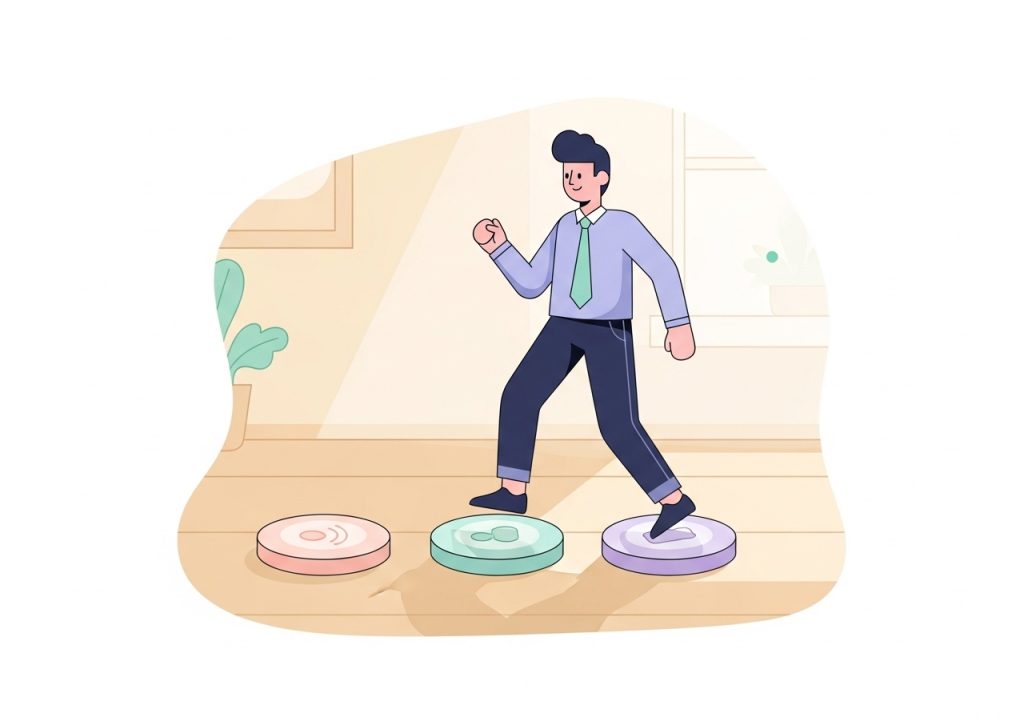
Sound Hops
This simple game requires zero prep and works well in any setting. The goal is to help the child segment words into individual sounds.
- Setup: Place three to four hoops, mats, or tape marks on the floor in a line.
- Action: Give the child a word, such as “fish.”
- Movement: The child jumps into a new hoop for each sound they hear (/f/ – /i/ – /sh/).
- Progression: Ask them to jump back to the beginning and say the whole word fast.
Obstacle Course Blending
An obstacle course adds an element of excitement and heavy work, which is calming for the nervous system. You can set this up indoors or outdoors.
- Station 1: The child performs a task (like crawling through a tunnel) and the adult gives the first sound of a word (e.g., /m/).
- Station 2: The child balances on a beam, and the adult gives the second sound (/a/).
- Station 3: The child does wall push-ups, and the adult gives the final sound (/t/).
- Finish Line: The child runs to the end and shouts the blended word (“Map!”).
Red Light, Green Light Rhyming
This variation of the classic playground game builds rhyming discrimination.
- The adult stands at one end of the room as the “traffic light.”
- The adult says two words.
- If the words rhyme (e.g., “star” and “car”), the children can run forward (Green Light).
- If the words do not rhyme (e.g., “star” and “moon”), the children must freeze (Red Light).
- If a child moves on a non-rhyming pair, they take a step back.
Integrating these active games is a great way to ensure learning continues outside the classroom, similar to purposeful play routines during breaks.
Fine Motor and Tactile Strategies for Sound Segmentation
Fine motor activities focus on the smaller muscles of the hands. These tasks provide tactile feedback, which reinforces the physical “feeling” of sounds. Manipulatives give children a concrete representation of something that is otherwise invisible.

Bead Slide
Using pipe cleaners and pony beads creates a simple tool for segmenting and blending.
- Setup: String three or four beads onto a pipe cleaner. Twist the ends so the beads don’t fall off.
- Action: Push all beads to one side. Say a word like “sun.”
- Movement: As the child says each sound (/s/, /u/, /n/), they slide one bead across to the other side.
- Visual: This helps the child visualize that one word is made of three distinct parts.
Playdough Smashes
Playdough offers resistance, which provides excellent sensory feedback. It is a favorite tool in many therapy sessions.
- Setup: Roll three small balls of playdough and place them in a row.
- Action: Say a word segment by segment.
- Movement: The child uses their index finger or palm to smash one ball flat for every sound they hear.
- Reset: Rolling the balls back up works on in-hand manipulation skills, adding a fine motor strengthening component to the lesson.
Button Push
For children who like structure, using buttons or counters on a grid is effective.
- Draw a series of connected boxes (Elkonin boxes) on a piece of paper.
- Give the child a handful of buttons or coins.
- As they identify a sound, they push a button into the corresponding box.
- This creates a clear left-to-right progression, which reinforces the directionality needed for reading and writing.
Adapting Activities for Different Skill Levels
Every learner processes information at their own pace. The beauty of multisensory phonemic awareness activities is that you can easily modify them to match the child’s current ability level.
For beginners, start with compound words. These are easier to hear than individual phonemes. For example, in the “Sound Hops” game, have the child jump once for “rain” and once for “bow” to make “rainbow.” Once they master this, move to syllables (jump for “wa-ter”), and finally to individual sounds.
For advanced learners, increase the complexity by asking them to manipulate the sounds. Ask them to jump out the sounds for “slip,” then ask, “What happens if we don’t jump for the /l/ sound?” (It becomes “sip”). This requires a higher level of auditory processing and working memory.
Consistency is vital. Practicing these skills for five to ten minutes a day yields better results than a long, once-a-week session. These short bursts of practice are perfect for skill-building summer activities for afterschoolers or weekend reviews.
Building a Strong Foundation
Phonemic awareness is the bedrock of literacy. By moving away from purely auditory instruction and embracing multisensory strategies, we open new doors for learners who think and process differently. Whether through jumping, smashing playdough, or sliding beads, these activities make the abstract nature of sound concrete and manageable.
Occupational therapy principles remind us that the body and brain work together. When we engage the hands and the body in the learning process, we support not just the development of reading skills, but the confidence and engagement of the child. With the right tools and a playful approach, building these essential skills becomes an enjoyable part of the daily routine.
Ready to make skill-building easier and more effective? Visit The Inspiring OT shop to download printable activities, worksheets, and guides designed by an experienced occupational therapist to support your learners’ growth today.
Leave a Reply