

A developmental milestones checklist is an invaluable tool for any occupational therapist, teacher, or parent. It provides a structured way to observe a child’s progress, celebrate their strengths, and identify areas where they might need more support. Instead of guessing or relying on memory, a well-designed checklist offers clear, objective insights into a child’s skills across different domains. Creating your own checklist allows you to tailor it to specific needs, whether for an individual child, a classroom, or a therapy group. This guide will walk you through the practical steps to build and use a checklist that truly supports developmental growth.
Step 1: Define the Purpose and Age Range
Before you begin listing milestones, it is essential to clarify the purpose and scope of your checklist. A focused tool is far more effective than a generic one. Start by asking yourself a few key questions: Who will be using this checklist? Are you an OT tracking specific therapy goals, a preschool teacher monitoring a classroom of 4-year-olds, or a parent curious about your toddler’s development? The answer will shape the entire document.
Next, define the specific age range. Developmental milestones change rapidly, especially in early childhood. A checklist for an 18-month-old will look very different from one for a 5-year-old. Narrowing your focus to a specific period, such as 24-36 months or the preschool years (ages 4-5), ensures that the milestones are relevant and manageable. This clarity prevents the checklist from becoming overwhelming and helps you gather precise, actionable information about the child or group you are observing.
Step 2: Research and Select Key Developmental Domains
Once you have your purpose and age range, the next step is to organize your checklist around key developmental domains. These categories help structure your observations and ensure you are looking at the whole child. While specific domains can vary, most comprehensive checklists include a few core areas. Understanding these main types of skills in child development provides a solid foundation for your checklist.
Common developmental domains to include are:
- Fine Motor Skills: Involves the use of small muscles in the hands and fingers, such as grasping objects, writing, and using scissors.
- Gross Motor Skills: Relates to the large muscles used for sitting, walking, running, and jumping.
- Language and Communication Skills: Covers a child’s ability to understand language (receptive) and express themselves through words and gestures (expressive).
- Social-Emotional Skills: Focuses on interacting with others, managing emotions, showing empathy, and developing self-awareness.
- Cognitive Skills: Pertains to thinking, problem-solving, memory, and learning about the world.
- Self-Help and Adaptive Skills: Includes daily living tasks like feeding, dressing, and basic hygiene.
Grouping milestones under these headings makes the checklist easier to navigate and helps you spot patterns in a child’s skill set.

Step 3: Gather Specific and Observable Milestones
This step is where your checklist takes shape. The goal is to populate each domain with milestones that are specific, observable, and measurable. Vague statements like “has good motor skills” are not helpful. Instead, you need concrete actions that you can see and document. For example, instead of “plays well with others,” a more specific milestone would be “Takes turns in games” or “Shares toys with prompting.”
To find appropriate milestones, consult reliable sources. Organizations like the Centers for Disease Control and Prevention (CDC), the American Occupational Therapy Association (AOTA), and Zero to Three provide evidence-based milestone lists for different age groups. Using these resources aligns your checklist with established standards and is a key part of applying evidence-based practice in your work. When selecting milestones, always phrase them as clear, observable behaviors. This objectivity is critical for accurate tracking and reduces personal bias during observation.
Step 4: Structure Your Developmental Milestones Checklist
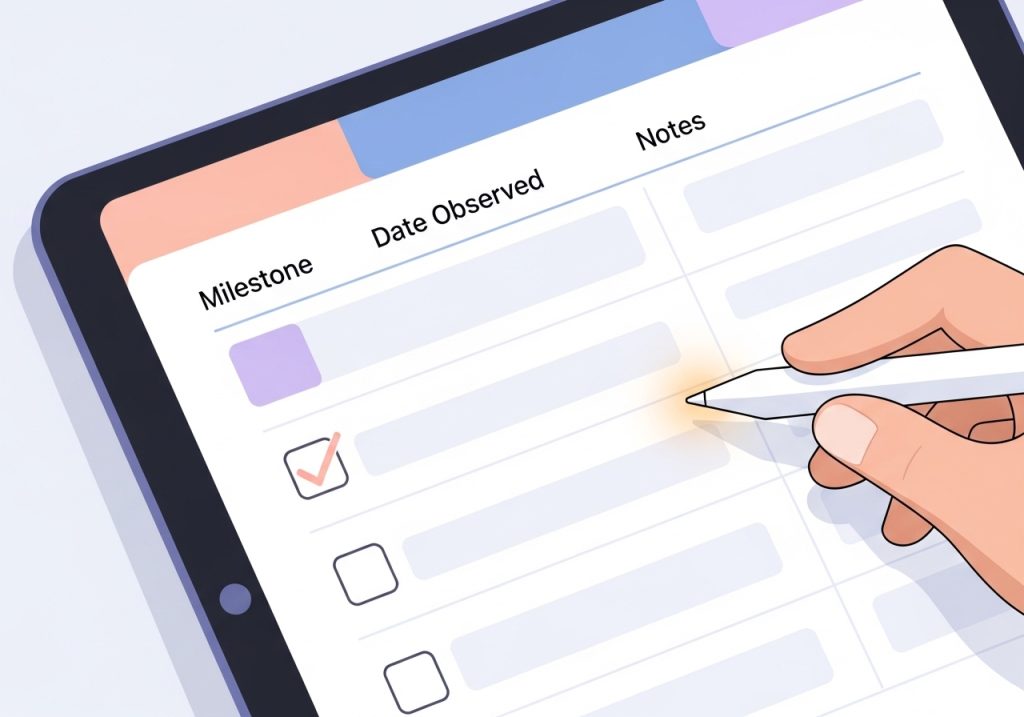
An effective checklist is easy to read and simple to use. A clean, organized layout will make the process of recording observations much more efficient. A table format is often the most practical choice. Create a document with several columns to capture all the necessary information.
A good structure typically includes:
- Milestone Column: A clear description of the specific skill (e.g., “Hops on one foot three times”).
- Observation Column: This can be a simple checkbox, a space to write the date the skill was observed, or a simple rating scale (e.g., Not Yet, Emerging, Consistent). Choose the method that best suits your purpose.
- Notes Column: This space is incredibly valuable. Here, you can add context to your observations. For example, you might note that a child can stack blocks but only with verbal prompts, or that they only share with a specific friend. These details provide a richer picture of the child’s abilities.
Whether you create a digital spreadsheet or a printable PDF, keep the design uncluttered. The goal is function over flair. A simple, well-structured format allows you to focus on the child, not on figuring out how to use the tool.
Step 5: Use the Checklist for Observation, Not Diagnosis
This is perhaps the most important principle to remember when using a developmental milestones checklist. The tool is a screener, not a diagnostic instrument. Its purpose is to guide your observation, help you track progress, and identify areas where a child may need extra support. It is not meant to label a child or diagnose a developmental delay or disorder. Only qualified professionals can make a formal diagnosis.
Think of the checklist as a conversation starter. The information you gather can facilitate productive discussions with parents, colleagues, or other specialists. It provides concrete examples to share when discussing a child’s progress. Approaching the checklist with this mindset ensures that it remains a supportive and positive tool, focused on understanding and helping the child grow.
Step 6: Analyze the Results and Plan Next Steps
Once you have completed your observations, the final step is to analyze the information and decide what comes next. Review the checklist to identify patterns. Where is the child demonstrating consistent skills? Which milestones are just beginning to emerge? Are there any domains where the child seems to be struggling more than others?
This analysis should directly inform your planning. If you notice a child is having difficulty with fine motor tasks, you can introduce more activities that build hand strength and coordination. If social skills are an area for growth, you might structure more opportunities for turn-taking and cooperative play. For example, if your checklist highlights challenges in drawing or copying shapes, you could introduce some practical visual motor integration activities to build those skills. The checklist transforms your observations into an actionable plan, allowing you to provide targeted, meaningful support where it is needed most. You can revisit the checklist periodically, perhaps every few months, to update it and track progress over time.
Creating and using a developmental milestones checklist is a proactive way to support a child’s journey. It moves beyond simple observation to provide a structured framework for understanding and fostering growth. By defining your purpose, selecting appropriate milestones, and using the tool thoughtfully, you can gather valuable insights that inform your therapy plans, classroom instruction, or parenting strategies. Ultimately, a good checklist empowers you to celebrate every achievement and provide the right support at the right time.
Creating custom checklists is an excellent practice, but sometimes you need reliable, ready-to-use resources to support the skills you are tracking. The Inspiring OT offers a wide range of practical, OT-designed printables that make skill-building engaging and effective. From fine motor activities to sensory tools and informal assessments, you can find low-prep materials to help every learner succeed. Explore the full collection of resources in The Inspiring OT shop and find the perfect tools to complement your work.
Leave a Reply