

Teaching children how to navigate disagreements is a fundamental part of their social and emotional development. For therapists, educators, and parents, finding effective tools is key to making these complex lessons stick. Well-designed conflict resolution worksheets can provide a structured way to introduce concepts like empathy, communication, and problem-solving. These resources are not just busy work; when used correctly, they become powerful catalysts for building skills that learners can carry with them into the classroom, onto the playground, and through life. This guide will walk you through a practical, step-by-step process for using these tools to foster meaningful and lasting social skills.
Step 1: Identify the Specific Social-Emotional Skill to Target
Before you print a single worksheet, the first step is to observe and identify the specific challenge a learner is facing. Conflict resolution is a broad area, and a one-size-fits-all approach is rarely effective. By narrowing your focus, you can select a tool that directly addresses the root of the difficulty. A learner who struggles to understand another’s perspective needs a different intervention than one who has trouble managing an angry reaction.
Spend time observing the child in social situations. What part of the conflict process breaks down? Common areas to target include:
- Identifying Feelings: The learner may have difficulty recognizing or naming their own emotions or the emotions of others.
- Perspective-Taking: The inability to see a situation from someone else’s point of view is a frequent source of conflict.
- Generating Solutions: The learner may get stuck in the problem and be unable to brainstorm possible positive outcomes.
- Using “I” Statements: They might resort to blaming (“You always take my toy!”) instead of expressing their own feelings (“I feel sad when I don’t get a turn.”).
- Compromise and Negotiation: The concept of meeting in the middle or finding a win-win solution may be abstract.
By pinpointing the specific skill gap, you can choose a worksheet that provides targeted practice. This focused approach is far more effective than a generic activity and makes it easier to measure progress. For a more structured way of noting these observations, you might consider tracking social-emotional development with a clear checklist to identify patterns over time.
Step 2: Select Appropriate Conflict Resolution Worksheets
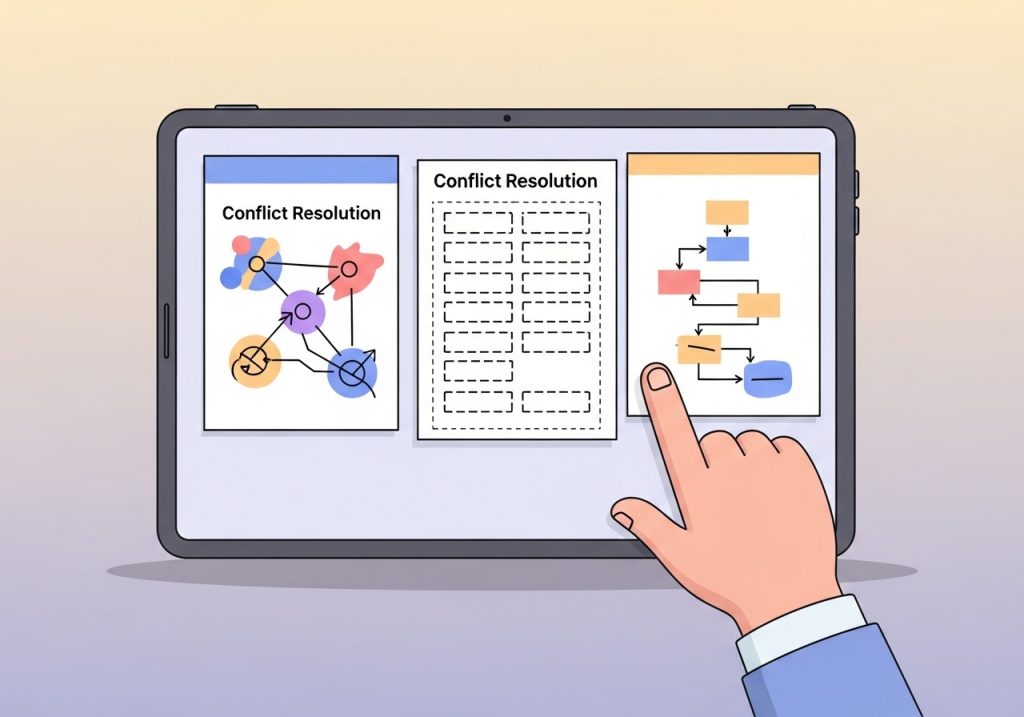
Once you know which skill to target, you can find the right worksheet. The internet is full of resources, but not all are created equal. The goal is to find a tool that is both instructive and engaging for the learner. A worksheet that feels like a test will likely be met with resistance, while one that is clear and visually appealing can invite participation.
When evaluating conflict resolution worksheets, consider the following criteria:
- Developmental Level: A worksheet for a preschooler should rely on pictures, matching, and simple sorting. An older elementary student can handle written scenarios, fill-in-the-blanks, and more complex problem-solving prompts.
- Clarity: The instructions and layout should be simple and uncluttered. Too much text or too many images on a single page can be overwhelming and distract from the learning objective.
- Relevance: Look for scenarios that are relatable to the child’s world. Situations involving sharing toys, taking turns in a game, or disagreeing with a friend are more meaningful than abstract corporate examples.
- Skill Focus: Ensure the worksheet directly addresses the skill you identified in the first step. If the goal is perspective-taking, the activity should prompt the learner to think about what another person might be feeling or thinking.
Step 3: Prepare the Learner and the Environment
How and when you introduce the activity is just as important as the worksheet itself. The ideal time to teach conflict resolution skills is during a calm, neutral moment, not in the heat of a disagreement. When emotions are high, the brain’s capacity for learning new information is significantly reduced. Instead, find a quiet time when you and the learner can focus without pressure or distractions.
Create a supportive and positive atmosphere. Frame the worksheet not as a punishment for past behavior but as a helpful tool for making friendships easier and more fun. You could say something like, “I found a cool activity that can help us practice figuring out what to do when friends have different ideas. Want to try it with me?” This approach is part of a systematic approach to teaching life skills, where preparation sets the stage for successful learning. Ensure the space is comfortable and you have all the necessary materials, like pencils or crayons, ready to go.
Step 4: Guide the Learner Through the Activity
Simply handing a child a worksheet and expecting them to complete it independently misses the most valuable part of the process. Your role is to be a guide and a co-participant. Working through the sheet together transforms it from a solitary task into a relational learning experience. This interaction allows you to model thinking, clarify misunderstandings, and provide immediate, encouraging feedback.
Follow these steps to facilitate the activity effectively:
- Read the instructions aloud. Go through the directions together to make sure the learner understands the goal of each section.
- Model your thought process. For the first problem or scenario, think out loud. For example, “Okay, this says, ‘What could Maria say to Ben?’ I see Maria looks upset. I think she feels angry because Ben took her crayon. A good ‘I’ statement would be, ‘I feel angry when you take my crayon without asking.’”
- Provide scaffolding. If the learner is stuck, offer sentence starters (“You could start by saying, ‘I feel…’”) or a choice of two possible answers. The goal is to build confidence, not to test them.
- Validate their contributions. Acknowledge and praise their effort and ideas. If a response is off-track, gently guide them back without criticism. You could say, “That’s an interesting idea. Let’s also think about how the other person in the picture might feel.”
Remember, the goal is the conversation and the thought process the worksheet stimulates. A perfectly filled-out paper is less important than the skill-building that happens along the way.
Step 5: Practice and Generalize the Skills
The final and most crucial step is to move the skills off the page and into the real world. A worksheet is a tool for introducing a concept, but generalization is what makes the learning functional. The ultimate goal is for the learner to use these strategies independently during actual social interactions. You can support this transfer of skills in several ways.
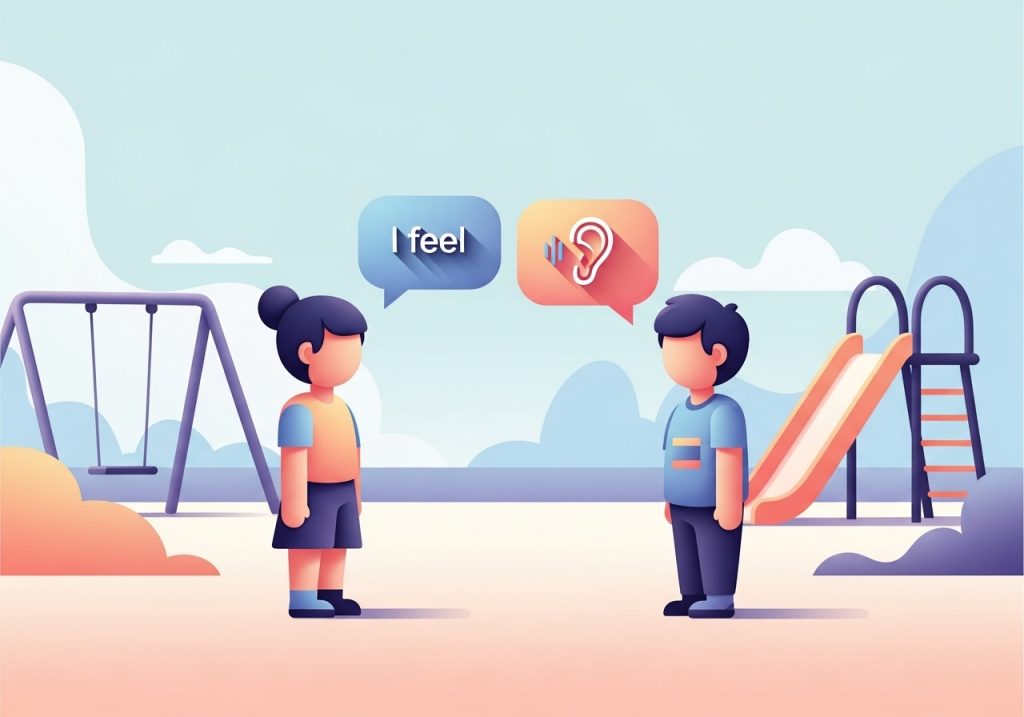
One of the most effective methods is role-playing. Use the scenarios from the worksheet or create new ones based on recent events. Take turns playing different roles. This active practice helps solidify the concepts and builds muscle memory for using new communication techniques. You can also “catch” them using a skill successfully. When you see the learner use an “I” statement or compromise with a sibling, acknowledge it specifically: “I noticed you told your brother how you felt instead of yelling. That was a great way to solve that problem.” This positive reinforcement makes them more likely to repeat the behavior.
Conflict resolution worksheets are a valuable resource in any therapist’s, teacher’s, or parent’s toolkit. Their effectiveness, however, depends entirely on thoughtful implementation. By identifying a specific skill, selecting an appropriate tool, creating a supportive environment, guiding the learning process, and focusing on real-world application, you can transform a simple piece of paper into a powerful mechanism for growth. This structured approach helps children build the confidence and competence needed to manage social challenges successfully.
Ready to put these strategies into practice? Finding the right materials shouldn’t be another challenge. The Inspiring OT shop offers a wide range of practical, OT-designed worksheets and activities that target key social-emotional skills. Save time and support your learners with evidence-informed, ready-to-use resources. Explore our collection of downloadable tools to make skill-building engaging and effective.
Leave a Reply