

Teaching a child how to handle money is one of the most practical life skills they can learn. It builds independence, supports mathematical reasoning, and prepares them for real-world interactions. A key part of this process is learning to make change correctly. While the concept can be abstract, using well-designed making change worksheets can provide structured practice. These tools help break down complex transactions into manageable steps. This guide offers a clear, step-by-step approach for occupational therapists, teachers, and parents to effectively use worksheets for teaching this essential skill.
Before beginning, it’s important to remember that money skills are part of a larger set of abilities. Understanding concepts like counting and value is tied to overall cognitive growth. For a broader look at skill development, you might find it helpful to review the main types of skills in child development.
Step 1: Assess Foundational Skills First
Before handing a student a worksheet, you need to confirm they have the necessary prerequisite skills. Jumping into multi-step problems without a solid foundation can lead to frustration and confusion. A quick, informal assessment will tell you if the learner is ready or if you need to review some basics first.
Key Skills to Check:
- Coin and Bill Identification: Can the learner accurately identify common coins (penny, nickel, dime, quarter) and bills ($1, $5)? The ability to tell these apart is the first step. You can practice this with simple sorting games, which supports effective discrimination training between different objects.
- Value Recognition: Does the learner know the value of each coin and bill? They should be able to state that a dime is worth 10 cents or that a quarter is worth 25 cents. Flashcards or matching games can reinforce this knowledge.
- Basic Math Proficiency: Making change relies on addition and subtraction. Check if the learner is comfortable with adding single and double-digit numbers and subtracting from totals up to 100 or more, depending on the worksheet’s complexity.
To assess these skills, you can use simple prompts. For example, place a few coins on the table and ask, “Can you show me the nickel?” or “How much money is this?” Their responses will give you a clear picture of their readiness for making change worksheets.
Step 2: Start with Concrete, Hands-On Practice
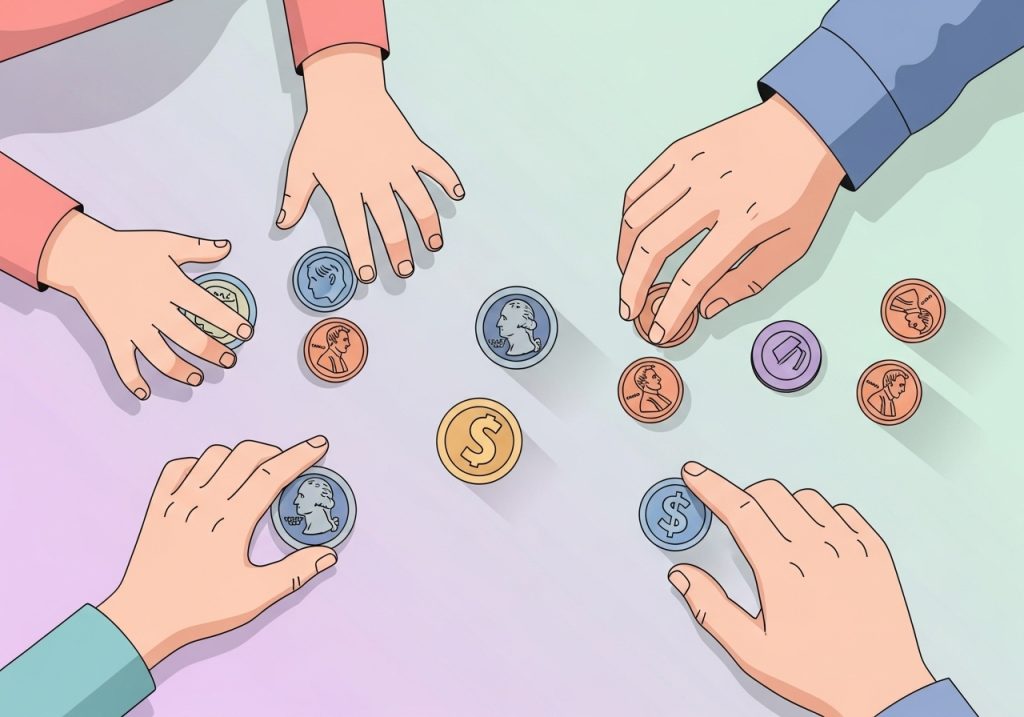
Children learn best when they can connect abstract concepts to tangible objects. Before introducing paper and pencil tasks, use real or high-quality play money to make the idea of financial transactions concrete. This hands-on phase allows learners to physically manipulate the money, which helps them build a stronger mental model of how change is calculated.
Set up simple scenarios where the child can act as a customer or cashier. For example, create a small “store” with a few items priced under a dollar. Give the learner a one-dollar bill and have them “buy” an item. Guide them through the process of paying and receiving change. This interaction makes the concept meaningful and engaging.
During this stage, focus on one of two common strategies for making change:
- Counting Up: This is often the most intuitive method. If an item costs 70 cents and the customer pays with $1.00, you would start at 70 cents and count up to a dollar. You could give back a nickel (to get to 75 cents) and then a quarter (to get to $1.00).
- Subtraction: This method requires stronger math skills. The learner would subtract the item’s cost from the amount paid ($1.00 – $0.70 = $0.30). They would then need to find the combination of coins that equals 30 cents.
Practice with physical money first helps the learner understand the logic behind the calculations they will later perform on a worksheet.
Step 3: Choose the Right Making Change Worksheets
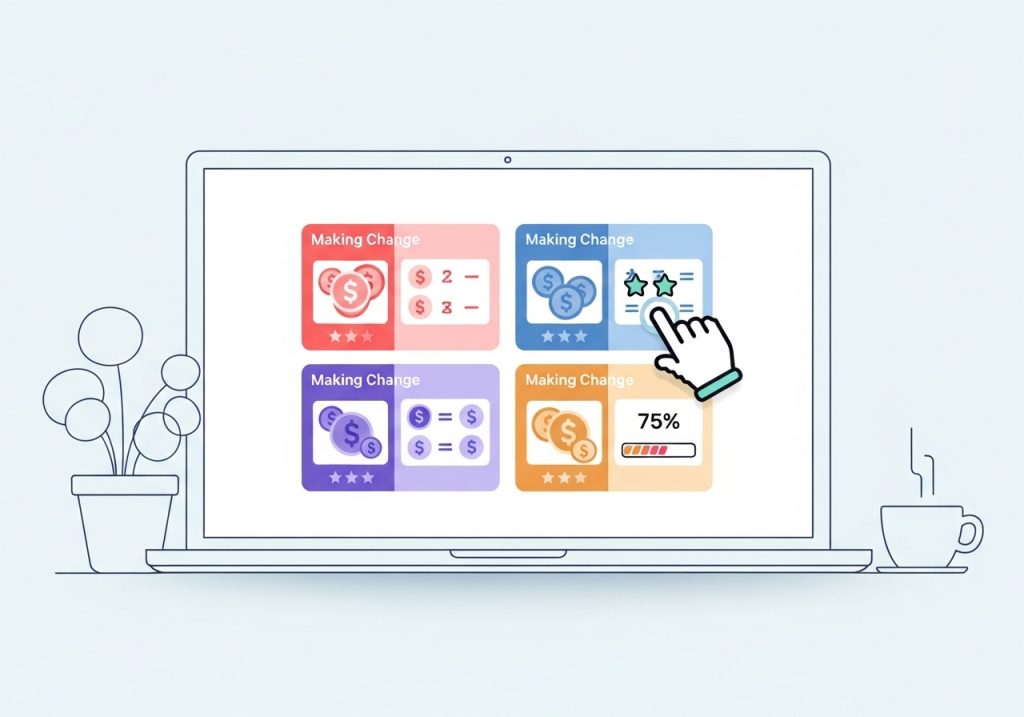
Once a learner is comfortable with hands-on practice, you can introduce worksheets to reinforce and generalize their skills. The key to success is selecting the right materials. A worksheet that is too difficult can discourage a child, while one that is too easy will not provide a meaningful challenge. Look for worksheets that align with the learner’s current ability level and offer clear, uncluttered visuals.
How to Select Appropriate Worksheets:
- Start Simple: Begin with worksheets that feature transactions under one dollar. The problems should involve paying with a single bill, like a $1 bill.
- Gradual Progression: Look for a set of worksheets that gradually increases in difficulty. The progression might look like this:
- Problems with prices ending in 0 or 5.
- Problems with varied prices (e.g., $0.67, $0.89).
- Problems involving paying with larger bills ($5, $10).
- Problems that require the fewest number of coins for change.
- Clear Formatting: The best worksheets have clear images of coins and bills, ample space for writing, and easy-to-read text. A cluttered page can be visually overwhelming.
Remember that you can always modify existing materials to better suit a learner’s needs. If a worksheet is too complex, you can cover some of the problems or provide extra visual aids. Thinking about how to adapt worksheets for diverse learners is a valuable strategy for any educator or therapist.
Step 4: Guide and Model the Process
Simply giving a child a worksheet is not enough. Your role is to guide them through the problem-solving process. The “I do, we do, you do” model works very well here. First, you model how to solve a problem. Then, you work on a problem together. Finally, the learner tries one independently.
A powerful technique is the “think-aloud” strategy. As you complete a problem, verbalize every step of your thought process. For example, you might say, “The candy costs 80 cents, and I paid with a one-dollar bill. To find the change, I’ll start at 80 cents. I can add two dimes to get to one dollar. 80… 90… one dollar. So the change is two dimes, which is 20 cents.”
Provide scaffolding as needed. You can use a number line or a hundreds chart to help the learner visualize counting up. For subtraction, encourage them to write out the problem. Having physical coins available while working on the worksheet can also serve as a helpful bridge between concrete and abstract thinking.
Step 5: Connect Worksheet Practice to Real-Life Scenarios
The ultimate goal of using making change worksheets is to prepare learners for real-world situations. The skills practiced on paper must be generalized to functional contexts. After a child shows proficiency with worksheets, create structured opportunities for them to use their new knowledge in practical ways.
Ideas for Generalization:
- Classroom or Home Store: Continue using the pretend store. You can increase the complexity by adding more items, using multi-item purchases, or introducing pretend sales tax.
- Community Outings: Plan a trip to a real store. Start small, like buying a single item from a vending machine or a snack at a convenience store. Prepare the learner ahead of time by discussing how much the item costs and how much money they will use to pay.
- Menu Math: Use take-out menus to practice. Ask questions like, “If you wanted to buy a slice of pizza that costs $2.50 and you paid with a $5 bill, how much change would you get back?”
- Reviewing Receipts: Look at a real grocery or store receipt together. Identify the total cost and the amount paid. This helps connect the worksheet problems to everyday family activities.
Teaching money skills is a journey that moves from foundational knowledge to abstract problem-solving and finally to real-world application. By following these steps, you can use making change worksheets as an effective tool to build a learner’s confidence and competence. The structured practice they provide, when combined with hands-on activities and real-life experiences, helps solidify a skill that will support their independence for years to come.
Ready to put these steps into practice? Finding the right materials can make all the difference. The Inspiring OT shop offers a variety of engaging, low-prep printable activities and worksheets designed by an experienced occupational therapist. Our resources are crafted to support functional skill development in a way that is clear and accessible for every learner. Explore our collection of practical tools to help you teach money skills and other essential life skills with confidence.
Leave a Reply