
The best handwriting curriculum is developmentally appropriate, systematic, and adaptable to the individual needs of each learner. Choosing the right program involves looking beyond simple letter tracing to find a structured approach that builds foundational motor skills, provides explicit instruction, and offers opportunities for functional practice. For therapists, teachers, and parents, this decision can significantly impact a child’s confidence and academic success, and systematic reviews have examined the efficacy of different curriculum-based interventions.
Core Principles of an Effective Handwriting Curriculum
A strong handwriting curriculum is built on a few key principles. First, it follows a logical developmental sequence. Instruction should begin with foundational pre-writing strokes (vertical and horizontal lines, circles, and crosses) before moving to more complex letter formation. The program should introduce letters in groups based on similar motor patterns rather than in alphabetical order. For example, lowercase letters that start with a “magic c” stroke (like c, o, a, d, g, and q) are often taught together. This approach allows learners to master one motor plan and then apply it to several different letters, which builds confidence and reinforces correct formation habits.
Second, effective instruction is multi-sensory. Children learn best when they can see, hear, say, and feel how letters are formed. A good curriculum incorporates activities that engage various senses to create stronger neural pathways for learning. This might include tracing letters in a sand tray or with a finger dipped in paint, forming them with clay or dough, or saying verbal cues aloud while writing. This multi-sensory approach to handwriting instruction helps solidify motor memory and makes learning more engaging for students with different learning styles or underlying challenges.
Essential Components to Evaluate in a Program
When you are comparing different options, look for specific, tangible components. A comprehensive program should provide clear, direct guidance on several aspects of handwriting development. Evaluating these elements will help you determine if a curriculum is thorough enough to meet your learners’ needs.
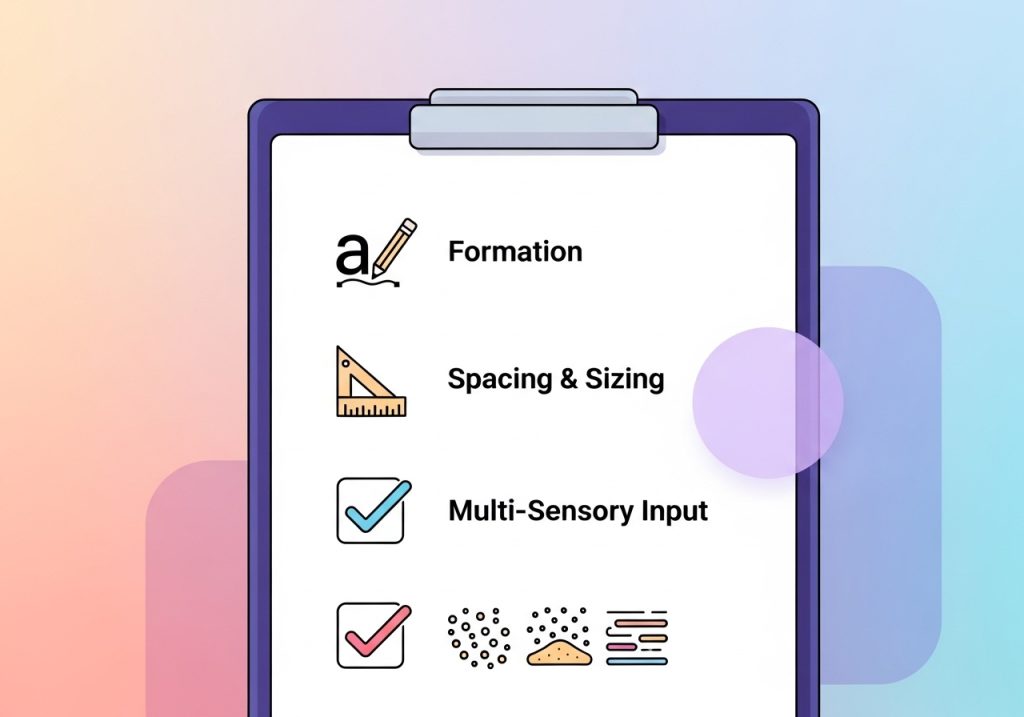
- Explicit Letter Formation Instruction: The curriculum must teach a consistent and efficient path of motion for forming each letter and number. It should provide clear verbal cues (e.g., “Big line down, frog jump up, little curve”) and visual models that are easy for children to follow. Programs like Handwriting Without Tears are well-known for their systematic, OT-developed approach to formation.
- Spacing and Sizing: Proper spacing between letters and words is critical for legibility. Look for materials that explicitly teach these concepts. This might involve using a finger or a small object as a spacer. The program should also address letter size (tall, small, and descending letters) and placement on the lines. While specialized paper can be helpful initially, the program should also guide the transition to standard notebook paper.
- Opportunities for Practice and Repetition: Mastery requires practice. A good program includes worksheets and activities that reinforce skills without becoming monotonous. The materials should be well-designed and uncluttered to avoid visual distraction. The amount of practice should be sufficient to build automaticity, where a child can write without consciously thinking about how to form each letter.
- Clear Uppercase and Lowercase Progression: The curriculum should have a clear rationale for how it introduces uppercase and lowercase letters. Many programs begin with uppercase letters because they are formed with simpler straight and curved lines and are all the same height. This can be less confusing for young learners. The transition to lowercase letters should then be systematic.
The Role of Assessment and Individualization
Handwriting skills vary greatly from one child to another. A one-size-fits-all approach is rarely effective, as each learner brings a unique profile of motor skills, visual perception, and attention. An ideal handwriting curriculum includes tools for informal assessment to identify a student’s specific strengths and areas of difficulty. This allows you to establish a baseline for skills like pencil grasp, posture, letter formation, and spacing, then track progress over time. An initial assessment helps you know where to start instruction.
The program must also be flexible enough to allow for individualization. You should be able to modify the pacing, activities, and level of support based on a child’s response to instruction. For instance, a child struggling with fine motor control may need more time with multi-sensory activities and pre-writing exercises before moving to pencil-and-paper tasks. In contrast, a child who has mastered letter formation might need more focus on sentence writing, speed, and applying legibility in context. A curriculum that offers a variety of activities and entry points is far more valuable than a rigid, linear one.
Integrating Handwriting Practice Beyond the Worksheet
While structured practice is important, the ultimate goal of handwriting is clear, efficient, and automatic written communication. A curriculum’s effectiveness is often measured by how well skills transfer to real-world tasks. The best programs encourage applying handwriting skills in functional and meaningful ways, connecting practice to purpose.

This can include activities like writing a thank-you note to a family member, making a grocery list, labeling drawings, or completing a science journal entry. Integrating handwriting into other academic subjects or daily routines makes practice relevant. It helps children understand why legibility matters and provides intrinsic motivation to improve. As students become proficient with print, these functional tasks can also be a great way to introduce new skills and learn how to write in cursive for greater speed and fluency.
Making the Right Choice for Your Learners
Selecting a handwriting curriculum requires careful consideration of its methodology, components, and adaptability. The most successful approach will be one that is systematic yet flexible, providing explicit instruction while accommodating the unique needs of each learner. By focusing on a developmental progression, using multi-sensory techniques, and providing opportunities for meaningful practice, you can build a strong foundation for legible and automatic handwriting. Remember to evaluate each program based on its instructional clarity, practice materials, and options for individualization. Your choice will help shape a child’s ability and confidence in written expression for years to come.
Ready to support your learners with practical, engaging activities? The Inspiring OT offers a wide range of downloadable resources designed by a licensed occupational therapist to build fine motor, visual motor, and handwriting skills. From foundational worksheets to fun, themed activities, you’ll find everything you need to simplify your planning and help every child succeed. Explore the collection today.
Leave a Reply