
Integrating speech and language practice into daily routines is a powerful way to support a learner’s communication development. For occupational therapists, teachers, and parents, finding effective slp activities that fit naturally into a session, lesson plan, or home schedule can make a significant difference. The key is not to add more to your plate, but to embed language opportunities into the activities you already do. This approach helps learners generalize their skills in meaningful contexts, moving beyond structured drills to functional communication. This guide outlines a clear, five-step process for choosing, adapting, and using activities to reinforce speech and language goals collaboratively.
Step 1: Consult with the SLP to Define Target Goals
The foundation of effective support is collaboration. Before selecting any activity, it is essential to have a clear understanding of the learner’s specific communication goals. Partnering with the speech-language pathologist (SLP) ensures that your efforts are aligned and targeted. Schedule a brief meeting or exchange emails to discuss the primary objectives. Ask for specific examples, such as target sounds for articulation, a list of core vocabulary words, or the types of sentence structures the child is working on. This collaboration helps you focus your support precisely where it is needed most. Having this clarity is the first step in targeting a specific set of skills and avoiding generic interventions that may not be as effective. The SLP can provide valuable insights into which cues are most successful and what level of prompting is appropriate for the learner.
Step 2: Select Foundational Activities with Language Potential
The best activities for language development are often the ones that are already part of a child’s routine. Instead of searching for specialized “speech” games, look for tasks that are inherently engaging and offer natural opportunities for communication. Hands-on activities are particularly useful because they involve objects, actions, and processes that children can talk about. Consider options like building with blocks, sensory bin exploration, simple craft projects, or reading a storybook. These activities provide a rich context for introducing and practicing new words and concepts. For example, a simple art project can become a lesson in naming colors, requesting supplies like “glue” or “scissors,” and describing actions such as “cutting” and “pasting.” You can also use theme worksheets to boost engagement and provide structured practice within a fun context.
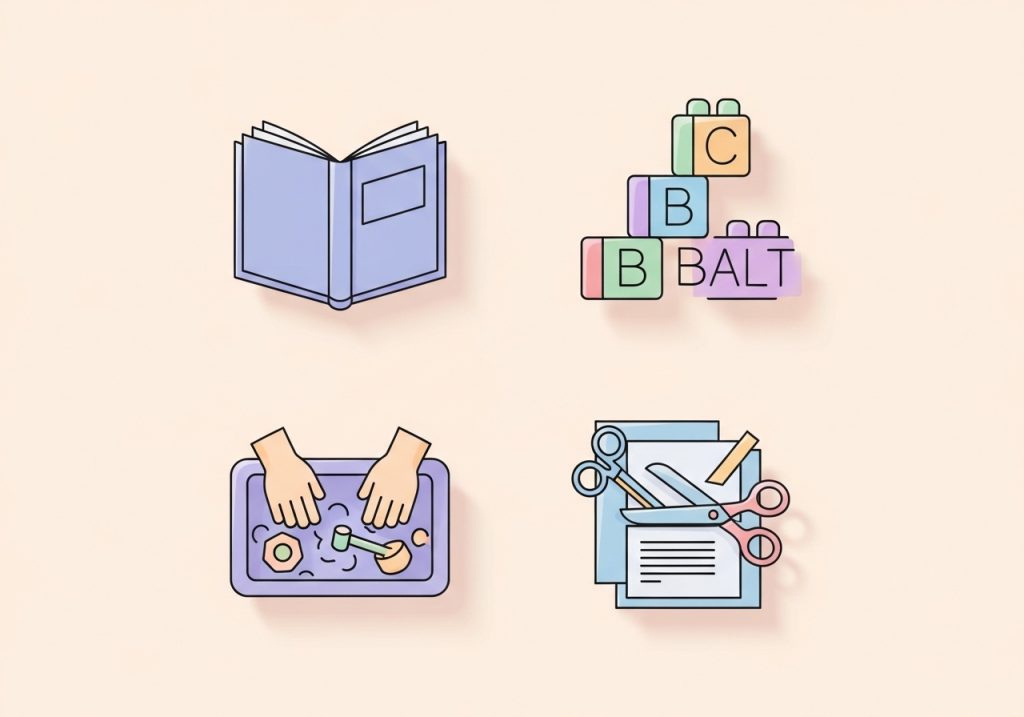
The goal is to choose activities that the learner enjoys. When a child is motivated and interested, they are more likely to communicate spontaneously. A low-prep activity that captures a child’s attention is often more valuable than a complex one that requires extensive setup and instruction.
Step 3: Modify Your Chosen SLP Activities for Specific Skills
Once you have a foundational activity, the next step is to adapt it to address the specific communication goals identified in Step 1. A single activity can be modified in numerous ways to target different skills, making it a versatile tool for both individual and group settings. This adaptability is what makes routine-based intervention so efficient. You are not creating new lessons, but rather embedding new goals into existing frameworks. The key is to be intentional about the language you model and the opportunities you create for the learner to practice.
Here are a few examples of how to modify a common activity, such as playing with dough:
- Articulation: If the target sound is /s/, you can focus on making “snakes,” “stars,” or a “sun.” You can model the sound clearly as you say words like “squish,” “press,” and “smooth.”
- Vocabulary and Concepts: Work on naming colors (“Let’s use the blue dough”), shapes (“Can you make a circle?”), and descriptive words (“This dough is so soft and squishy”). You can also introduce concepts like size (big/little) and length (long/short).
- Following Directions: Give simple one or two-step commands related to the activity. For example, “First, get the red dough, then roll it into a ball.” This helps with receptive language skills.
- Sentence Structure: Model simple sentences to describe your actions (“I am rolling the dough”) and encourage the learner to do the same. You can use carrier phrases like “I see a…” or “I want the…” to help them build sentences.
By making small tweaks, you can transform a familiar play routine into a targeted practice session that feels natural and fun for the learner.
Step 4: Use Strategic Prompts and Modeling
How you interact with a learner during an activity is just as important as the activity itself. Your role is to be a supportive communication partner. This means providing language models and gentle prompts without creating pressure or anxiety. Avoid demanding that the child repeat words after you. Instead, use strategies that encourage spontaneous communication. One powerful technique is self-talk, where you describe your own actions as you perform them (“I am cutting the paper”). Another is parallel talk, where you describe the child’s actions (“You are stacking the blue block”).

Language expansion is another effective strategy. If the learner says a single word, like “car,” you can expand on it by adding more information: “Yes, it’s a big, red car.” This models a more complete utterance without directly correcting them. Using open-ended questions that require more than a “yes” or “no” answer, such as “What should we do next?” or “Tell me about your picture,” can also invite more complex language. Remember to provide adequate wait time, giving the learner several seconds to process what you said and formulate a response.
Step 5: Document and Share Observations
Consistent communication among all members of a learner’s team is critical for success. After a session or activity, take a moment to jot down a few brief notes. This documentation does not need to be formal or time-consuming. It can be as simple as a sticky note or a quick entry in a shared digital log. Note any new words the child used, sounds they produced correctly, or instances where they successfully followed a complex direction. It is equally important to note what strategies were most effective. Did a visual cue help? Did a particular type of question lead to a longer response?
Sharing these observations with the SLP, teachers, and family members creates a more complete picture of the child’s progress. This feedback loop allows the SLP to adjust therapy goals based on how the learner is performing in different environments. It also helps everyone on the team use the most successful strategies, providing the child with consistent support throughout their day. This collaborative approach ensures that everyone is working together toward the same communication milestones.
By following these five steps, you can confidently integrate supportive SLP activities into your existing routines. The process starts with clear goals from the SLP and focuses on using familiar, engaging activities as a vehicle for language practice. Through intentional modification, strategic modeling, and consistent team communication, you can create a rich language-learning environment that helps children build functional and lasting communication skills. The most impactful support often happens during these everyday moments of connection and play.
Ready to put these strategies into action? Finding the right materials can make all the difference. Explore The Inspiring OT shop for a wide range of practical, low-prep printable activities and resources designed by an experienced occupational therapist. Support skill development in a way that is both effective and engaging. Browse our collection today and find the perfect tools for your therapy sessions, classroom, or home.
Leave a Reply