
Teaching a new or complex skill can sometimes feel daunting, especially when a learner struggles to grasp the entire task at once. Shaping is a powerful, evidence-based strategy used to teach new behaviors by breaking them down into smaller, achievable steps. Instead of expecting mastery from the start, you systematically reinforce successive approximations until the final goal is reached. This guide offers a step-by-step process and practical shaping behavior examples to help you effectively build skills in the classroom, clinic, or at home.
Step 1: Identify a Clear Target Behavior
The first step in shaping is to define exactly what you want to teach. A vague goal like “improve listening skills” is difficult to measure and reinforce. Instead, choose a target behavior that is specific, observable, and measurable. This clarity ensures that both you and the learner understand the objective.
For example, instead of “be more independent during morning routines,” a better target behavior would be “put on a shirt without assistance.” Similarly, “get better at writing” could be refined to “write their first name with correct letter formation.” When you are precise about the final skill, you can create a clear path to get there. This process of defining clear objectives is a key part of writing measurable and specific goals for any learning plan.
Step 2: Establish a Baseline
Before you begin teaching, you need to know the learner’s current abilities related to the target skill. This is called establishing a baseline. Observe the learner attempting the task without any prompts or assistance. What parts of the skill can they already do? Where does the breakdown occur? For instance, if the goal is to tie shoes, you might observe that the learner can successfully cross the laces but does not know how to create the loops.
This baseline information is critical. It tells you exactly where to start the shaping process. Starting at a point that is too advanced can lead to frustration, while starting too far back can be inefficient. A clear baseline ensures you are meeting the learner exactly where they are, setting them up for initial success and building momentum.
Step 3: Define the Successive Approximations
This is the core of the shaping technique. A successive approximation is a small step in a series of progressive steps that leads to the target behavior. You must break the final skill down into a logical sequence of manageable actions. Think of it as building a staircase to the final goal, with each step representing one approximation.
Let’s use the goal of teaching a child to write the name “SAM.” The approximations could be:
- Holds a pencil with a functional grasp.
- Makes a curved line for the ‘S’.
- Makes the second curve to complete the ‘S’.
- Makes a downward diagonal line for the ‘A’.
- Makes a second downward diagonal line for the ‘A’.
- Makes the horizontal crossbar to complete the ‘A’.
- Makes a vertical line for the ‘M’.
- Makes a downward curve for the ‘M’.
- Makes the final downward curve to complete the ‘M’.
Each of these steps gets the learner closer to the final behavior of writing their name independently. The key is to make each step small enough that the learner can achieve it with minimal frustration.

Step 4: Choose a Meaningful Reinforcer
Reinforcement is what motivates the learner to continue trying. For shaping to be effective, you must use a reinforcer that the individual finds genuinely rewarding. A reinforcer can be anything that increases the likelihood a behavior will occur again. It could be social praise (“Great job making that line!”), a tangible item (a sticker), or a brief preferred activity (two minutes of playing with a favorite toy).
The best reinforcer is specific to the learner. What works for one person may not work for another. Take time to observe what the individual enjoys. For many children, specific, enthusiastic praise is highly effective. Remember, the goal of reinforcement is to encourage effort and progress. Properly using effective positive reinforcement is the engine that drives the shaping process forward.
Step 5: Reinforce Each Step Systematically
Once you have your steps and your reinforcer, you can begin the process. Start by reinforcing the very first approximation. Using our “SAM” example, you would provide reinforcement as soon as the child makes the first curved line of the ‘S’. Once they can do that step consistently, you stop reinforcing it. You now only provide reinforcement for the next step: completing the entire ‘S’.
This is called differential reinforcement. You are reinforcing behaviors that are a closer approximation of the target skill while no longer reinforcing earlier, mastered steps. This systematic approach gently pushes the learner forward along the sequence you created. It is important to provide the reinforcement immediately after the desired behavior occurs so the learner makes a clear connection between their action and the reward.
Step 6: Real-World Shaping Behavior Examples
Shaping is a flexible strategy that can be applied to a wide range of skills, from academic tasks to daily living activities. Here are a few concrete shaping behavior examples to illustrate how it works in different contexts.
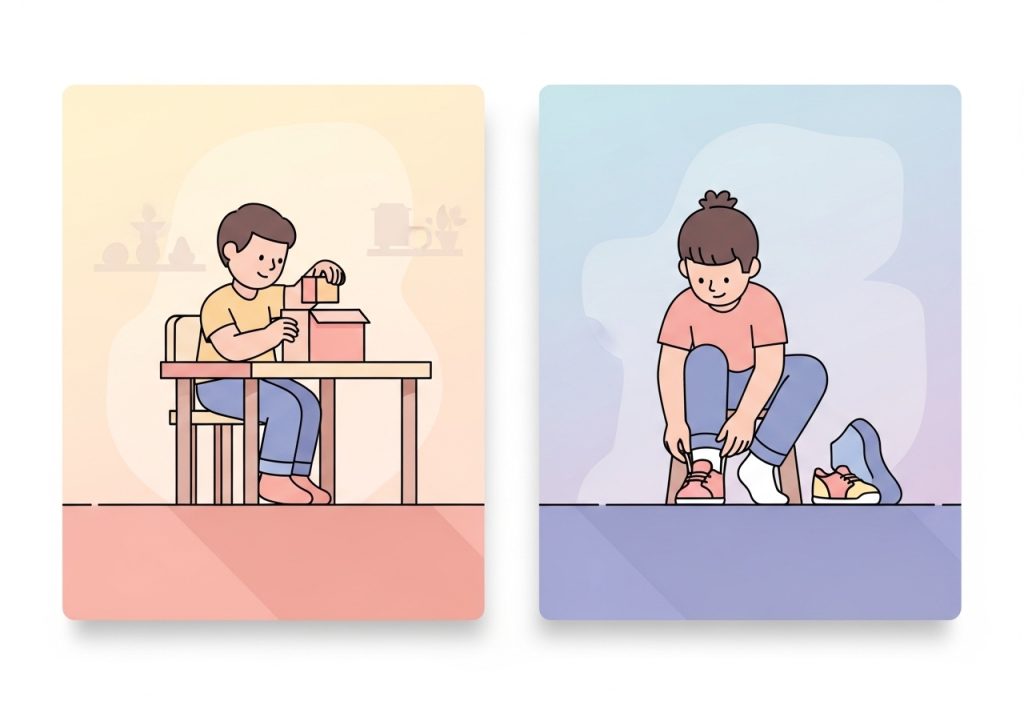
Handwriting: Tying Shoelaces
Tying shoes is a complex fine motor task that is perfect for shaping.
- Target Behavior: Independently tying shoelaces.
- Approximations:
- Crosses the laces to make an ‘X’.
- Tucks one lace under the other.
- Pulls both laces tight.
- Makes one lace into a “bunny ear” loop.
- Holds the loop with one hand.
- Wraps the other lace around the loop.
- Pushes that lace through the hole to create a second loop.
- Pulls both loops tight.
- Reinforcement: Praise each completed step. “You made the first loop! Awesome!” As each step is mastered, praise is reserved for the next step in the chain. These small, targeted interventions can help improve overall handwriting skills and other fine motor abilities.
Communication: Using a Complete Sentence
Shaping can be used to expand a child’s verbal expressions.
- Target Behavior: Requesting a drink using the sentence, “I want water, please.”
- Approximations:
- The child points to water. (Baseline)
- Reinforce the child for saying “wa-wa.”
- Once consistent, only reinforce saying “water.”
- Next, only reinforce saying “want water.”
- Then, only reinforce “I want water.”
- Finally, only reinforce the full sentence, “I want water, please.”
- Reinforcement: Providing the water immediately after the attempt, along with specific social praise. “You said ‘water!’ Here you go!”
Classroom Participation: Raising a Hand to Speak
This example is useful for a student who tends to call out answers.
- Target Behavior: Raising a hand and waiting to be called on before speaking.
- Approximations:
- Student puts a finger on their lips instead of calling out.
- Student raises their hand a few inches from their desk.
- Student raises their hand to shoulder height.
- Student raises their hand fully and waits quietly.
- Reinforcement: Calling on the student as soon as they display the desired approximation, along with a quiet thumbs-up or nod of approval.
Shaping is a patient, positive, and highly effective teaching method. By breaking down skills and celebrating every small success along the way, you build a learner’s confidence and foster a willingness to tackle new challenges. The key is to start with a clear goal, define manageable steps, and provide consistent, meaningful reinforcement. With this approach, you can help individuals achieve complex skills that once seemed out of reach.
Ready to put these principles into practice? Finding the right tools can make all the difference in supporting skill development. At The Inspiring OT, you’ll find a collection of practical, engaging, and low-prep resources designed by an experienced occupational therapist. Explore printable activities, worksheets, and guides to help your learners build essential skills in a fun and effective way. Visit The Inspiring OT resource shop today to find the perfect tools to support your therapy sessions, classroom instruction, or at-home learning.
Leave a Reply