
As occupational therapists, teachers, and parents, we constantly seek ways to build resilience and persistence in the children we support. A powerful tool in this effort is fostering a growth mindset, which is the understanding that abilities and intelligence can be developed through dedication and hard work. Stanford researcher Carol Dweck’s work highlights that individuals with a growth mindset see challenges as opportunities to learn rather than as insurmountable obstacles. By integrating practical growth mindset examples into our daily interactions, we can help learners embrace challenges, learn from setbacks, and ultimately achieve their goals. This guide offers actionable strategies you can start using today in your classroom, clinic, or home.
Reframe ‘I Can’t’ with the Power of ‘Yet’
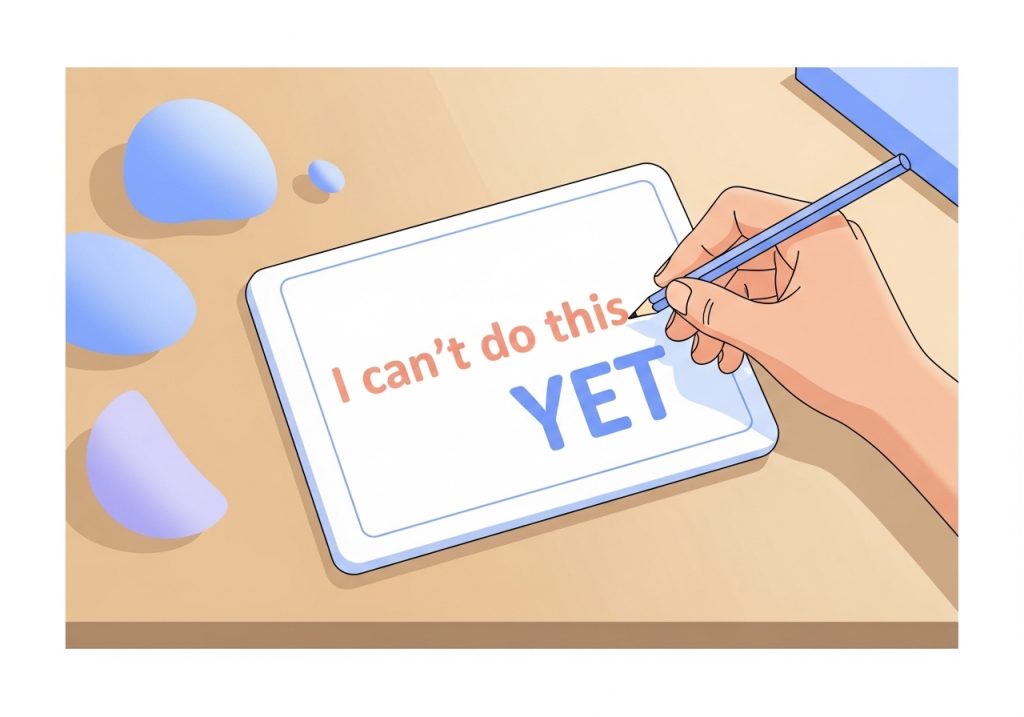
One of the simplest yet most effective ways to cultivate a growth mindset is by teaching learners to transform a fixed statement into one of hope and possibility. This is done by adding the word “yet.” This small linguistic shift is powerful because it reframes a challenge from a permanent inability to a temporary state. It implies that with more time, effort, or a different strategy, success is possible. This technique is especially useful for tasks that require practice and repetition, such as developing fine motor skills for handwriting or learning to tie shoelaces.
When a child says, “I can’t do this puzzle,” you can gently respond, “You mean you can’t do it yet. Let’s see if we can find a strategy to help.” This models the language and validates their current struggle while simultaneously instilling confidence that they are capable of future success. The power of “yet” opens the door to problem-solving and persistence instead of allowing a moment of frustration to shut down the learning process.
Here are some examples of how to apply this:
- Fixed statement: “I can’t write my name.”
Growth mindset reframe: “I can’t write my name yet, but I’m practicing.” - Fixed statement: “I don’t know how to use the scissors.”
Growth mindset reframe: “I’m still learning how to use the scissors.” - Fixed statement: “I’ll never get this right.”
Growth mindset reframe: “I haven’t figured this out yet. What’s another way I can try?”
View Mistakes as Brain-Building Moments
It’s crucial to model the idea that making a mistake is not a failure but an essential and productive part of the learning process. You can explain to children that when we make mistakes, our brains are actually working hard and forming new connections. This concept, rooted in the science of neuroplasticity, helps demystify errors and reduce the anxiety or shame often associated with them. When a child understands that messing up is a sign of their brain getting stronger, they are more likely to take healthy risks and engage with difficult material.
Instead of glossing over a mistake, you can highlight it as a learning opportunity. Say things like, “That’s an interesting mistake! It shows your brain is trying something new. What do you think we can learn from it?” This approach turns a potential moment of discouragement into an exciting moment of discovery. It builds resilience and teaches children to analyze their own work, a critical skill for lifelong learning. Research from Stanford University confirms that students with a growth mindset are more likely to challenge themselves and achieve more because they are not afraid of failure.

Praise the Process and Effort, Not Just the Result
The type of praise we give has a significant impact on a child’s mindset. Praising innate ability, such as saying “You’re so smart,” can inadvertently foster a fixed mindset. It suggests that talent is a static trait, which can make children afraid to tackle challenges where they might not look smart. In contrast, praising the process, effort, strategy, and perseverance reinforces a growth mindset. It communicates that success comes from hard work and dedication, which are factors a child can control.
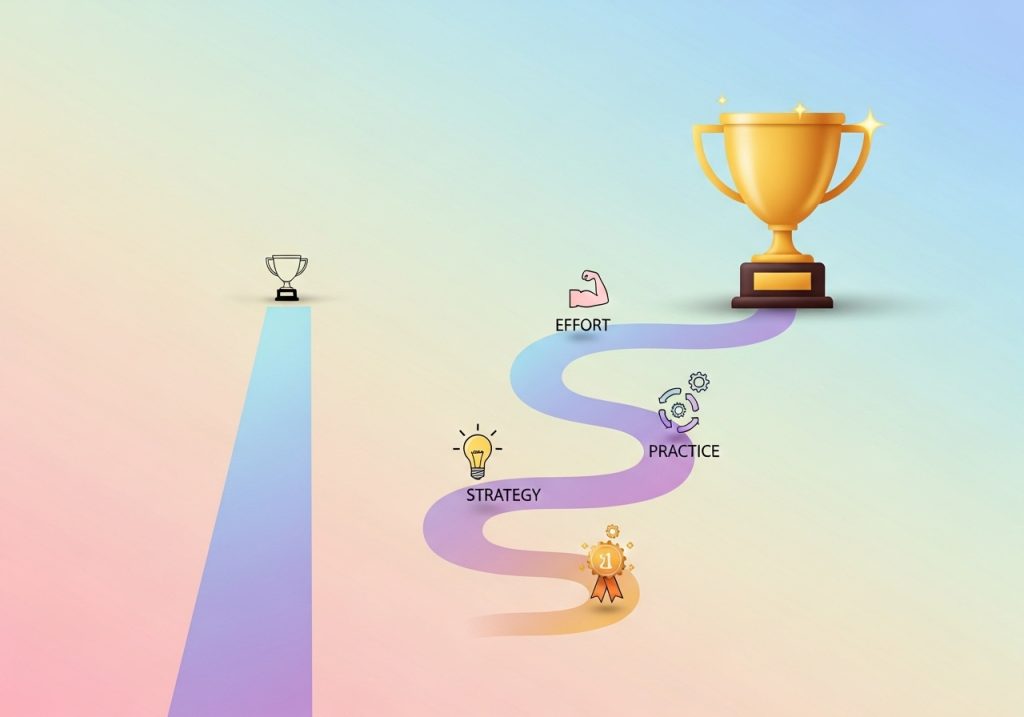
Be specific in your praise to highlight the behaviors you want to encourage. Focusing on the process teaches children to value the journey of learning itself. Creating this type of classroom or home culture, as noted by the American Psychological Association, reassures students of their capabilities. Here are some examples of process-focused praise:
- Instead of “You’re a natural artist,” try “I noticed how you carefully chose your colors and took your time. The amount of detail you included is fantastic.”
- Instead of “You finished the puzzle so fast,” try “I saw how you kept trying different pieces even when it was tricky. Your persistence paid off.”
- Instead of “Great job on your test,” try “You worked so hard studying for this test. All of your practice with different strategies really shows.”
Use Specific Language: Everyday Growth Mindset Examples
The language we use in daily conversations subtly shapes a child’s beliefs about learning and intelligence. By intentionally incorporating growth-oriented phrases, we can model this way of thinking and make it a natural part of their internal dialogue. It involves simple swaps that shift the focus from fixed abilities to the potential for growth. Over time, children will begin to adopt this language themselves, which is a key part of developing stronger self-advocacy and a proactive approach to their learning.
Here are some common fixed mindset phrases and their growth mindset alternatives:
- Instead of: “I’m not good at this.”
Try: “What am I missing to be successful at this?” or “I’m going to train my brain to get better at this.” - Instead of: “This is too hard.”
Try: “This might take more time and effort,” or “This challenge will help me grow.” - Instead of: “I give up.”
Try: “I’ll take a short break and then try a different strategy.” - Instead of: “I made a mistake.”
Try: “Mistakes help me learn. What can I do differently next time?” - Instead of: “She’s so much better at this than I am.”
Try: “What can I learn from her approach?”
Focus on Trying Different Strategies
When a child is stuck on a task, their fixed mindset instinct may be to give up and conclude they are incapable. A growth mindset encourages a different response: if one method is not working, it is time to try another. Guiding children to think about alternative approaches builds crucial problem-solving skills and resilience. It teaches them that there is almost always another way to approach a problem and that being “stuck” is just a temporary state that precedes a breakthrough.
You can facilitate this by asking open-ended questions that prompt strategic thinking. This empowers the child to become an active agent in their own learning rather than a passive recipient of help. For some learners, this may also involve considering if environmental factors are creating a barrier. For instance, exploring different sensory adaptations can be a powerful strategy to help a child regulate and refocus on a task.
Try asking questions like:
- “That approach didn’t work out. What is another way we could try this?”
- “Is there a different tool or resource we could use to help us?”
- “Let’s brainstorm three new ideas together before we try again.”
- “Who could we ask for advice or a different perspective?”
Use Feedback as a Tool for Improvement
Feedback is a gift, but its delivery determines whether it is received as a tool for growth or as a criticism. When providing feedback, it is important to frame it as helpful information that can guide a learner toward their goal. A growth mindset thrives on constructive feedback because it sees it as a roadmap for what to do next. It separates the child’s identity from their work, allowing them to receive suggestions without feeling personally criticized.
A helpful framework is to present feedback that is specific, actionable, and focused on the task, not the person. Start by acknowledging their effort or a specific positive aspect of their work. Then, offer a clear and concrete suggestion for improvement. Finally, end with a statement of encouragement that expresses your confidence in their ability to grow. This method makes feedback feel supportive and motivational.
For example, if a child is working on handwriting, you could say: “You did a fantastic job remembering to start your sentences with a capital letter. For the next one, let’s focus on making sure all the lowercase letters sit on the bottom line. I know you can do it with a little more practice.”
Shift ‘This is Too Hard’ to ‘This Takes Time’
Many children believe that if they do not master a skill quickly, they are simply not good at it. It is essential to help them understand that learning is a gradual process that requires time and patience. Mastering complex skills, from using scissors correctly to regulating big emotions, does not happen overnight. Normalizing the idea that difficulty is an expected part of the learning journey helps manage frustration and encourages perseverance.
Use analogies to make this concept more concrete. You can compare learning to building a muscle at the gym—it takes consistent practice over time to get stronger. Or you can compare it to growing a plant—it needs regular care and time before it can blossom. As noted by educators at MIT, a person’s mindset can be domain-specific, meaning a child might have a growth mindset for reading but a fixed mindset for math. This highlights the importance of consistently reinforcing that all skills take time to develop.
By framing challenges in terms of time and practice, we give children permission to be beginners. This perspective reduces pressure and allows them to focus on making small, steady steps of progress, which is the foundation of all meaningful learning.
Adopting a growth mindset is a transformative process for both adults and children. It involves a conscious shift in language, perspective, and response to challenges. By consistently applying these growth mindset examples, you can create a supportive environment where learners feel safe to take risks, learn from their mistakes, and understand that their potential is not limited. The result is more resilient, confident, and motivated individuals who are prepared to tackle any challenge that comes their way.
Ready to put these ideas into practice? The Inspiring OT offers a wide range of practical, low-prep resources designed by an occupational therapist to support skill development. From fine motor activities to sensory toolkits, you’ll find engaging materials that make learning and growth easier for everyone. Explore the shop today to find the perfect tools to support your learners on their journey.
Discover evidence-informed activities at The Inspiring OT shop.
Leave a Reply