
Visual motor integration is the essential link between what our eyes see and how our bodies respond. This coordination is critical for countless everyday tasks, from writing the alphabet and using scissors to buttoning a coat and catching a ball. When children have opportunities to practice these skills, they build a strong foundation for academic success and daily independence. For therapists, educators, and parents looking to support this growth, a collection of practical visual motor activities can make a significant difference. These activities help refine eye-hand coordination, spatial awareness, and motor control in engaging ways.
Developing these skills doesn’t require complicated equipment. Often, the most effective activities are simple, repeatable, and easily adapted to different ability levels. By integrating purposeful play and practice into routines, you can help learners strengthen the connection between their visual system and motor output. The following strategies provide a starting point for building these crucial abilities in the clinic, classroom, or at home. They are designed to be low-prep while offering meaningful opportunities for skill development.
Start with Foundational Tracing and Drawing Tasks
Tracing and drawing are fundamental activities that directly train the brain to guide hand movements based on visual cues. This process is essential for developing the control needed for handwriting and other precision tasks. The goal is to move beyond simple coloring and focus on following a specific visual path, which strengthens the eye-hand connection with each repetition.
The beauty of these tasks lies in their scalability. A child can begin with very simple forms and gradually progress to more complex patterns as their control improves. According to a systematic review published by the National Center for Biotechnology Information, fundamental childhood activities like handwriting directly rely on these integrated skills. Starting with pre-writing strokes establishes the motor patterns required for forming letters and numbers.
Here are some ways to implement tracing and drawing:
- Pre-Writing Strokes: Begin with tracing simple lines and shapes. This includes vertical lines, horizontal lines, circles, and crosses. These are the building blocks for all letters of the alphabet. You can use worksheets, a dry-erase board, or even a tray filled with sand or salt for a sensory experience.
- Shape and Letter Tracing: Once basic strokes are mastered, move on to tracing simple shapes, letters, and numbers. Using dotted lines or lightly drawn guides can provide the necessary structure.
- Picture Completion: Use worksheets where a child completes a drawing by tracing the missing half. This requires them to visually perceive the existing image and replicate its mirror image, adding a layer of spatial reasoning.
- Vary the Mediums: Keep the activity engaging by using different tools. Finger painting, using chalk on a sidewalk, drawing with a stick in the dirt, or using markers on a vertical surface like an easel all offer unique sensory feedback and challenges.
Use Blocks and Puzzles for Spatial Reasoning
Building with blocks and completing puzzles are powerful visual motor activities that teach spatial relationships, problem-solving, and motor planning. When a child copies a block design, they must analyze the visual model, identify the correct pieces, and physically orient them to match the picture. This sequence demands constant communication between the eyes and the hands.
Puzzles function similarly. The child must visually scan for shapes and patterns, mentally rotate pieces to see if they fit, and then use fine motor skills to place them correctly. These activities build more than just coordination; they enhance the brain’s ability to interpret visual information, a skill that supports everything from geometry to organizing a backpack.
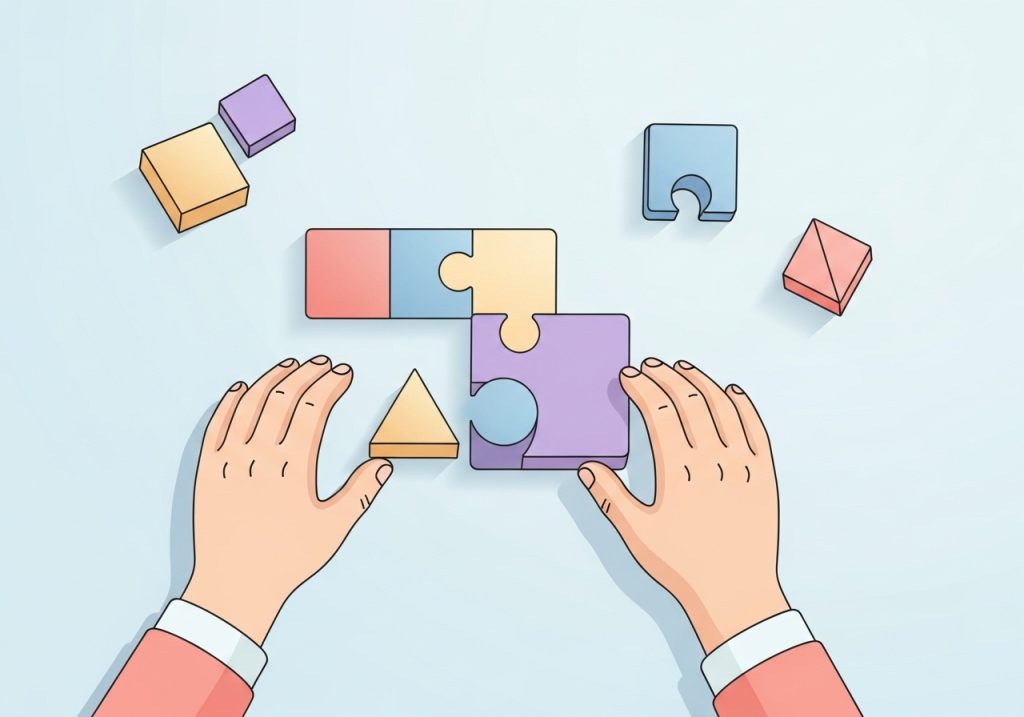
Ideas for block and puzzle activities include:
- Block Duplication: Create a simple structure with two or three blocks and have the child replicate it. As they succeed, increase the complexity of the design. You can use printed cards with designs or build a model for them to copy.
- Inset Puzzles: For younger learners, inset puzzles with knobs are an excellent starting point. They help develop pincer grasp while teaching shape recognition.
- Jigsaw Puzzles: Start with puzzles that have a small number of large pieces and gradually increase the piece count as the child’s skills develop. Working on a puzzle together also offers opportunities for social interaction and collaborative problem-solving.
- Tangrams and Pattern Blocks: These geometric shapes can be used to create or replicate specific designs. They challenge a child to see how smaller shapes combine to form a larger picture, enhancing part-to-whole visual reasoning.
Practice Cutting with Scissors Along Lines
Using scissors is a complex task that is excellent for developing visual motor skills. It requires hand strength, bilateral coordination (using both hands together, one to hold the paper and one to cut), and precise visual guidance. The eyes must track the line while the hand adjusts the scissors’ direction and pressure, a constant feedback loop that refines motor control.
The progression of cutting skills is important. A child must master the basic open-and-close motion before they can be expected to cut along a line with accuracy. Providing appropriate tools, like spring-loaded scissors for children who struggle with hand strength, can set them up for success.
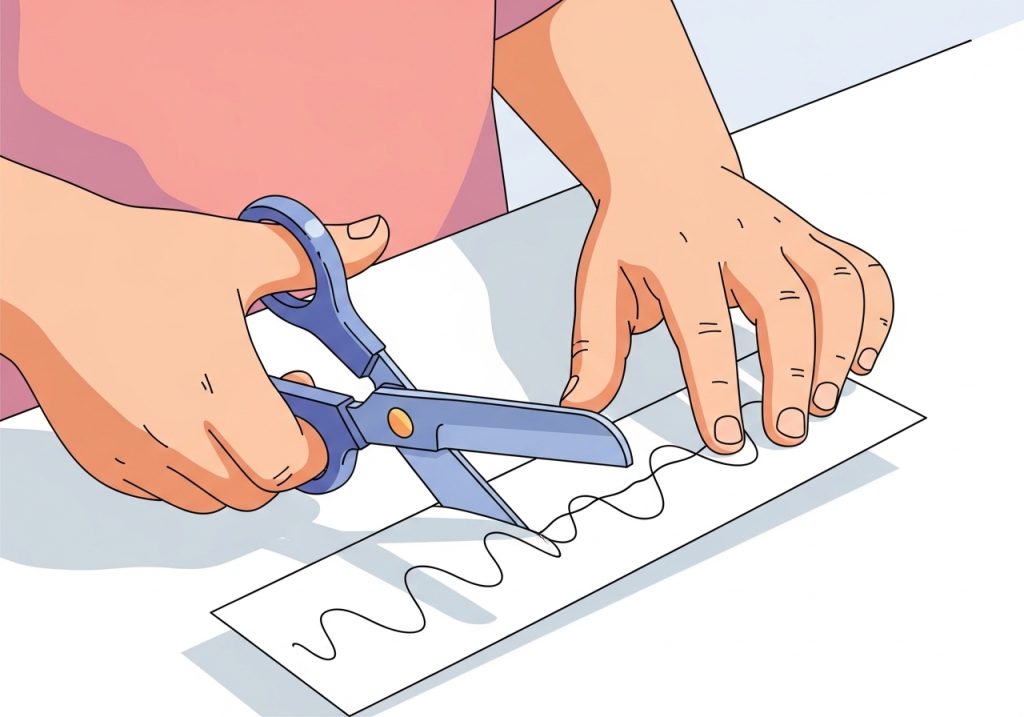
Follow this progression for cutting practice:
- Snipping: Start by having the child make small snips along the edge of a piece of paper or into play-doh. This teaches the basic motor pattern of the scissors.
- Cutting on Straight Lines: Draw thick, bold lines on paper for the child to cut across. Start with short lines and work up to cutting across the entire length of the page.
- Cutting on Curved and Angled Lines: Once straight lines are manageable, introduce zig-zags and simple curves. This requires the child to reorient the paper and the scissors more frequently.
- Cutting Out Simple Shapes: Begin with large squares and triangles, then move to circles and more complex shapes like stars or hearts. Cutting out pictures from magazines or catalogs is also great practice.
Incorporate Lacing and Threading Activities
Lacing and threading are classic fine motor tasks that heavily rely on visual motor precision. These activities require a child to use a pincer grasp to hold the lace and visually target a small hole, guiding the tip through with controlled movement. It is an excellent way to improve dexterity, concentration, and eye-hand coordination.
These activities are also beneficial for developing bilateral skills, as one hand must stabilize the lacing card or bead while the other manipulates the string. You can easily create your own lacing cards or use common household items to keep the task fresh and interesting.
Here are some lacing and threading ideas:
- Lacing Cards: Use store-bought or homemade lacing cards. You can create your own by punching holes around the perimeter of a shape drawn on cardboard.
- Bead Stringing: Stringing beads onto a shoelace or pipe cleaner is a great way to practice. Start with large beads with big holes (like pony beads or even cut-up straws) and move to smaller beads as skill improves.
- Pasta Necklaces: Use dried pasta shapes like penne or rigatoni for a fun and inexpensive threading activity.
- Sewing Practice: For older children, using a large plastic needle and yarn to “sew” on a piece of burlap or plastic canvas introduces a more advanced version of the skill.
Engage with Connect-the-Dots and Mazes
Connect-the-dots and mazes are enjoyable, game-like activities that pack a significant visual motor punch. The May Institute notes that games like dot-to-dot are great for observing how a child engages with visual-motor tasks. Completing a maze requires visual scanning to find a viable path and then controlled pencil movements to stay within the lines.
Connect-the-dots activities serve a dual purpose. They reinforce number or letter sequencing while requiring the child to visually locate the next target and draw a line to it. Both activities encourage motor planning and sustained visual attention, which are critical for tasks like writing on a line or copying notes from a board.
To get the most out of these activities:
- Start Simple: Choose mazes with wide paths and a clear start and finish. For connect-the-dots, start with puzzles that have fewer than 10 dots.
- Encourage Strategy: Before starting a maze, encourage the child to trace the path with their finger first. This helps with motor planning before they commit with a pencil.
- Use a Variety of Formats: Find activity books, print free worksheets online, or draw your own simple mazes. Using a highlighter to trace the path can also be a helpful modification.
- Increase the Challenge: Gradually introduce more complex mazes with narrower paths and more dead ends. For connect-the-dots, move to puzzles with more numbers or that use the alphabet.
Try Simple Sorting and Matching Games
Sorting and matching activities help children develop visual discrimination skills, which is the ability to detect differences and similarities in size, shape, color, and pattern. When these activities require a physical component, such as placing objects into different containers, they become valuable visual motor tasks. The child must see the attribute, process it, and then perform a motor action based on that information.
These games are foundational for pre-academic skills in both math and literacy. Recognizing the differences between a ‘b’ and a ‘d’ or sorting numbers into groups are tasks that rely on a well-developed ability to connect visual details with a correct response.
Effective sorting and matching games include:
- Color Sorting: Use colored blocks, pom-poms, or even snack foods like colored crackers. Have the child sort them into corresponding colored bowls.
- Shape Sorting: Use shape-sorter toys or cut-out paper shapes. The child must match the shape to the correct opening or a corresponding shape on a mat.
- Object Matching: Play memory games with matching cards. This adds a working memory component to the visual discrimination task.
- Sorting by Attribute: Move beyond color and shape to sort objects by size (big vs. small), texture (rough vs. smooth), or category (animals vs. vehicles).
Incorporate Gross Motor Visual Motor Activities
Visual motor skills are not limited to the hands and fingers. Gross motor activities that involve the entire body are just as important for developing a strong sense of body awareness and coordination. As the NAPA Center explains, many common activities like catching a ball or coloring within lines require visual motor skills. These larger-scale movements help the brain learn to judge distance, speed, and location to coordinate actions.
Integrating gross motor tasks provides a well-rounded approach to development and can be especially helpful for children who need to move their bodies. These activities are often playful and can be easily incorporated into outdoor time or a classroom brain break.
Try these gross motor ideas:
- Target Practice: Set up a bucket or hoop and have the child throw beanbags or soft balls into it. This helps them learn to visually gauge distance and adjust their motor output.
- Catching and Bouncing: Start by rolling a large ball back and forth. Progress to bouncing and catching, which requires more precise timing. Using a balloon can slow down the action and make it easier to track visually.
- Balance Beam Walking: Walking on a line made of tape on the floor, a low balance beam, or a curb requires the child to use visual input to keep their body centered and balanced.
- Obstacle Courses: Create a simple obstacle course where the child has to crawl under a table, step over pillows, and weave around chairs. This forces them to constantly assess their environment visually and adjust their body movements accordingly.
By regularly engaging children in a variety of these visual motor activities, you can provide them with the foundational skills necessary for success in school and in life. The key is to keep the tasks engaging, provide just the right amount of challenge, and celebrate their effort and progress along the way. These simple, hands-on experiences are powerful tools for building stronger connections between a child’s eyes, brain, and body.
Looking for more ways to support skill development? The Inspiring OT shop on Teachers Pay Teachers offers a wide range of practical, low-prep resources designed by an experienced occupational therapist. Explore printable activities, worksheets, and guides to make skill-building engaging and effective for every learner. Find your next great resource at The Inspiring OT.
Leave a Reply