
A visual perceptual skill is the brain’s ability to interpret and make sense of the information the eyes see. This cognitive process is distinct from visual acuity, or how clearly a person sees, and is fundamental for successfully navigating the world and engaging in learning tasks like reading, writing, and mathematics.
For occupational therapists, teachers, and parents, understanding the role of visual perception is key to supporting a child’s development. When these skills are underdeveloped, a child might struggle with classroom activities despite having perfect vision. They may have difficulty distinguishing between similar letters, copying notes from a board, or even organizing their belongings. This guide explains the core components of visual perception, how challenges in this area can affect learning, and practical ways to help strengthen these essential skills.
What Is a Visual Perceptual Skill?
Think of the eyes as cameras that capture images. Visual perception is the complex work the brain does to process those images into useful information. It involves recognizing, organizing, and interpreting visual input to understand relationships between objects and oneself. According to Cincinnati Children’s Hospital, these skills allow a child to make sense of what they are seeing. For example, when a child sees the letters “c-a-t,” it is their visual perceptual ability that allows them to recognize the individual shapes, process them in the correct order, and understand that they form the word “cat.”
This skill is not about eyesight. A child can pass a vision screening with 20/20 vision and still face significant challenges with visual processing. The difficulty lies not in receiving the visual data, but in the brain’s interpretation of it. This is why addressing visual perceptual deficits requires specific interventions that go beyond correcting vision.
The Seven Core Components of Visual Perception
Visual perception is not a single skill but a collection of related abilities that work together. Understanding these individual components helps therapists and educators identify specific areas of difficulty and tailor support accordingly. The primary components include:

- Visual Discrimination: The ability to determine differences or similarities in objects based on size, color, shape, and orientation. This is crucial for recognizing the difference between letters like ‘b’ and ‘d’ or ‘p’ and ‘q’.
- Figure-Ground Perception: The ability to distinguish an object or shape from its background. A child uses this skill to find a specific word on a busy page or locate a favorite toy in a cluttered toy box.
- Visual Closure: The ability to recognize a complete figure or object even when part of it is hidden or missing. This skill helps a child read words quickly without needing to analyze every single letter.
- Form Constancy: The ability to recognize that a form or object remains the same even when it changes its size, orientation, or is viewed from a different angle. This allows a child to recognize the letter ‘A’ whether it is written in print, cursive, or a different font.
- Visual Memory: The ability to recall visual information that has been seen. This is essential for remembering sight words, copying notes from a whiteboard, and recalling the sequence of letters in a word for spelling.
- Visual Sequential Memory: The ability to recall a sequence of objects, letters, or numbers in the correct order. Spelling, reading, and following multi-step directions all depend heavily on this skill.
- Visual-Spatial Relations: The ability to understand the relationship of objects to each other and to oneself in space. This skill is important for proper letter spacing in handwriting, understanding prepositions like “over” and “under,” and avoiding bumping into things.
Difficulties in any one of these areas can impact a wide range of academic and daily tasks. Many resources provide in-depth information on each visual perceptual skill and associated activities.
How Visual Perception Impacts a Child’s Learning
Strong visual perceptual skills are a foundation for academic success. When these skills are weak, children may struggle to keep up with their peers, leading to frustration and a reluctance to engage in schoolwork.
In reading, a child needs visual discrimination to tell letters apart, figure-ground perception to focus on one word at a time, and visual memory to recognize familiar words. Without these, reading can be slow and laborious. In writing, visual-spatial relations are needed for proper spacing, while form constancy helps with consistent letter formation. Copying from a board requires strong visual memory to hold the information long enough to transfer it to paper.
Math is also highly visual. Students need to align numbers correctly for calculations, recognize geometric shapes, and interpret data from graphs and charts. Beyond academics, these skills affect many of the essential abilities for independent living, such as getting dressed (matching socks, buttoning shirts), organizing a backpack, or assembling a simple meal.
Identifying Challenges with Visual Processing
While only a qualified professional like an occupational therapist can formally diagnose a visual processing disorder, parents and teachers are often the first to notice the signs. Children with visual perceptual difficulties may not be able to articulate their struggles, so observation is key. Common indicators include:
- Frequent letter or number reversals (e.g., b/d, 6/9) past the age of seven.
- Losing their place frequently when reading or copying from a book or board.
- Difficulty with puzzles, dot-to-dot activities, or hidden picture games.
- Messy or poorly spaced handwriting.
- Trouble distinguishing between the main idea and details on a page.
- Complaining of tired or sore eyes during close-up work.
- Difficulty finding specific items on a crowded shelf or in a drawer.
- Appearing clumsy or having trouble with sports that require tracking a ball.
Occupational therapists often use standardized assessments, such as the Test of Visual Perceptual Skills (TVPS), to identify specific areas of deficit and guide intervention planning.
Practical Activities to Build Visual Perceptual Skills
The good news is that visual perceptual skills can be improved with consistent practice. Engaging a child in fun, targeted activities is an effective way to strengthen these abilities without making it feel like work. The goal is to provide playful repetition in a supportive environment.
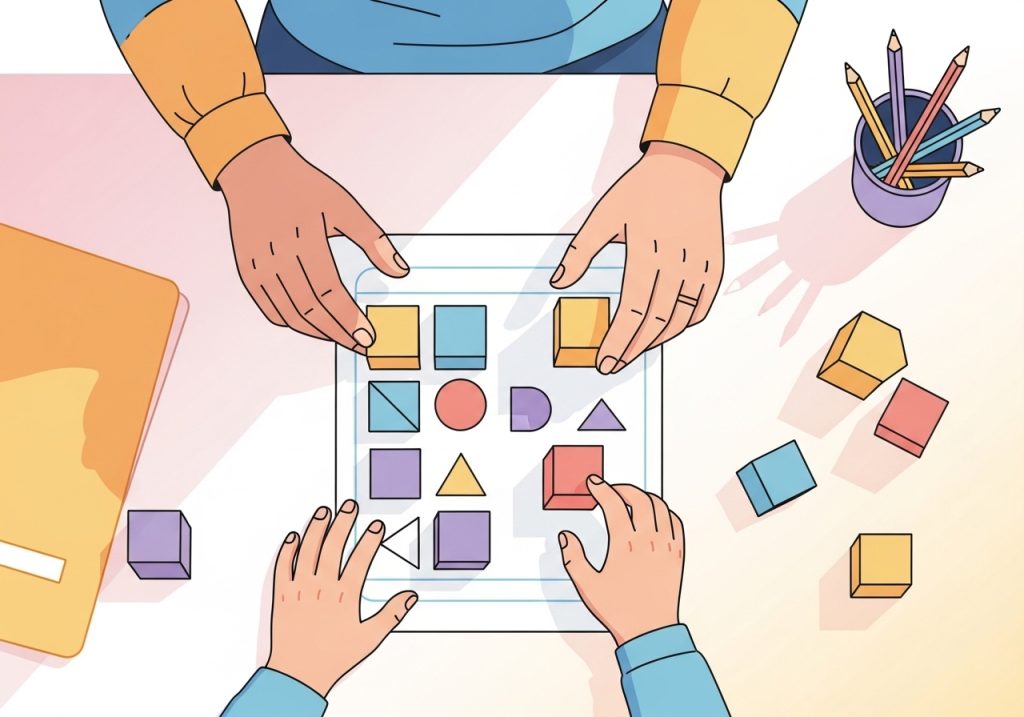
Here are some simple activities you can incorporate into therapy sessions, classroom centers, or home routines:
- Puzzles: Jigsaw puzzles, tangrams, and shape sorters are excellent for improving visual-spatial relations and form constancy.
- “I Spy” Games: This classic game is a fun way to practice figure-ground perception by having a child find an object in a busy environment.
- Matching Games: Card games like Memory or worksheets that require matching identical pictures, letters, or shapes build visual discrimination and memory.
- Building with Blocks: Ask a child to copy a structure you have built. This strengthens spatial awareness and visual memory.
- Hidden Picture Worksheets: These activities, often found in children’s magazines or activity books, directly target figure-ground skills.
- Drawing and Tracing: Copying simple shapes, tracing lines, and completing dot-to-dot pictures help develop visual-motor integration, a closely related skill.
- Sorting Activities: Have a child sort objects by color, shape, or size. This reinforces visual discrimination.
Many everyday tasks can be adapted to support these skills. For more ideas, you can look for themed activities, like these skill-building activities for Thanksgiving, which often include visual components.
Supporting Learners with Targeted Resources
While general games and activities are beneficial, using structured resources designed by a professional can provide more targeted and consistent practice. Well-designed worksheets, assessments, and activity bundles focus on specific visual perceptual components, allowing you to address a child’s unique needs systematically.
Using printable resources makes it easy to track progress over time. When a child completes a “find the difference” worksheet, you have a concrete record of their performance. This documentation is invaluable for progress monitoring, planning future sessions, and communicating with other members of a child’s support team. Creating effective student portfolios to track developmental skills is much simpler when you have tangible work samples that demonstrate growth.
A visual perceptual skill is a critical building block for learning and independence. By understanding what it is, recognizing potential challenges, and providing targeted support, you can help learners develop the visual processing abilities they need to thrive in the classroom and beyond. The key is to offer consistent, engaging practice that builds confidence and makes skill development a positive experience.
Ready to help your learners strengthen their visual perceptual skills? The Inspiring OT offers a wide range of practical, OT-designed printable activities and resources to make skill-building engaging and effective. From hidden picture worksheets to visual discrimination tasks, find the low-prep tools you need to support your students, clients, or children. Explore the shop today to simplify your planning and foster successful development.
Leave a Reply