
Phonological awareness is a critical building block for literacy, providing the foundation children need to learn how to read and write. It is the ability to recognize and work with the sounds in spoken language. Before a child can connect letters to sounds, they must first be able to hear and distinguish those sounds. For therapists, educators, and parents, incorporating simple, engaging phonological awareness activities for preschoolers into daily routines can make a significant impact on future academic success. These activities are not about letters or writing; they are entirely auditory and focus on listening, identifying, and manipulating sounds through play.
Developing these pre-reading skills does not require complex tools or extensive preparation. The most effective strategies are often woven into conversations, storytime, and games. By focusing on skills like rhyming, identifying syllables, and recognizing initial sounds, you help children tune their ears to the structure of language. This guide offers seven practical activities that are easy to implement in a therapy session, a classroom, or at home. They are designed to be fun and interactive, ensuring that children build essential skills while they play. You can integrate these ideas into your planning, similar to how you might structure other skill-building sessions using practical lesson plan examples for skill development.
Start with Rhyming Games
Rhyming is often one of the earliest phonological awareness skills to develop and serves as an excellent entry point. It teaches children to identify words that share the same ending sounds, a key part of recognizing patterns in language. When children can identify rhymes, they are learning to listen closely to the specific sounds within words. This auditory skill is fundamental for later decoding words when they begin to read.
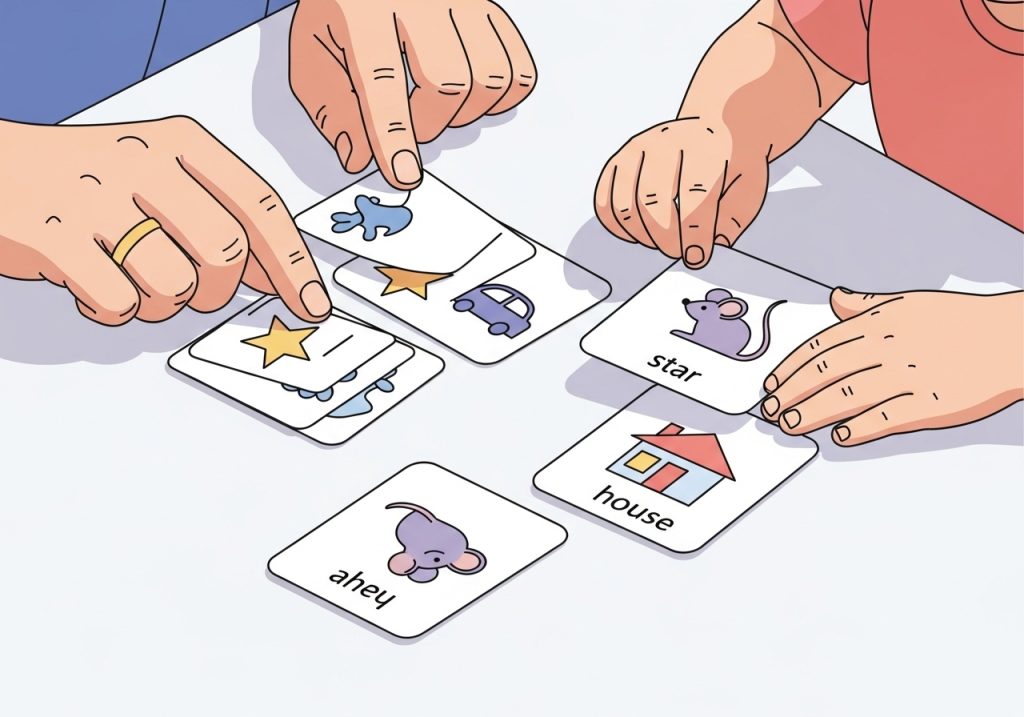
You can introduce rhyming in many playful ways. Reading books with strong rhyming patterns, like many stories by Dr. Seuss, is a natural way to expose children to rhyme. As you read, you can pause and emphasize the rhyming words. Singing nursery rhymes and simple songs also reinforces these sound patterns. For a more direct activity, try a rhyming word match game. Use picture cards of simple objects and have the child find the pairs that rhyme, such as “cat” and “hat” or “frog” and “log.” Another idea is to play “I’m thinking of a word that rhymes with…” and provide clues. For example, “I’m thinking of a word that rhymes with ‘car’ and is bright in the night sky.” These games make learning an interactive and enjoyable experience.
Clap Out Syllables
Understanding that words are made up of smaller parts, or syllables, is another crucial component of phonological awareness. This skill, known as syllable awareness, helps children break down longer words into more manageable chunks. It supports both reading fluency and spelling as they advance in their education. A simple and effective way to teach this concept is by having children clap the “beats” they hear in a word.
Start with familiar words, like their own name. For example, you would clap once for “Sam” (Sam) and three times for “A-man-da” (A-man-da). This kinesthetic feedback helps solidify the auditory concept. You can turn this into a game by clapping the syllables of objects around the room, foods you are eating, or characters from a favorite book. To keep it interesting, vary the motor action. Instead of clapping, try stomping, tapping the table, jumping, or hitting a small drum for each syllable. This multisensory approach helps reinforce the learning and keeps children engaged, especially those who benefit from movement.

Go on a Sound Hunt
A sound hunt is a wonderful way to work on phoneme isolation, which is the ability to identify a single sound within a word. This skill is typically focused on the initial sound of a word, as it is the easiest for young children to hear. This activity helps bridge the gap between spoken language and the alphabetic principle, where children learn that letters represent specific sounds.
To start a sound hunt, pick a target sound for the day, such as the /m/ sound. Then, challenge the child to find objects around the room, in a book, or outside that begin with that sound. You could say, “Let’s search for things that start with the ‘mmmm’ sound.” Together, you might find a mat, a mug, a marker, and a marble. This makes the learning process active and exploratory. It connects the abstract concept of a sound to tangible, real-world objects. You can make it even more fun by giving the child a small bag or basket to collect the items they find. This activity requires no materials and can be done anywhere, from the classroom to the car.
Play ‘I Spy’ with First Sounds
The classic game of “I Spy” can be easily adapted to target phonological awareness. Instead of focusing on colors, you can shift the focus to initial sounds. This simple change transforms a fun pastime into a powerful learning tool. It encourages children to actively listen for beginning sounds and scan their environment to connect those sounds with objects.
The game is easy to play. Simply say, “I spy with my little eye, something that starts with the /s/ sound.” The child then looks around and guesses objects like “sun,” “sock,” or “spoon.” This approach helps children practice isolating initial phonemes in a low-pressure, conversational format. If a child is struggling, you can provide more clues, such as, “It’s something you wear on your foot and it starts with /s/.” Playing this game regularly builds listening skills and strengthens a child’s ability to identify and differentiate the first sound in words, a skill vital for both reading and spelling.
Blend Sounds to Make Words
Phoneme blending is the skill of pulling individual sounds together to form a whole word. It is a foundational skill for decoding, or sounding out words, when learning to read. When a child hears /c/…/a/…/t/ and can identify the word as “cat,” they are successfully blending phonemes. This can be a challenging concept, so it is best introduced through fun, simple games.
Start with short, three-sound words (consonant-vowel-consonant, or CVC words). Say the sounds with a slight pause between them and ask the child to guess the “mystery word.” Using a “robot voice” to say the sounds can make it more entertaining. For example, say in a robotic tone, “I-see-a-d-o-g.” Then ask, “What did I see?” As the child becomes more proficient, you can gradually increase the speed at which you say the sounds, reducing the pause between them. You can also use puppets. Have a puppet “talk” in segmented sounds, and the child’s job is to figure out what the puppet is saying. This playful approach helps children master blending without feeling like they are doing work.
More Phonological Awareness Activities for Preschoolers to Try
Beyond the basics of rhyming and initial sounds, you can introduce other phonological awareness activities for preschoolers as they become ready. Two important related skills are phoneme segmentation and sound isolation. These skills often form the basis of practical academic goals examples for early literacy and are essential for spelling and writing.
Phoneme segmentation is the opposite of blending. It involves breaking a word down into its individual sounds. You can say a word like “sun” and ask the child to tell you all the sounds they hear: /s/…/u/…/n/. To make this more concrete, use small objects like blocks or tokens. Have the child push one block forward for each sound they say. Sound isolation can also be expanded beyond just the initial sound. You can ask, “What is the last sound you hear in the word ‘cup’?” or even “What is the middle sound in ‘hop’?” These more advanced activities challenge children to listen with greater precision and develop a deeper understanding of word structure.
Integrate Movement with Sounds
Many preschoolers are active learners who benefit from combining physical activity with cognitive tasks. Integrating movement into phonological awareness activities can increase engagement, improve focus, and help solidify learning. This approach is particularly effective in therapy sessions and group settings, as it allows children to use their whole bodies to learn.
There are many ways to connect sound skills with movement. For syllable practice, have children hop or jump for each syllable in a word. You could set up “lily pads” on the floor and have them hop from one to the next as they say each part of a word. For initial sounds, play a game of “Sound Toss” with a beanbag. Call out a sound, like /p/, and have the child toss the beanbag to a picture of an object that starts with that sound (e.g., a picture of a pig). You can also play a version of “Red Light, Green Light” where you call out pairs of words. If the words rhyme, the children take a step forward (green light). If they do not, they stay still (red light). These activities make practice feel like playtime while reinforcing key auditory skills.
By consistently incorporating these simple and playful phonological awareness activities, you provide preschoolers with the essential tools they need for a successful transition to reading. These strategies are not about drills or memorization. They are about fostering a curiosity for language and helping children discover the sounds that make up the words they hear and speak every day. Whether in the classroom, a therapy setting, or at home, these interactions build a strong and lasting foundation for literacy.
Ready to support skill development with more engaging, low-prep resources? As an occupational therapist with nearly two decades of experience, I design practical activities to help learners thrive. Explore The Inspiring OT shop for printable worksheets, assessments, and guides that make skill-building accessible and effective.
Leave a Reply