
Communication is a fundamental human need, allowing us to connect, learn, and express ourselves. For many individuals with autism spectrum disorder (ASD), developing these skills can be a unique journey. Effective autism speech language therapy provides a structured and supportive path to building functional communication, improving social interaction, and fostering greater independence. This guide offers practical insights for occupational therapists, teachers, and parents on the core principles and strategies that underpin successful communication development.
Understanding the Connection Between Autism and Communication
Autism spectrum disorder is characterized by differences in social communication and interaction, along with restricted, repetitive patterns of behavior or interests. The impact on communication is not uniform; it varies widely from person to person. Some individuals may be non-speaking, while others may have extensive vocabularies but find it difficult to use language in a social context.
Common communication differences seen in autism include:
- Delayed or atypical speech development: Some children may have a limited spoken vocabulary or begin speaking later than their peers.
- Echolalia: This is the repetition of words or phrases heard from others, either immediately or after a delay. It can serve various functions, including self-regulation or affirming a question.
- Challenges with pragmatics: Pragmatic language refers to the social rules of communication. This can include difficulties with initiating conversations, taking turns speaking, maintaining a topic, or understanding non-literal language like idioms and sarcasm.
- Difficulty with non-verbal cues: Interpreting or using body language, facial expressions, and tone of voice can be challenging.
- Receptive language issues: Some individuals may struggle to understand complex sentences, follow multi-step directions, or process spoken language quickly.
It is critical to recognize that these are differences, not deficits. The goal of therapy is not to “fix” the individual but to provide them with the tools and strategies needed to communicate effectively in their own way.
Core Goals of Autism Speech Language Therapy
The objectives of speech and language therapy are always individualized to the learner’s unique strengths, needs, and personal goals. However, most therapeutic plans center on a few key areas. A speech-language pathologist (SLP) works with the individual and their support team to develop a plan that targets functional outcomes.
Primary goals often include:
- Developing Functional Communication: The top priority is ensuring the individual can express their wants and needs. This could mean teaching them to request a desired item, refuse something they do not want, ask for help, or share information. This is foundational for autonomy and reducing frustration.
- Improving Social Communication: Therapy can help learners navigate social interactions more comfortably. This involves teaching skills like greeting others, asking and answering questions, and understanding the give-and-take of conversation. Addressing these areas is key to developing important soft skills that support relationships.
- Enhancing Language Comprehension: This focuses on the receptive side of language. Goals might involve improving the ability to follow directions of increasing complexity, understand different types of questions (who, what, where), and grasp concepts like time and sequence.
- Building Expressive Language: For verbal individuals, this could mean expanding vocabulary, using more complex sentence structures, or learning to tell stories and describe events.
- Exploring Augmentative and Alternative Communication (AAC): For learners who are non-speaking or have limited verbal abilities, introducing AAC systems is a vital goal. These tools provide a reliable way to communicate.
Each of these objectives must be broken down into specific, achievable steps. The process of writing clear and measurable goals is essential for tracking progress and ensuring interventions are effective.
Evidence-Based Strategies for Therapists and Educators
A variety of proven methods are used in autism speech language therapy. The best approach often involves a combination of strategies tailored to the learner’s style and preferences. The key is to make learning motivating and meaningful.
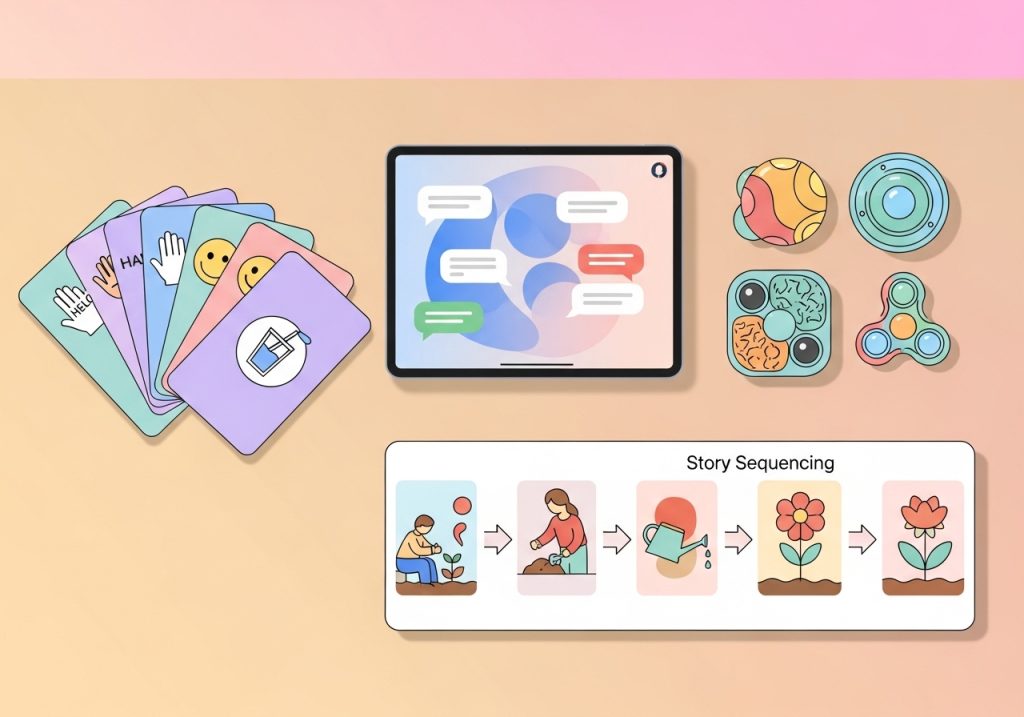
Augmentative and Alternative Communication (AAC)
AAC includes all forms of communication outside of oral speech. These tools can be no-tech (gestures, sign language), low-tech (picture boards, communication books), or high-tech (speech-generating devices and apps). A common misconception is that AAC hinders verbal speech development. Research consistently shows the opposite is true; AAC can reduce communication pressure and often supports the development of spoken language.
Visual Supports
Many autistic individuals are strong visual thinkers. Using visual supports makes abstract concepts like time and expectations concrete and understandable. Examples include:
- Visual Schedules: A sequence of pictures or words that shows the learner what will happen during the day or a specific activity. This predictability can reduce anxiety and ease transitions.
- First-Then Boards: A simple visual that shows a non-preferred activity (“First, we do work”) followed by a preferred one (“Then, we get the iPad”).
- Social Stories™ and Narratives: Short, descriptive stories that explain a social situation, skill, or concept. They help learners understand social cues and appropriate responses.
Naturalistic Developmental Behavioral Interventions (NDBI)
NDBIs are a collection of approaches that apply behavioral principles within natural, play-based settings. Instead of sitting at a table for structured drills, the therapist, teacher, or parent follows the child’s lead and embeds learning opportunities into their preferred activities. For example, if a child is playing with cars, the adult might model language like “fast car,” “car goes up,” or pause expectantly to encourage the child to request the “car.” This makes learning more engaging and helps with skill generalization.
The Importance of a Collaborative, Team-Based Approach
No single person can support a learner’s communication development in isolation. Success depends on a consistent, collaborative effort from everyone in the child’s life. The core team typically includes the speech-language pathologist, occupational therapist, teachers (general and special education), and family members.
Each member brings a unique perspective:
- Speech-Language Pathologists (SLPs) lead the assessment, goal-setting, and direct intervention for communication.
- Occupational Therapists (OTs) address sensory processing, fine motor skills, and daily living skills, all of which are interconnected with communication.
- Teachers create opportunities to practice communication skills in an academic and social context with peers.
- Parents and Caregivers are the experts on their child and are essential for carrying over strategies into the home environment, where most communication happens.
Regular communication among team members ensures everyone is working toward the same goals and using consistent strategies. When a child hears the same language and sees the same visual supports in therapy, in the classroom, and at home, their learning is reinforced much more effectively.

How OTs Can Integrate Speech Goals into Practice
Occupational therapy and speech therapy are natural partners. OTs can powerfully reinforce communication goals during their sessions by embedding language into every activity.
Here are some practical ways OTs can support speech and language development:
- Model and Expand Language: During a fine motor activity like stringing beads, the OT can model key vocabulary (“put on,” “pull,” “blue bead”) and expand on the child’s utterances. If the child says “bead,” the OT can respond, “Yes, a big, round bead!”
- Incorporate Sequencing and Following Directions: Many OT activities, like completing a craft or an obstacle course, require following steps in order. This provides a natural context for practicing receptive language. OTs can present directions verbally and with visual supports to support executive functioning skills at the same time.
- Create Communication Opportunities: OTs can structure activities to encourage communication. For example, they might place desired materials just out of reach to motivate the child to request them. During a sensory activity, they can prompt the child to describe how something feels (e.g., “slimy,” “soft,” “bumpy”).
- Use Turn-Taking in Games: Simple board games or motor activities provide an excellent framework for practicing the back-and-forth rhythm of social interaction.
Key Takeaways for Supporting Learners
Supporting communication growth in autistic learners is a long-term process built on patience, understanding, and a commitment to evidence-based practice. Whether you are a therapist, teacher, or parent, these core principles can guide your approach.
- Presume Competence: Always assume that an individual has the capacity to learn and understand, even if they cannot express it in a conventional way. Their receptive knowledge may far exceed their expressive abilities.
- Focus on Connection over Correction: Building a trusting, positive relationship is the foundation for all learning. Celebrate attempts to communicate, and respond to the intended message rather than focusing on perfect pronunciation or grammar.
- Use Strengths and Interests: Incorporate the learner’s passions into therapeutic and educational activities. If a child loves trains, use trains to teach vocabulary, sequencing, and social play. Motivation is a powerful engine for skill development.
- Be a Patient and Responsive Communication Partner: Give learners plenty of time to process language and formulate their responses. Avoid asking too many questions. Instead, use comments and observations to model language and invite interaction.
By working together and using individualized, strength-based strategies, we can help every learner find their voice and build the communication skills they need to thrive.
Ready to put these strategies into practice? The Inspiring OT offers a wide range of practical, evidence-informed printable resources designed by a licensed occupational therapist. From visual supports to engaging fine motor activities, our tools can help you create meaningful learning experiences that build essential skills. Explore the full collection of low-prep materials today to support your learners in the clinic, classroom, or at home.
Leave a Reply