
Writing effective Individualized Education Program (IEP) goals is a critical part of supporting a student’s success. A well-crafted goal acts as a roadmap, guiding instruction, therapy, and interventions throughout the school year. For educators, therapists, and parents, the process can feel challenging. The key is to create goals that are not only ambitious but also clear, measurable, and tailored to the student’s specific needs. This guide provides a framework and practical iep goal examples to help you develop meaningful objectives that truly make a difference.
Understanding the Foundation of a Strong IEP Goal
An IEP goal is a written statement that describes what a student is expected to achieve in a specific area within a given timeframe, typically one year. These goals are developed by the IEP team, which includes parents, teachers, special education staff, related service providers like occupational therapists, and, when appropriate, the student. The purpose of an IEP goal is to address a student’s unique needs resulting from their disability so they can access and make progress in the general education curriculum. A goal is not just a sentence in a document; it is a commitment to a student’s growth. Strong goals create accountability, foster clear communication among team members, and ensure everyone is working toward the same outcomes. They transform broad concerns into actionable steps.
Using the SMART Framework for Effective Goal Writing
The SMART acronym is a widely used and highly effective method for writing goals. It provides a checklist to ensure each goal is well-defined and trackable, removing ambiguity and setting clear expectations. Let’s break down what each letter means in the context of an IEP.
- Specific: The goal should target a precise skill or behavior. Vague goals lead to vague instruction. Instead of writing “will improve fine motor skills,” a specific goal would be “will cut along a 6-inch curved line using thumb-up scissor grasp.” This specificity tells everyone exactly what skill to work on and observe.
- Measurable: You must be able to track progress with objective data. This often involves numbers, such as frequency, duration, or accuracy. Phrases like “with 80% accuracy” or “in 4 out of 5 opportunities” make the goal measurable. This removes subjectivity and allows the team to see clear evidence of progress over time.
- Achievable: The goal should be realistic for the student to accomplish within the IEP year. It should present a challenge but not be so difficult that it causes frustration. This requires a solid understanding of the student’s current skill level, or baseline. If a student can barely hold scissors, a goal to cut out complex shapes is not achievable in the short term.
- Relevant: The goal must be connected to the student’s educational needs and have a functional impact. It should help them participate more fully in their classroom, learn essential life skills, or access the curriculum. A goal for tying shoes is highly relevant for a first grader, as it impacts their independence during the school day. It’s about targeting skills that matter most to that individual’s participation and learning, which may include addressing core academic skills.
- Time-bound: Every goal needs a deadline. For an IEP, this is typically by the end of the annual review period. Including benchmarks or short-term objectives (e.g., “by the end of the first grading period”) can help break the goal down into manageable steps and allows for more frequent progress checks.
A Bank of Practical IEP Goal Examples
Here are some examples organized by skill area. Remember, these are templates designed to illustrate the SMART format. They must be customized with specific details based on the student’s baseline data and individual circumstances. The conditions, behaviors, and criteria should reflect what is most appropriate for your learner.
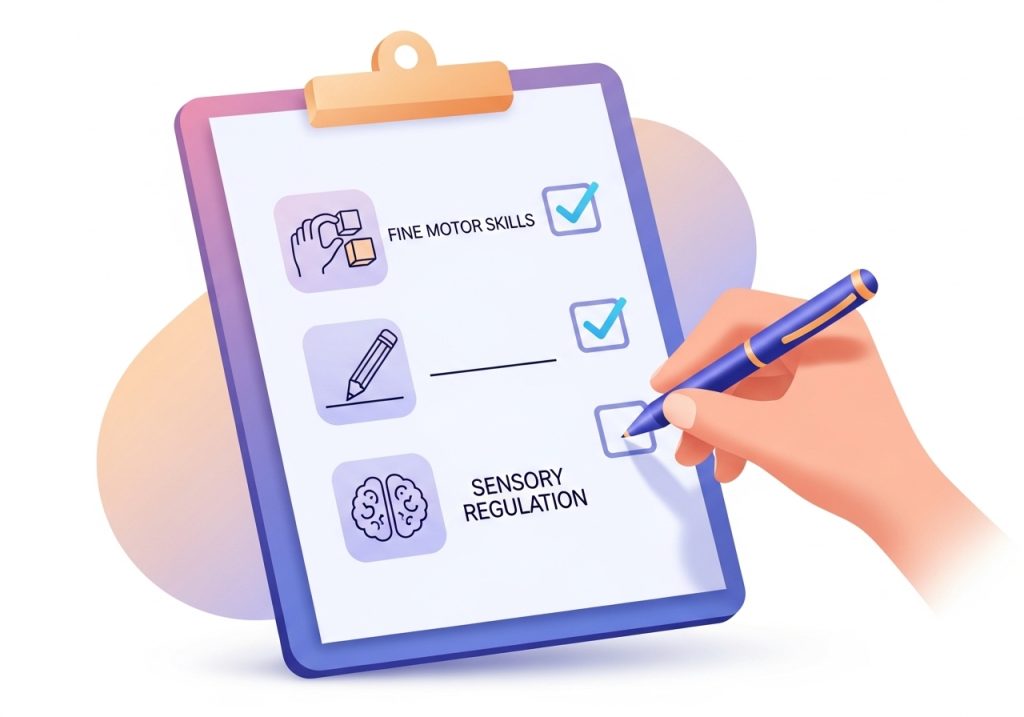
Fine Motor Skills
- Cutting: By (date), when given a piece of paper with 1/2-inch thick lines, the student will cut along a 6-inch curved line, staying within 1/8 inch of the line, in 4 out of 5 trials as measured by therapist observation and work samples.
- Fasteners: By (date), the student will be able to button three 1-inch buttons on a buttoning strip or self-care board independently within 2 minutes, with 100% accuracy, across 3 consecutive therapy sessions.
- Pencil Grasp: By (date), the student will demonstrate a functional tripod grasp on a standard-size pencil for 5 minutes during a writing task, with no more than 2 verbal cues from an adult, in 3 of 4 observed opportunities.
Handwriting and Visual Motor Skills
- Copying: By (date), when presented with a near-point model, the student will copy a 5-word sentence from the board to their paper, forming all letters correctly and using appropriate spacing between words, with 90% legibility in 4 out of 5 writing samples reviewed by the teacher.
- Letter Formation: By (date), the student will independently write all 26 uppercase letters of the alphabet from memory with correct formation (top-to-bottom strokes) and orientation on 3-lined paper, with 85% accuracy as measured by a weekly writing probe.
- Line Placement: By (date), when writing their first name, the student will place all lowercase letters correctly on the baseline (e.g., no floating letters) in 4 out of 5 opportunities, as measured by review of daily classwork.
Sensory Processing and Regulation
- Strategy Use: By (date), when feeling overwhelmed or overstimulated (as identified by the student or an adult), the student will independently select and use a calming strategy (e.g., deep breathing, using a fidget tool) from their visual choice board to return to a ready-to-learn state within 5 minutes, in 3 out of 4 observed instances.
- Attention: By (date), during seated group activities, the student will use a provided sensory tool (e.g., wiggle seat, weighted lap pad) to remain seated and focused on the instruction for a 10-minute period with no more than one verbal reminder from an adult, in 4 of 5 opportunities documented on a data sheet.
Activities of Daily Living (ADLs)
- Clothing Management: By (date), the student will independently manage their coat and backpack, including zippering their coat and hanging both items on their assigned hook, upon arrival at school on 4 out of 5 days, as documented by a staff checklist.
- Mealtime Skills: By (date), following lunch, the student will open all food containers, use a fork or spoon appropriately without spilling, and clean up their personal space with only one verbal prompt, in 3 out of 5 observed lunch periods. This goal helps with independence and also involves strengthening executive functioning skills like sequencing and organization.
How to Adapt Goals for Individual Student Needs
The examples above are starting points, not prescriptions. The most important step in goal writing is individualization. This begins with a thorough assessment to establish a baseline, which is a clear, data-supported picture of the student’s current abilities. The baseline data tells you where the student is starting, so you can set an achievable goal for where you want them to go. For instance, if a student can currently button one large button with help, a goal to independently button three small buttons is too large a leap. A better goal would target two large buttons with minimal assistance.

Always consider the student’s environment, motivation, and the specific classroom demands when writing and adapting goals. A goal that is meaningful in a one-on-one therapy session might need to be adjusted to be functional in a busy classroom. Collaboration is key. Talk with the student’s teacher, parents, and the student themselves to understand what skills will have the greatest positive impact on their daily life and learning.
Measuring Progress and Moving Forward
Once a goal is written, the work of data collection begins. Progress monitoring is not just for compliance; it provides valuable information about whether the interventions are effective. Data can be collected through direct observation, work samples, checklists, rating scales, or informal assessments. Keeping this process simple and embedding it into natural routines makes it more sustainable for the entire team.
Regular review of this data allows the IEP team to make informed decisions. If a student is progressing faster than expected, the goal can be updated to provide a new challenge. If they are struggling to meet their benchmarks, the team can come together to problem-solve. This might involve changing the level of support, trying a new approach, or breaking the skill down into even smaller steps. It is a dynamic process where the team might need to re-evaluate the instructional strategies being used to ensure they align with the student’s learning style.
Writing strong IEP goals is a collaborative process that blends professional expertise with a deep understanding of the individual student. By using the SMART framework and focusing on functional, relevant skills, you can create a clear path for student growth. The most effective goals are those that empower students, guide instruction, and bring the entire IEP team together with a shared purpose and a clear plan for success.
Ready to put these ideas into action? Finding the right tools can make all the difference in helping your learners meet their goals. Explore The Inspiring OT shop for a wide variety of practical, low-prep activities and resources designed by an experienced occupational therapist. From fine motor worksheets to sensory toolkits, you will find everything you need to make skill-building engaging and effective. Browse the collection today to simplify your planning and support successful growth.
Leave a Reply