
Crafting effective academic goals is a critical part of supporting a student’s educational journey. For occupational therapists, teachers, and parents, well-defined objectives act as a roadmap, guiding interventions and celebrating progress. Finding the right wording and structure can sometimes be a challenge. This guide offers a collection of practical academic goals examples designed to be clear, measurable, and easily adapted for Individualized Education Programs (IEPs), response to intervention (RTI) plans, or general classroom support. These examples cover key areas where students often need targeted help, from handwriting and math to organization and self-regulation.
Writing Meaningful Academic Goals
Effective academic goals provide clear direction for both the student and the support team. Before creating specific objectives, it is helpful to ensure they are well-constructed. A strong goal clearly identifies what the student will do, under what conditions, and to what level of proficiency. Think of it as breaking down a large skill into manageable, observable steps.
A goal should be specific enough that anyone on the student’s team can understand the expectation and measure progress consistently. For example, instead of a vague goal like “The student will improve their writing,” a better goal would be “The student will write a five-sentence paragraph with correct capitalization and punctuation in four out of five trials.” This level of detail makes tracking progress straightforward and helps in adjusting strategies as needed. Each goal should be directly relevant to the student’s unique needs and contribute to their overall success in the academic environment.
Academic Goals Examples for Handwriting
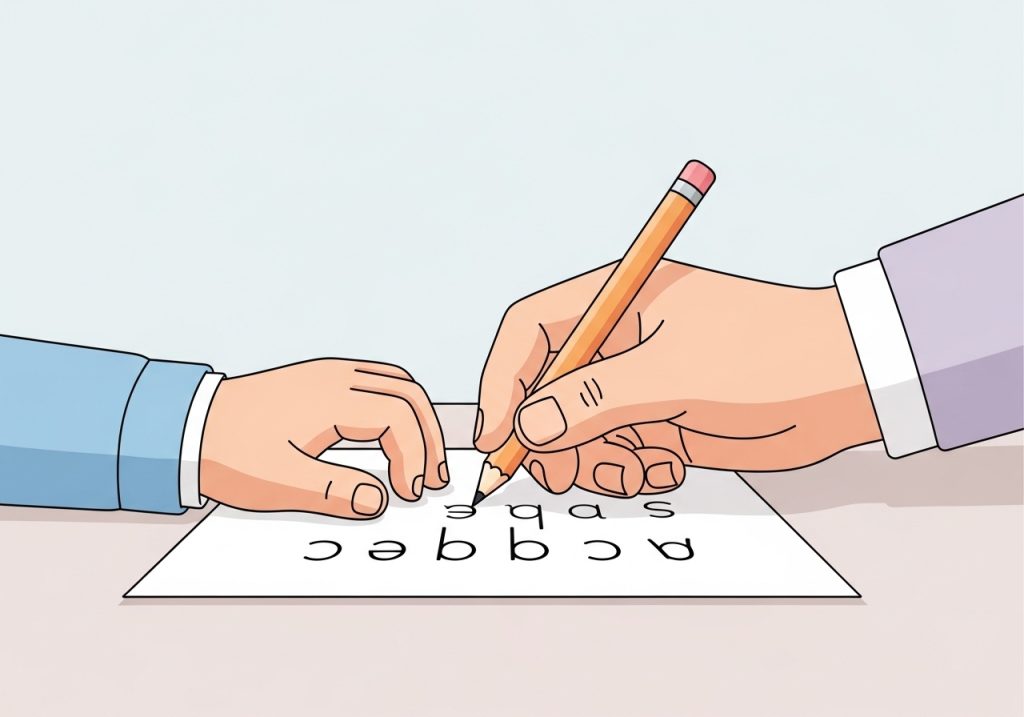
Handwriting remains a fundamental skill for note-taking, completing assignments, and communicating ideas. Goals in this area often focus on improving legibility so the student’s written work can be easily read by others. This involves addressing letter formation, sizing, spacing, and alignment.
Legibility and Letter Formation
Correct letter formation is the foundation of legible handwriting. When students form letters inefficiently, it can slow their writing speed and make their work difficult to read. Goals targeting formation aim for accuracy and automaticity.
- Goal Example 1: By [date], when given a model, the student will independently write all 26 lowercase letters of the alphabet with correct formation in 4 out of 5 trials, as measured by therapist observation and writing samples.
- Goal Example 2: By [date], the student will write their first and last name on assignments without a visual model, with all letters formed correctly and legibly, in 90% of opportunities.
- Goal Example 3: After learning the correct strokes, students who are ready can benefit from learning cursive letter formation to improve writing fluency and neatness.
Sizing, Spacing, and Alignment
Consistent letter size, appropriate spacing between words, and writing on the line are also essential for legibility. These skills help organize written work on the page.
- Goal Example 1: By [date], when completing a worksheet, the student will write sentences with appropriate spacing (a finger-width space) between 80% of the words.
- Goal Example 2: By [date], the student will write lowercase letters that correctly adhere to the baseline, with tall letters touching the top line and tail letters descending below, in 4 out of 5 written sentences.
Goals for Reading Comprehension and Fluency
Reading is more than just decoding words; it involves understanding meaning and reading smoothly. Goals in this area can target anything from identifying the main idea to reading at a conversational pace. Strong reading skills are necessary for success in every academic subject.
Reading Fluency
Fluency is the ability to read with speed, accuracy, and proper expression. It allows the reader to focus their cognitive energy on comprehension rather than on decoding individual words.
- Goal Example 1: By [date], when given a grade-level passage, the student will read aloud at a rate of [X] words correct per minute with fewer than [Y] errors in 3 consecutive trials.
- Goal Example 2: By [date], the student will read a familiar, short text aloud with appropriate intonation and attention to punctuation (e.g., pausing at periods, raising pitch for questions) in 3 out of 4 opportunities.
Comprehension Skills
Comprehension goals ensure a student is not just reading words but also constructing meaning from the text. These objectives can be broken down into understanding literal information and making inferences.
- Goal Example 1: By [date], after independently reading a one-page, grade-level story, the student will verbally state the main idea and two supporting details with 100% accuracy.
- Goal Example 2: By [date], after reading a short informational passage, the student will correctly answer 4 out of 5 “wh-” questions (who, what, where, when, why) about the text, as measured by weekly probes.
Examples for Mathematics and Numeracy
Math skills are sequential, building upon a foundation of basic numeracy. Academic goals in math should be specific to the student’s current level and target the next logical step in their learning. This could range from number recognition to solving multi-step word problems.
Number Sense and Basic Operations
A strong number sense is the starting point for all mathematical understanding. Goals often focus on counting, identifying numbers, and performing basic calculations.
- Goal Example 1: By [date], when presented with a group of up to 20 objects, the student will count them with one-to-one correspondence with 100% accuracy in 4 out of 5 trials.
- Goal Example 2: By [date], the student will solve 10 single-digit addition and subtraction problems (within 20) with 90% accuracy using visual aids or manipulatives.
Problem Solving
Applying mathematical concepts to solve real-world problems is a critical skill. These goals help students move from rote calculation to functional application.
- Goal Example 1: By [date], when given a one-step word problem, the student will identify the correct operation (addition or subtraction) and solve the problem with 80% accuracy over 5 consecutive sessions.
- Goal Example 2: By [date], the student will use a calculator to solve multi-digit multiplication problems related to classroom assignments with 95% accuracy.
Goals for Organizational and Executive Functioning Skills
Executive functions are the mental processes that enable us to plan, focus attention, remember instructions, and manage multiple tasks. For students, these skills are essential for managing assignments, materials, and time. Providing support in this area can have a significant impact on academic independence. Many students benefit from direct instruction and effective executive functioning training.

Material and Time Management
These goals help students keep track of their belongings and manage their schedules, reducing missed assignments and last-minute stress.
- Goal Example 1: By [date], the student will use a visual checklist to gather all necessary materials for a task (e.g., book, pencil, worksheet) within 2 minutes of a direction, for 4 out of 5 classroom activities.
- Goal Example 2: By [date], the student will independently record all homework assignments in their planner with 90% accuracy, as verified by a teacher’s check at the end of each school day.
Task Initiation and Completion
Getting started on a task and seeing it through to the end can be a major hurdle for some students. Goals in this area break down the process into smaller steps.
- Goal Example 1: By [date], when given a long-term project, the student will work with a teacher to break it into three smaller sub-tasks with due dates and will complete each sub-task by its deadline.
- Goal Example 2: By [date], the student will begin independent seatwork within one minute of the teacher’s instruction, requiring no more than one verbal prompt, in 80% of opportunities.
Goals Related to Self-Regulation and Participation
A student’s ability to manage their emotions, attention, and behavior directly impacts their ability to learn and participate in the classroom. Self-regulation goals help students develop the skills needed to engage appropriately in the learning environment. These objectives help students develop crucial soft skills that support academic and social success.
Following Classroom Routines and Directions
Predictable routines and the ability to follow instructions help create a functional and efficient learning environment. These goals focus on building a student’s capacity to participate in the structure of the school day.
- Goal Example 1: By [date], the student will independently transition between classroom activities (e.g., from reading centers to math groups) by following the 2-step visual schedule with 90% accuracy.
- Goal Example 2: By [date], the student will follow a 3-step verbal direction from a teacher without requiring repetition of the instruction in 4 out of 5 opportunities.
Attention and Emotional Regulation
These goals support a student’s ability to maintain focus and manage emotional responses so they can access instruction and interact positively with peers.
- Goal Example 1: By [date], during a 15-minute whole-group lesson, the student will maintain attention on the speaker (e.g., eyes on teacher, quiet hands) with no more than two prompts for redirection.
- Goal Example 2: By [date], when encountering a non-preferred task, the student will use a pre-taught calming strategy (e.g., deep breathing, using a fidget tool) to remain in the learning area in 3 out of 4 instances.
Creating specific, measurable academic goals is an investment in a student’s future. The academic goals examples provided here serve as a starting point for therapists, educators, and families. By tailoring these objectives to the individual needs of each learner, you create a personalized path toward building confidence and achieving success. Remember that goals are dynamic; they should be reviewed and adjusted regularly to reflect the student’s progress and evolving needs.
Ready to put these ideas into action? Finding the right tools can make all the difference. The Inspiring OT offers a collection of practical, low-prep printable activities, assessments, and guides designed by an experienced occupational therapist. Explore the shop for evidence-informed resources that make skill-building engaging and effective for every learner. Visit The Inspiring OT on Teachers Pay Teachers to find your next resource.
Leave a Reply