
Creating effective classroom rules is more than just posting a list of “dos” and “don’ts” on the wall. For occupational therapists, teachers, and parents, it’s about building a predictable, safe, and supportive environment where every child can thrive. When rules are mismatched with a child’s developmental stage, sensory needs, or processing abilities, they can become a source of frustration instead of a guide for success. The goal is not compliance for its own sake, but the co-creation of a community agreement that fosters self-regulation, respect, and engagement. This guide offers five practical, OT-informed tips for developing classroom rules that truly work for every learner.
Frame Expectations Positively
One of the most impactful shifts you can make when establishing classroom guidelines is to frame them positively. This means stating what you want students to do, rather than what you want them to stop doing. For a child’s developing brain, processing a negative command like “Don’t run” requires extra steps. The brain first has to picture the action of running and then engage executive functions to inhibit that impulse. This can be especially challenging for young children or those with attention or impulse control difficulties.
In contrast, a positive command like “Use walking feet” provides a clear, direct, and actionable instruction. The brain receives a single, straightforward motor plan to follow. This approach reduces cognitive load and sets the child up for success. It also shifts the classroom tone from one of prohibition to one of empowerment and guidance.
Practical Examples of Positive Framing:
- Instead of “No yelling,” try “Use an inside voice.”
- Instead of “Don’t touch your neighbor,” try “Keep your hands in your own space.”
- Instead of “Stop interrupting,” try “Raise your hand to share your idea.”
- Instead of “Don’t leave your supplies on the floor,” try “Put your materials in your cubby.”
By consistently using positive language, you are not just managing behavior. You are actively teaching children the specific, desired actions that contribute to a positive learning environment. This method builds a child’s internal script for appropriate behavior, making it easier for them to make good choices independently over time.
Use Visual and Kinesthetic Supports
Children learn in many different ways. Relying solely on verbal instructions and written rules excludes learners who process information visually or through movement. Integrating multi-sensory supports ensures that every child can understand, remember, and apply the classroom expectations. Visuals are particularly powerful because they are constant, concrete reminders that don’t depend on auditory processing skills, which can be inconsistent, especially when a child is tired, overwhelmed, or anxious.
Simple icons or photographs depicting the desired behavior can be incredibly effective. A picture of two children sharing blocks is much clearer than the abstract concept of “sharing.” For kinesthetic learners, associating a physical movement with each rule can anchor the concept in their motor memory. For example, when you say, “It’s time for quiet work,” you and the students could all touch a finger to your lips. This physical cue reinforces the verbal instruction and provides a non-verbal reminder that can be used later without disrupting the class.

Ideas for Implementation:
- Create a Visual Rules Chart: Use clear, simple pictures or photos next to the written rule. Review it daily.
- Use Social Stories: For more complex situations like transitioning between activities or navigating disagreements, a social story with pictures can break down the expected behaviors step-by-step.
- Develop Hand Signals: Establish simple, non-verbal cues for common requests and reminders, such as a thumbs-up for “good work,” a hand raised for “I need help,” or two fingers up for “I need to use the restroom.”
- Incorporate Movement: When teaching the rule “Line up quietly,” have students practice walking in a line while balancing a beanbag on their head. This turns practice into an engaging motor task.
Involve Students in Creating Classroom Rules
When students have a voice in establishing their own classroom rules, they develop a sense of ownership and personal responsibility. Instead of seeing rules as a list of demands imposed by an authority figure, they view them as a shared agreement they helped create to make their classroom a better place for everyone. This collaborative process builds community, promotes problem-solving skills, and increases the likelihood that students will follow the expectations because they understand the reasoning behind them.
Facilitating this process requires guidance to ensure the rules are positive, clear, and aligned with school-wide policies. You can start with a simple question: “What do we need to do to make our classroom a safe, kind, and good place for learning?” Document all ideas on a whiteboard or chart paper. As a group, you can then sort these ideas into broader categories like “Be Safe,” “Be Kind,” or “Be a Learner.” From there, work together to phrase them as positive, actionable statements. This exercise helps children understand that rules exist not to restrict them, but to help everyone feel comfortable and able to do their best work.
Connect Rules to Sensory and Regulation Needs
From an occupational therapy perspective, many behaviors that violate typical classroom rules are not acts of defiance but rather signals of dysregulation or unmet sensory needs. A child who is constantly wiggling is not trying to be disruptive; their body may be craving proprioceptive or vestibular input to feel organized. A student who withdraws or puts their head down might be overwhelmed by the auditory or visual stimulation in the room. Effective classroom rules acknowledge and plan for these needs.
Instead of creating rules that punish these behaviors, create expectations that teach students how to manage their needs appropriately. This means embedding self-regulation strategies directly into the classroom structure. A designated “calm-down corner” or “cozy space” is not a time-out area, but a tool students can choose to use when they feel overwhelmed. By providing access to sensory tools and teaching children to recognize their internal states, you empower them with lifelong self-regulation skills. For educators and therapists, developing a solid behavior intervention plan often starts with understanding these underlying sensory triggers.
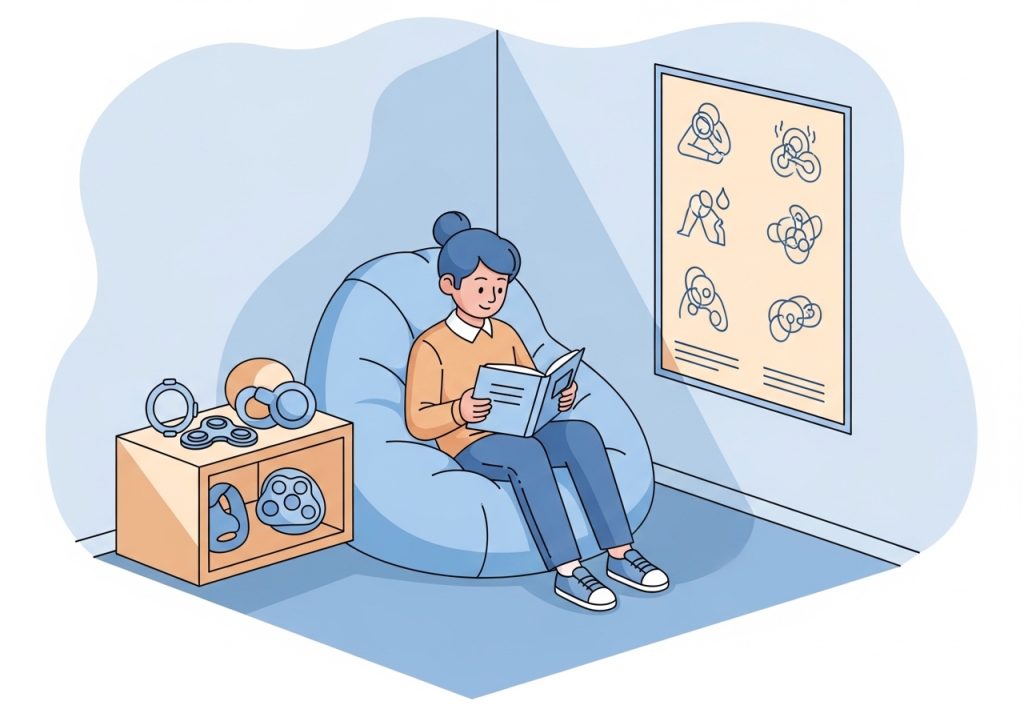
Examples of Sensory-Aware Rules:
- “It’s okay to take a break in the calm corner.”
- “You can ask for a fidget tool to help you focus.”
- “Let the teacher know if you need a movement break.”
By incorporating these ideas, you validate students’ experiences and teach them that their needs are important. This approach helps build trust and reduces the anxiety that can lead to challenging behaviors. Integrating sensory diet activities into the daily schedule can also proactively address these needs, making it easier for all students to follow classroom expectations.
Teach, Model, and Practice Every Rule
It’s a common mistake to assume that once rules are posted and discussed, the job is done. Rules are skills, and just like any other academic skill, they must be explicitly taught, modeled by the adults, and practiced by the students. You cannot expect a child to master a behavioral expectation without instruction and rehearsal, any more than you could expect them to know how to read without phonics lessons. Dedicate time, especially at the beginning of the school year and after long breaks, to actively teach what each rule looks, sounds, and feels like.
Modeling is crucial. Children are always watching the adults in their environment. If the rule is to “use an inside voice,” the teacher must also use an inside voice. If the rule is to “clean up your space,” the teacher’s desk should also be organized. This consistency shows students that the rules apply to everyone and are part of the shared culture of the classroom.
Practice should be ongoing and can be made fun. Role-playing is a fantastic tool. Present different scenarios and have students act out the “right way” to handle it. For example, “What does it look like to ask a friend to play?” or “Show me how you would get the teacher’s attention if you need help.” Creating lesson plans focused on social-emotional skills and classroom procedures can formalize this practice. Positive reinforcement, such as specific praise (“I saw how you used walking feet in the hallway, that was very safe!”), is far more effective than focusing on mistakes. This feedback reinforces the desired behavior and builds a child’s confidence and competence.
Ultimately, effective classroom rules are not about control; they are about creating a predictable and emotionally safe foundation for learning. By framing expectations positively, using multi-sensory supports, involving students in the process, accounting for sensory needs, and actively teaching the rules as skills, you can build a classroom community where every child feels respected and capable. These strategies transform rules from a static list on a wall into a dynamic tool that supports development, fosters independence, and allows every student to participate successfully.
Ready to put these strategies into action? Creating a supportive environment is easier with the right tools. At The Inspiring OT, you’ll find a collection of practical, OT-designed printables and activities to help you teach and reinforce essential skills. From visual schedules and self-regulation guides to engaging fine motor tasks, our resources are made to simplify your planning and support every learner’s growth. Visit The Inspiring OT shop today to find low-prep resources that bring these concepts to life in your classroom, clinic, or home.
Leave a Reply