
Finding effective kindergarten activities that are both engaging and developmental can be a constant challenge for educators, therapists, and parents. The goal is to move beyond simple entertainment and provide experiences that build a solid foundation for academic and life skills. An occupational therapist’s perspective can be invaluable here, focusing on activities that support the development of fine motor control, sensory processing, and visual motor skills. These are the underlying abilities children need to hold a pencil, read a book, and participate successfully in the classroom. This guide offers practical, OT-recommended kindergarten activities designed to strengthen these essential areas in a playful, purposeful way.
Develop Pincer Grasp with a Bead Threading Station
A simple bead threading station is a powerful tool for developing the pincer grasp, which is the coordination of the index finger and thumb to hold an item. This grasp is fundamental for tasks like buttoning a coat, zipping a backpack, and, most importantly, holding a pencil correctly. Research from government education bodies like the What Works Clearinghouse emphasizes that such hands-on activities are crucial for preparing young children for school.
Setting up this activity is straightforward. It supports not only fine motor precision but also improves crucial eye to hand coordination as children guide the string through the bead. You can easily adjust the difficulty to meet each child’s skill level.
How to Set It Up:
- Gather Materials: You will need beads with varying hole sizes and stringing materials like pipe cleaners, shoelaces, or yarn. For beginners, start with large wooden beads and stiff pipe cleaners, which are easier to manipulate.
- Create the Station: Arrange the materials in a small tray or container. This keeps the items organized and creates an inviting, designated workspace for the child.
- Grade the Activity: To increase the challenge, introduce smaller beads and more flexible stringing materials like yarn. You can also encourage children to follow a color or shape pattern to add a cognitive component to the motor task.
Build Pre-Writing Skills with Sensory Trays
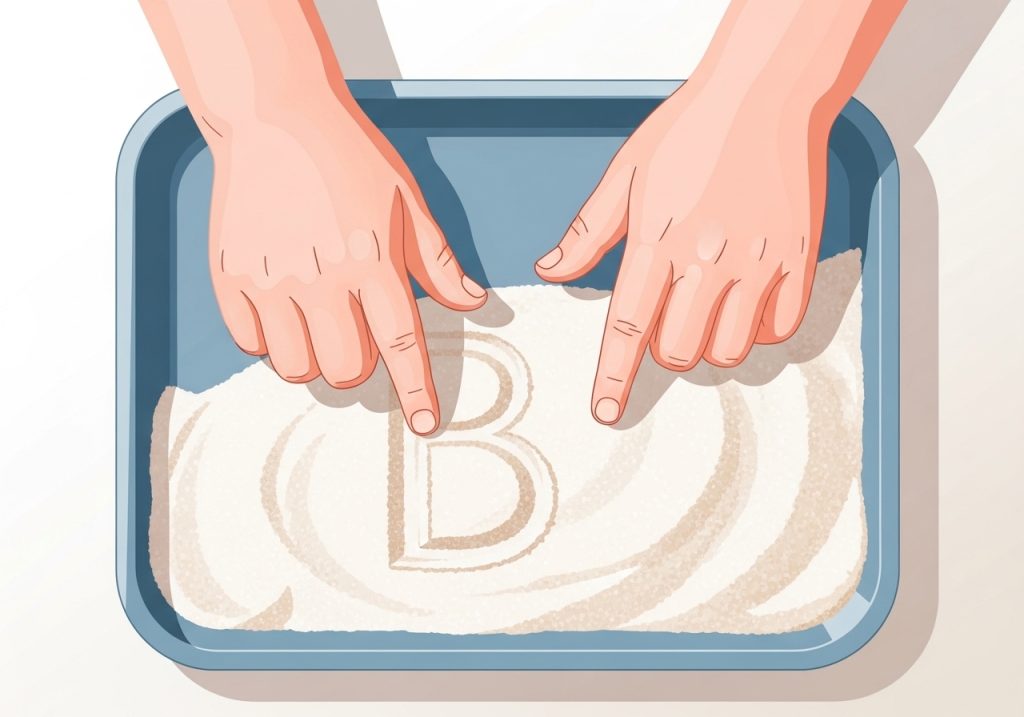
Many children feel pressure when presented with a pencil and paper. A sensory tray removes this anxiety by allowing them to practice forming shapes, letters, and numbers using just their finger. This tactile experience reinforces motor memory and makes learning pre-writing strokes a playful exploration. By focusing on the movements required for writing, these trays help strengthen the foundational skills needed to improve on handwriting later on.
The sensory input from materials like sand or salt can be calming and help improve a child’s focus on the task. This approach aligns with the principles of playful learning, which are widely recognized for their effectiveness in early childhood education. Studies published by organizations like the National Association for the Education of Young Children (NAEYC) show that playful learning supports development across all domains.
Materials for a Sensory Tray:
- The Tray: A shallow baking sheet, a plastic tray, or a shirt box lid works well.
- The Filler: Use materials like sand, salt, cornmeal, rice, or shaving cream. Choose a filler that provides pleasant tactile feedback.
- Visual Prompts: Have alphabet cards, number cards, or shape flashcards nearby for the child to reference.
To use the tray, simply have the child use their index finger to copy the shapes or letters from the prompt cards into the sensory material. Gently shake the tray to “erase” the surface and start again.
Enhance Visual Motor Skills with Block Imitation
Visual motor integration is the ability to interpret visual information and respond with a coordinated motor action. Block imitation is an excellent activity for building this skill. It requires a child to look at a structure, analyze its components, and use their hands to replicate it. This process strengthens spatial awareness, problem-solving, and visual discrimination, which are all important for tasks like copying from a board, understanding math concepts, and organizing written work on a page.
This activity can be done individually or with a partner, adding a social communication element. The complexity can be scaled to suit different ability levels, from simple stacks to complex multi-block designs.
How to Implement Block Imitation:
- Start Simple: Begin by building a simple structure with two or three blocks, like a tower or a small bridge. Place it in front of the child with a pile of corresponding blocks.
- Instruct and Observe: Ask the child, “Can you build one that looks just like mine?” Observe how they approach the task. Do they identify the correct colors and shapes? Do they place the blocks in the correct orientation?
- Increase Complexity: As the child becomes more proficient, build more complex structures. You can also transition from a 3D model to a 2D picture of a block design that they must then build in 3D. This adds another layer of visual processing challenge.
Practice Safe Scissor Skills with a Cutting Bin
Developing scissor skills is a major milestone in kindergarten. It requires hand strength, bilateral coordination (using both hands together), and precise visual motor control. A dedicated cutting bin provides a safe and engaging way to practice without the pressure of cutting along a specific line perfectly. It allows children to build confidence and master the mechanics of opening and closing the scissors.
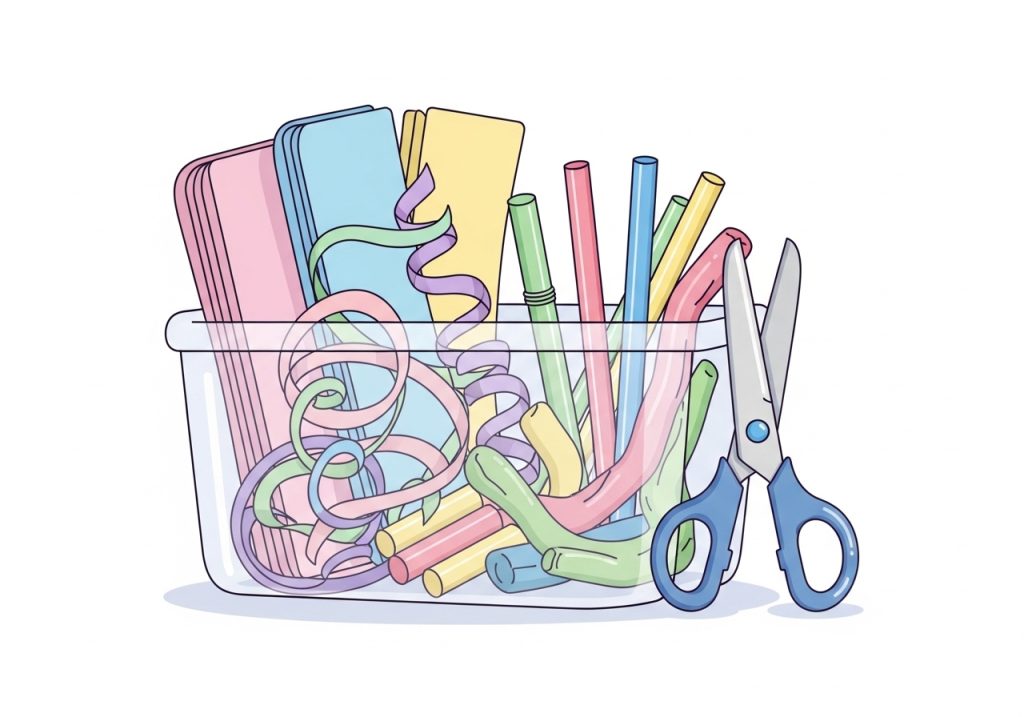
The variety of textures and materials in the bin keeps the activity interesting and helps children learn how much force is needed for different objects. Always supervise children when using scissors and start with child-safe scissors designed for small hands.
What to Put in a Cutting Bin:
- Strips of construction paper of varying widths
- Play-dough “snakes”
- Drinking straws -Yarn or string
- Cooked spaghetti noodles
- Old magazines or junk mail
Encourage the child to simply snip the materials into smaller pieces and let them fall into the bin. The goal is repetition and motor practice, not creating a perfect final product.
Integrate Heavy Work Activities for Regulation
Some children need more sensory input to help their bodies feel calm, organized, and ready to learn. “Heavy work” activities, which involve pushing, pulling, or carrying heavy objects, provide proprioceptive input to the muscles and joints. This type of input can be very regulating for the nervous system and can improve focus and attention. Integrating these tasks into daily routines is a natural way to provide this needed sensory input.
These activities are not about strength training. They are about activating the body’s sense of position and movement. They can be especially helpful for students managing first day jitters or those who seem to have boundless energy. These tasks give that energy a purposeful outlet.
Examples of Classroom Heavy Work:
- Pushing a cart to deliver supplies
- Carrying a stack of books to the library
- Washing tables or whiteboards with a sponge
- Stacking chairs at the end of the day
- Helping to move a small rug or beanbags
- Wall push-ups or chair push-ups
Refine Bilateral Coordination with Tearing Paper Art
Bilateral coordination is the ability to use both sides of the body together in a controlled and organized manner. It is essential for many daily tasks, such as stabilizing paper with one hand while writing with the other, tying shoes, or using a fork and knife. Tearing paper is a fantastic and simple activity to promote this skill.
To tear paper effectively, one hand must act as the “stabilizer” while the other acts as the “worker.” This requires constant communication between the left and right hemispheres of the brain. The torn pieces can then be used to create a beautiful mosaic art project, adding a creative component to the motor skill practice.
How to Create a Paper Mosaic:
- Choose Your Paper: Provide different colors and textures of paper, like construction paper, tissue paper, or magazine pages.
- Tear the Pieces: Show the child how to hold the paper with both hands and pull in opposite directions to create small pieces. Encourage them to make pieces of various sizes.
- Create the Art: Draw a simple outline of a shape (like a heart or an apple) on a piece of paper. Have the child glue the torn pieces inside the outline to fill the space. This final step also works on fine motor precision and visual planning.
Use Foundational Kindergarten Activities to Foster Independence
Many foundational kindergarten activities are embedded within everyday functional tasks. Turning classroom jobs or self-care routines into learning opportunities is an effective way to build skills in a meaningful context. Activities like buttoning, zipping, and pouring help develop the same motor control and coordination needed for academic work. Fostering independence in these daily living skills also builds a child’s confidence and sense of responsibility.
According to experts in early learning, there are several key skills beyond academics that are critical for kindergarten readiness, and many of them revolve around self-sufficiency and motor control.
Examples of Skill-Building Functional Tasks:
- Dressing Frames: Use frames with buttons, zippers, snaps, and laces for children to practice. These can be purchased or easily made.
- Watering Plants: Using a small watering can or a spray bottle helps develop hand strength and control.
- Setting the Table: Carrying plates, placing napkins, and organizing utensils works on bilateral coordination and following multi-step directions.
- Food Preparation: Simple tasks like spreading butter on toast or peeling a clementine are excellent for fine motor development.
By incorporating these seven OT-recommended activities into your kindergarten classroom, therapy sessions, or home routine, you can support robust skill development in a way that feels like play. Each activity is designed to target specific foundational abilities, helping children build the confidence and competence they need to thrive.
Looking for more low-prep, engaging resources to support skill development? The Inspiring OT shop on Teachers Pay Teachers is filled with practical, evidence-informed activities created by a licensed occupational therapist. From fine motor task cards to handwriting guides, you’ll find everything you need to simplify your planning and help your learners succeed. Explore the shop today to find your next great activity.
Leave a Reply