
Scaffolding in education is an instructional method where a therapist, teacher, or parent provides temporary, targeted support to help a learner master a new skill or concept. This approach acts as a bridge, allowing a student to move from their current level of understanding to a higher one with guidance. For occupational therapists, educators, and families, understanding how to use scaffolding effectively is key to building a child’s competence and confidence in areas from handwriting to daily routines.
Defining What Is Scaffolding in Education
The term “scaffolding” brings to mind the temporary framework used to support a building during construction. Once the structure is stable enough to stand on its own, the scaffolding is removed. The educational concept works in precisely the same way. It is not about making a task easier or doing the work for the student. Instead, it involves providing just enough support to help the learner succeed at a task that would otherwise be just out of their reach.
This idea is rooted in the work of psychologist Lev Vygotsky and his concept of the Zone of Proximal Development (ZPD). The ZPD is the gap between what a learner can do independently and what they can achieve with guidance from a more knowledgeable person. Scaffolding is the active process of providing that guidance within the ZPD. The support is intentionally designed to be withdrawn as the learner’s skills grow, ensuring the ultimate goal is independence.
The Key Principles of Effective Scaffolding
Effective scaffolding is a deliberate process, not just random help. It involves several key principles that work together to support the learner without creating dependency. These principles allow the educator or therapist to be responsive to the student’s needs in the moment.

- Modeling: The first step is often showing the learner how the task is done. This can be a “think-aloud” process where you verbalize your thought process, or a direct demonstration of a physical skill, like forming a letter or tying a shoe.
- Providing Prompts and Cues: These are hints that guide the learner toward the correct action. Cues can be verbal (“What sound does that letter make?”), visual (pointing to the next step on a chart), or physical (a light touch to guide a hand).
- Offering Feedback: Constructive feedback helps the learner understand what they are doing correctly and what needs adjustment. Effective feedback is specific and encouraging, focusing on the process rather than just the outcome.
- Structuring the Task: Breaking a complex skill into smaller, more manageable steps is a core part of scaffolding. For example, learning to get dressed can be broken down into choosing clothes, putting on a shirt, and then putting on pants. This reduces cognitive load and helps prevent overwhelm.
- Using Questioning: Instead of giving answers, skilled practitioners use questions to guide a student’s thinking. Open-ended questions like, “What do you think we should do next?” or “Why did that happen?” encourage critical thinking and problem-solving.
Scaffolding vs. Other Support Methods
It’s common for educators and therapists to use various support strategies, and it can be helpful to understand how scaffolding differs from other methods.
Scaffolding vs. Prompting: A prompt is a specific cue to elicit a single action. While prompting is one of the tools used in scaffolding, scaffolding itself is a broader, more systematic process. Scaffolding includes the initial teaching, the use of various supports (including prompts), and the crucial final step of gradually fading those supports. Prompting alone does not always have a built-in plan for removal.
Scaffolding vs. Differentiation: Differentiation involves modifying the content, process, or product to meet the diverse needs of learners. For instance, a teacher might offer different reading materials or project options based on student readiness. Scaffolding, on the other hand, typically keeps the learning goal the same for all students but provides different levels of temporary support to help everyone reach it. As explained by Edutopia, one of the most effective scaffolding strategies is to break learning into smaller chunks, which helps all students access the same core lesson.
Practical Scaffolding Strategies for Skill Development
Scaffolding is not an abstract theory. It is a set of practical actions you can apply to almost any learning situation. Here are specific examples relevant to occupational therapy, special education, and home learning environments.
Fine and Visual Motor Skills
Developing hand-eye coordination and small muscle control is fundamental for many academic and life tasks. There are many practical visual motor activities that can be scaffolded for success.
- Cutting with Scissors: Start with snipping play-doh, then move to snipping paper strips, then cutting along thick straight lines, and finally cutting out simple shapes.
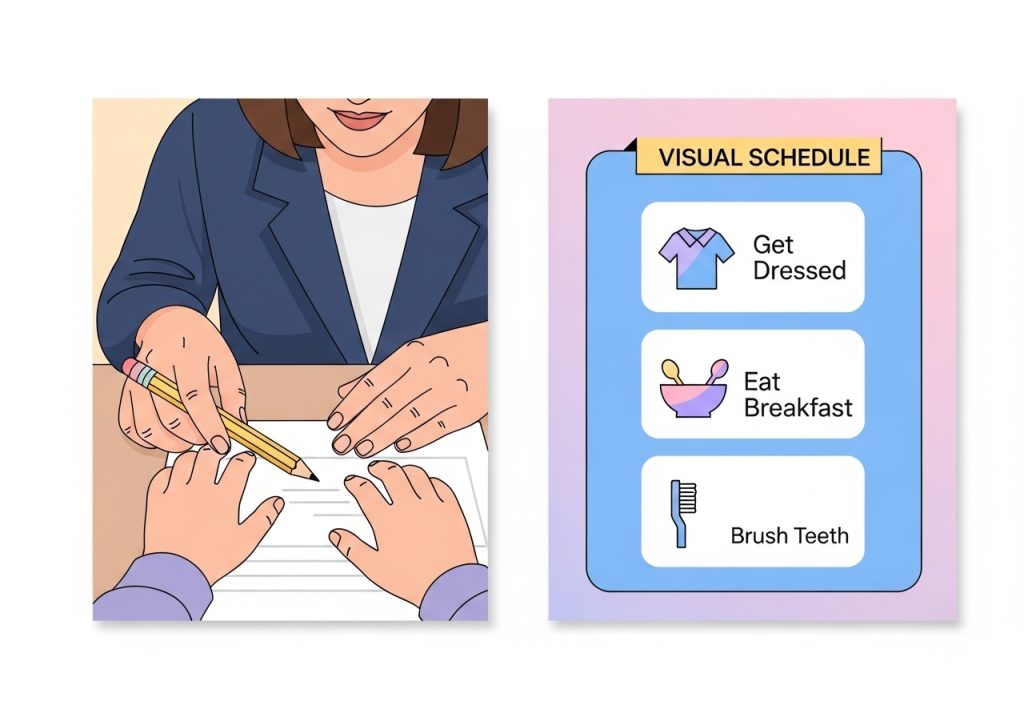
- Pencil Grasp: Use hand-over-hand assistance to help a child feel the correct grasp. Gradually reduce support to just guiding their wrist, then providing only a verbal cue (“Remember your helper hand!”).
- Drawing Shapes: Provide a dot-to-dot template of a shape before asking the child to draw it freehand. The next step could be tracing a faint line, then copying the shape from a model.
Handwriting
Handwriting can be a complex task that integrates motor, visual, and cognitive skills. Scaffolding makes it less intimidating.
- Letter Formation: Use verbal cues that break down the motor plan for each letter (e.g., “For ‘b,’ it’s a big line down, bounce up, and around”). Provide papers with highlighted lines to guide letter size and placement.
- Sentence Writing: Offer sentence starters to help a student organize their thoughts (e.g., “My favorite part was…”). This removes the cognitive load of idea generation so they can focus on the mechanics of writing.
- Spacing: Give the student a small physical object, like a craft stick or their own finger, to place between words to ensure proper spacing.
Emotional Regulation
Learning to manage emotions is a critical life skill that often requires significant scaffolding.
- Identifying Feelings: Use a visual chart with faces showing different emotions. When a child is upset, you can point to the chart and ask, “Which one looks like how you feel?”
- Coping Strategies: Co-regulate with the child by modeling calming techniques. For example, you can say, “I see you’re frustrated. Let’s take three deep breaths together,” and then do it with them.
- Problem-Solving: Instead of solving a social conflict for a child, talk them through it with questions. “What happened? How did that make you feel? What could we do to solve this?”
Daily Living Skills
Scaffolding is essential for teaching the routines and habits that lead to independence. These abilities are often called essential life skills for independent living.
- Morning Routine: Create a visual schedule with pictures for each step: get dressed, eat breakfast, brush teeth, get backpack. This external support reduces the need for verbal reminders.
- Tying Shoes: Break the task into small, named steps (“Make the bunny ears, cross them over, tuck one under…”). Use two different colored laces to make the steps visually distinct.
- Making a Simple Snack: Start by having the child do only the last step (e.g., putting the two pieces of bread together for a sandwich). Over time, have them complete more of the preceding steps.
How to Gradually Remove Scaffolds to Foster Independence
The true success of scaffolding lies in its removal. The goal is to fade support systematically as the learner demonstrates mastery. If supports are removed too quickly, the learner may become frustrated. If they are left in place too long, the learner may become dependent on them.
The process of fading involves careful observation. Pay close attention to the learner’s performance. Are they completing the step with more ease? Are they starting to self-correct their mistakes? These are signs that they are ready for less support. For instance, you might move from a physical prompt to a verbal one, or from a detailed checklist to a simple reminder.
This gradual release of responsibility empowers the learner. It helps them build self-efficacy and a belief in their own abilities. When a child recognizes they can now do something that once required help, it reinforces the idea that challenges can be overcome with effort, which is the core of many practical growth mindset examples. The key is to find that sweet spot where the task is challenging but achievable, allowing them to feel a sense of accomplishment.
Ultimately, scaffolding is a responsive and respectful way to teach. It acknowledges where a learner is and provides the precise support they need to move forward. By understanding its principles and applying its strategies, therapists, teachers, and parents can effectively guide children toward greater independence, one supported step at a time.
Ready to put these strategies into action? Finding the right tools can make all the difference. The Inspiring OT offers a wide range of practical, low-prep printable activities and resources designed by an experienced occupational therapist. Support skill development in fine motor, handwriting, sensory processing, and more with engaging materials that make learning successful. Explore the shop to find the perfect resources for your classroom, clinic, or home.
Leave a Reply