
A visual perceptual skill is the brain’s ability to interpret and make sense of what the eyes see, a critical process for everyday activities from dressing and eating to writing and reading. While we often think of vision as simply seeing clearly, perception is what happens next. It is the complex cognitive process of organizing and understanding visual information to interact with the world effectively. Without strong visual perceptual skills, a child might struggle to learn the alphabet, complete a puzzle, or even find their shoes in a messy room.
Understanding these skills is essential for occupational therapists, educators, and parents who support learners. It helps reframe certain academic or daily living challenges, moving the focus from a child “not trying” to recognizing a potential gap in their visual processing abilities. By identifying the specific components of visual perception, we can provide targeted support and activities that build a solid foundation for success in the classroom and beyond.
Breaking Down the 7 Components of Visual Perception
Visual perception is not a single skill but a combination of several distinct abilities that work together. When a child struggles, it is often due to a weakness in one or more of these specific areas. According to occupational therapy resources, these components are essential for processing visual input from the environment. Knowing them helps pinpoint the source of a difficulty and tailor interventions accordingly.
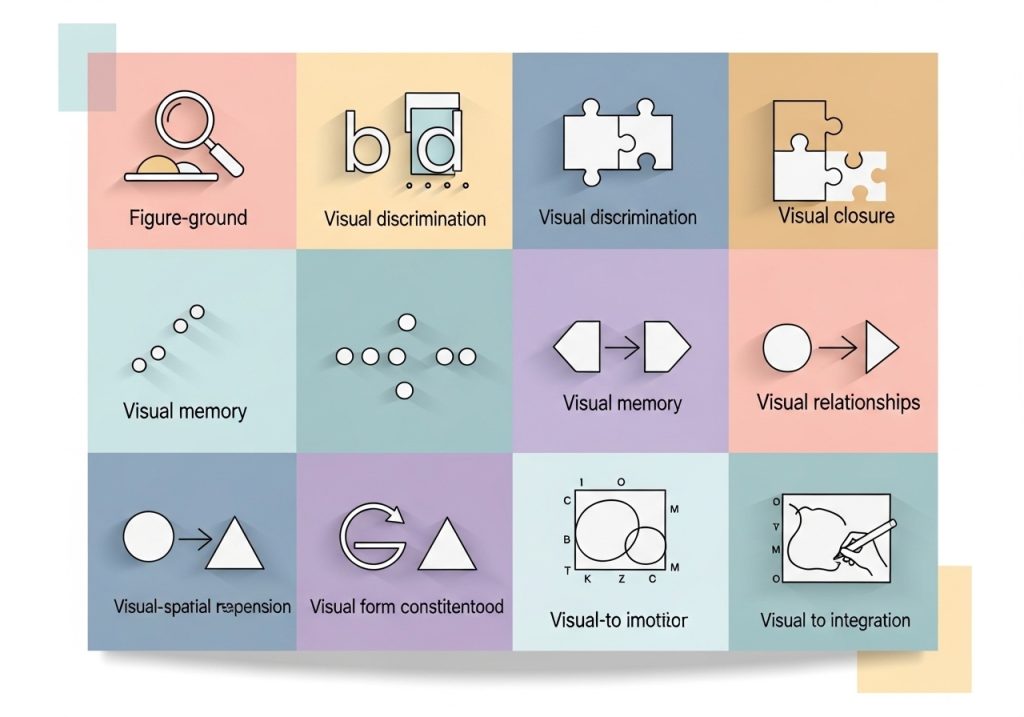
Here are the seven key components of visual perception:
- Visual Discrimination: This is the ability to determine differences or similarities in objects or forms based on size, shape, color, or orientation. It is what allows a child to see the difference between the letters ‘b’ and ‘d’ or find a matching pair of socks.
- Visual Memory: This involves recalling visual information that was seen previously. A child uses visual memory to remember what a word looks like, copy notes from the board, or remember a sequence of numbers.
- Figure-Ground Perception: This skill allows a person to distinguish an object or shape from its surrounding background. It is used when finding a specific word on a crowded page, locating a toy in a full toy box, or picking out a face in a crowd.
- Form Constancy: This is the ability to know that a form or object is the same even when it has been made smaller, larger, or has been turned around. It helps a child recognize the letter ‘A’ whether it is written in print, cursive, or in a different font.
- Spatial Relations: This refers to understanding the position of objects in relation to each other and to oneself. It is crucial for understanding concepts like up, down, over, under, left, and right, which affects handwriting spacing and interpreting maps or graphs.
- Visual Closure: This is the ability to identify a complete figure or object when only parts of it are visible. A strong visual closure skill helps a child read words quickly without having to sound out every letter or recognize an object that is partially hidden.
- Sequential Memory: This skill involves recalling a sequence of objects, letters, or numbers in the correct order. It is essential for spelling, following multi-step directions, and correctly writing phone numbers or math equations.
As outlined by experts at Eyas Landing, each of these skills plays a unique role, but they must all work together for efficient visual processing.
The Connection Between Visual Perception and Classroom Success
Strong visual perceptual skills are a cornerstone of academic learning. When these abilities are well-developed, students can navigate classroom demands more easily. Conversely, weaknesses in this area can create significant hurdles that may be mistaken for inattention or a lack of effort.
In reading, students rely on visual discrimination to tell letters apart, sequential memory to track words across a page, and visual closure to recognize familiar words quickly. A student who struggles with figure-ground perception may lose their place while reading or have trouble finding information in a textbook.
When it comes to handwriting, spatial relations are key for proper letter spacing and staying on the line. Visual memory is needed to recall how to form each letter correctly. Without solid form constancy, a child’s handwriting may be inconsistent, with letters varying in size and orientation.
Even mathematics depends heavily on visual processing. Students use spatial skills to align numbers for addition and subtraction problems. They need visual discrimination to differentiate between symbols like + and ×. Solving geometry problems requires a strong understanding of shapes, angles, and orientation.
Beyond academics, these abilities are vital for developing essential everyday life skills. Tasks like buttoning a shirt, organizing a backpack, or following a recipe all depend on the brain making sense of visual information.
Common Signs of Visual Perceptual Challenges
Identifying potential challenges early can lead to more effective support. While only a professional can diagnose a visual processing disorder, educators and parents can watch for common signs that a child may need extra help. It is important to remember that many of these behaviors are normal in young children, but they may indicate a problem if they persist as the child gets older.
Here are some signs to look for:
- Letter and Number Reversals: Frequently confusing ‘b’ and ‘d’, ‘p’ and ‘q’, or ‘6’ and ‘9’ past the age of seven.
- Difficulty Copying: Struggling to copy text accurately from a board, book, or another piece of paper. The child may work very slowly or make frequent mistakes.
- Loses Place Often: Skips words or entire lines when reading, or uses a finger to keep their place long after peers have stopped.
- Poor Spacing in Writing: Words may be crammed together or have inconsistent spacing between letters and words. Writing may drift off the line.
- Trouble with Puzzles and Matching: Avoids or struggles with activities like puzzles, sorting games, or finding hidden pictures.
- Clumsiness: May have difficulty navigating their environment, bumping into objects or struggling with tasks that require judging distance.
- Disorganization: Has a messy desk, backpack, or bedroom and has trouble finding things.
When you notice these patterns, documenting these observations over time can be valuable information to share with a school-based occupational therapist or a developmental optometrist.
Activities to Build a Stronger Visual Perceptual Skill
The good news is that visual perceptual skills can be strengthened through practice and targeted activities. Many of these can be easily incorporated into playtime, homework, or daily routines. The key is to make them engaging and fun, not another chore. For more ideas, The OT Toolbox offers a wide range of activities for different skill areas.
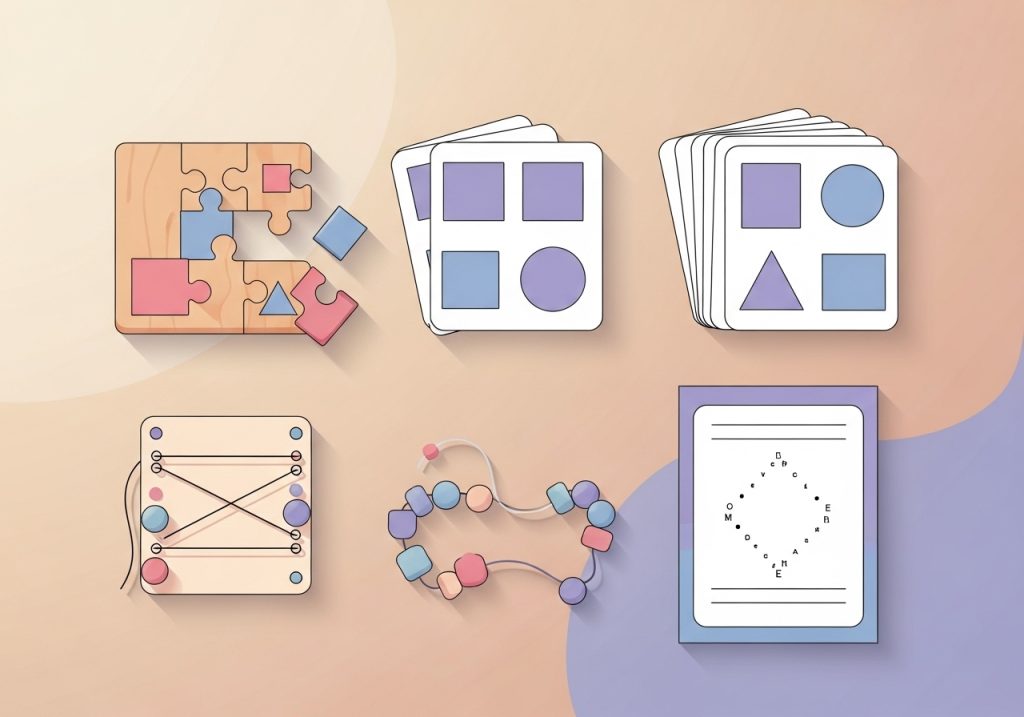
Activities for Visual Discrimination
- Matching Games: Classic memory games with cards are excellent. You can also match socks from the laundry, lids to containers, or similar-looking toys.
- Sorting Tasks: Ask your child to sort buttons, beads, or blocks by color, size, or shape. In the kitchen, they can sort silverware.
- “What’s Different?” Games: Use worksheets or picture books where the child has to find the one item in a row that is different from the others.
Activities for Figure-Ground Perception
- “I Spy”: This classic game is a fun way to practice picking out an object from a busy background.
- Hidden Picture Puzzles: Magazines and activity books are full of these. You can also make your own by drawing simple shapes overlapping each other.
- Word Searches: Finding words hidden among a jumble of letters is a direct exercise in figure-ground skills.
Activities for Visual Memory
- Memory Tray: Place several items on a tray. Let the child look at them for 30 seconds, then cover the tray and ask them to name the items they remember. You can also remove one item and ask them which one is missing.
- Drawing from Memory: Show the child a simple drawing (like a house or a flower) for a few seconds. Then, hide it and ask them to draw it from memory.
Activities for Spatial Relations
- Building with Blocks: Copying block designs or building from a picture helps develop an understanding of how objects relate to each other in space.
- Obstacle Courses: Set up a simple course where the child has to go over, under, around, and through various objects.
- Mazes and Dot-to-Dots: These activities require planning and understanding spatial direction.
Supporting the development of a strong visual perceptual skill set gives learners a powerful tool for academic achievement and confident participation in daily life. By understanding the components and recognizing the signs of a challenge, you can provide meaningful activities that build a solid foundation for lifelong learning.
Ready to support your learners with engaging, low-prep resources? The Inspiring OT offers a wide variety of printable activities designed by an experienced occupational therapist to build visual perceptual, fine motor, and handwriting skills. Explore the shop to find practical, evidence-informed tools that make skill-building effective and accessible for every student.
Visit The Inspiring OT shop today to find worksheets, assessments, and activities that simplify your planning and help learners thrive.
Leave a Reply