
Have you ever watched a student look up at the classroom whiteboard, then down at their paper, and then back up again, only to lose their place? Or perhaps you’ve noticed a child who complains of headaches after reading or avoids puzzles and coloring. These behaviors might seem related to attention, but they can often point to an underlying challenge with a crucial visual skill. Understanding what is visual accommodation is the first step for any therapist, teacher, or parent hoping to support a learner’s success. This skill is the eye’s automatic focusing system, and when it doesn’t work efficiently, it can create significant barriers to learning.
Understanding the Basics: What Is Visual Accommodation?
Visual accommodation is the ability of the eye to change its focus from distant objects to near objects, and vice versa, while maintaining clarity. Think of it like the autofocus feature on a camera. When you point your camera at a flower up close, the lens adjusts to make it sharp. When you then point it at a mountain in the distance, the lens shifts again to bring the new subject into focus. The eye’s crystalline lens does the exact same thing, but it does so constantly and without conscious effort.
This dynamic process allows us to perform countless daily tasks. It’s what lets a driver glance from the road to the speedometer, a chef read a recipe and then check on ingredients across the kitchen, or a student copy notes from a presentation screen. For children in a learning environment, this skill is in constant use.
Why Accommodation Matters for Learning and Everyday Tasks
Efficient visual accommodation is fundamental for academic performance. In a typical classroom, a child’s eyes are continuously shifting focus. They look from their desk to the teacher, from a textbook to their notebook, and from the board back to their own paper. Each of these shifts requires a rapid and accurate adjustment by the eye’s lens.
When this skill is weak or slow, a child may experience:
- Difficulty with Copying Tasks: The constant refocusing between a distant board and a near paper can be slow and strenuous. This often leads to errors, omissions, and a much slower work pace.
- Reading Fatigue: Maintaining clear focus on the small print in a book requires sustained accommodation. A child with accommodative issues may experience blurry vision after a few minutes, causing them to lose their place, skip lines, or simply give up.
- Poor Handwriting and Spacing: Visual skills are deeply connected to motor output. Inefficient focus can contribute to challenges with neat and efficient handwriting, as the child struggles to clearly see the lines and their own letter formations.
- General Eye Strain: The muscles in the eye have to work overtime to compensate for poor accommodation, leading to physical symptoms like headaches, watery eyes, and eye rubbing.
Beyond the classroom, this skill is necessary for playing sports that involve tracking a ball, engaging in hobbies like building with blocks, or even just navigating a busy playground safely.
How Visual Accommodation Works: A Look Inside the Eye
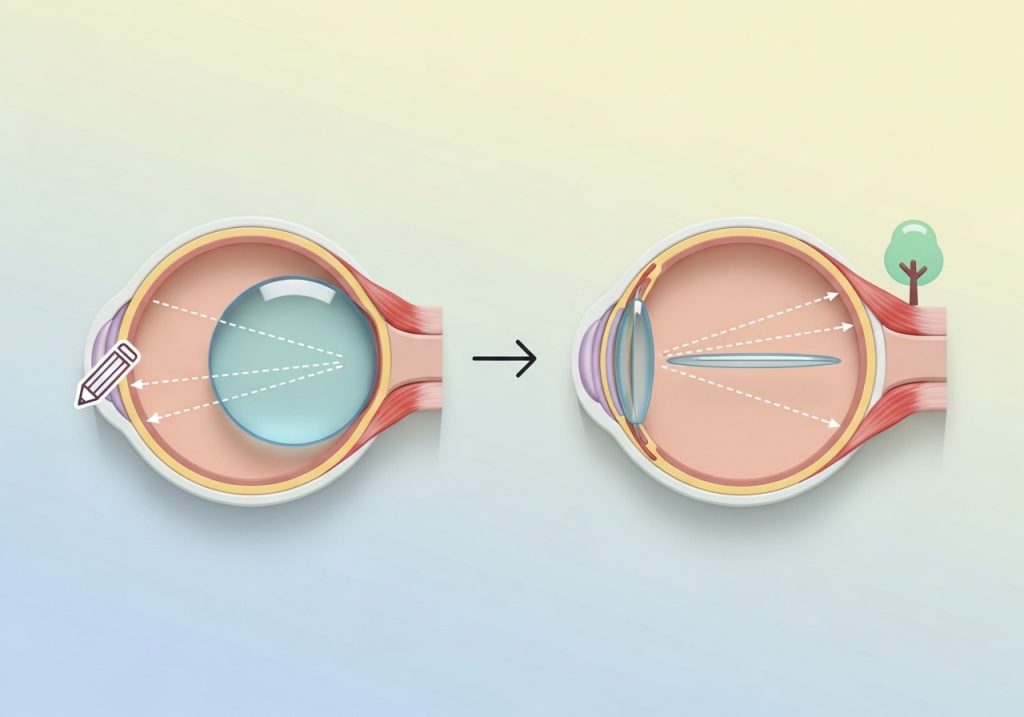
To appreciate accommodation challenges, it helps to understand the basic mechanics. Inside the eye, just behind the iris, is the crystalline lens. This lens is flexible and is surrounded by a tiny muscle called the ciliary muscle. These two parts work together to focus light directly onto the retina at the back of the eye, which is what allows us to see a clear image.
- Focusing on a Near Object: When you look at something close, like a book, the ciliary muscle contracts. This contraction relaxes the fibers holding the lens, allowing the lens to become thicker and more curved. This increased curvature bends the light rays more sharply, bringing the nearby object into focus.
- Focusing on a Distant Object: When you look at something far away, the ciliary muscle relaxes. This relaxation tightens the fibers around the lens, pulling it and causing it to become thinner and flatter. This shape is ideal for focusing the parallel light rays coming from a distant object.
An accommodative disorder occurs when this system is sluggish, weak, or spasms, preventing the lens from changing shape smoothly and accurately for the required distance.
Common Signs of Visual Accommodation Difficulties
Identifying potential issues with visual accommodation begins with observation. Children often don’t know that what they are experiencing is not normal, so they may not complain. Instead, they may exhibit certain behaviors that serve as red flags for parents, teachers, and therapists.
Look for these common signs:
- Reports of blurry vision, especially after reading or doing close work.
- Holding books or papers unusually close to the face.
- Frequent complaints of headaches, particularly in the forehead or temples.
- Excessive eye rubbing or blinking.
- Losing place when reading or copying from the board.
- Appears to have a short attention span for near-point tasks like reading or writing.
- Avoidance of activities that require sustained visual focus up close.
- Covering or closing one eye to see better.
- Difficulty completing assignments in a reasonable amount of time.
These signs can overlap with other conditions, which is why a professional evaluation is important. However, recognizing these patterns is the first step toward getting a child the right support.

Strategies to Support Visual Accommodation Skills
While vision therapy from a qualified optometrist is the primary treatment for significant accommodation disorders, therapists and educators can incorporate activities and strategies to support and strengthen this skill. These activities encourage the eyes to practice focusing at different distances in a playful, low-stress way.
Practice Activities
- Near-Far Copying: Have the child copy a word, sentence, or design from a paper taped to a wall about 8-10 feet away. This forces them to look up (far), remember the information, and look down (near) to write it. Start with small amounts of information and gradually increase the complexity.
- Pencil Push-Ups: Hold a pencil at arm’s length. Have the child focus on the tip while slowly moving it toward their nose. They should try to keep the tip single and clear for as long as possible. Stop when it becomes blurry or double, then move it back out. Repeat this 5-10 times.
- Ball Tossing and Catching: Simple games of catch are excellent for practicing accommodation. The eyes must track the ball as it moves toward and away from the body, constantly adjusting focus.
- Beading and Lacing: Activities that require shifting focus from the pile of beads (near) to the tip of the lace (also near, but at a slightly different depth) provide good practice for fine-tuned focusing.

Classroom and Home Accommodations
- Provide a Slant Board: Using a slant board for reading and writing reduces the angle of gaze, which can decrease strain on the accommodative system.
- Minimize Copying from the Board: When possible, provide a printed copy of notes or instructions that can be placed on the child’s desk.
- Encourage Visual Breaks: Teach the 20-20-20 rule. Every 20 minutes, take a 20-second break to look at something 20 feet away. This helps relax the eye muscles.
- Ensure Proper Lighting: Good, non-glare lighting can reduce overall visual stress, making it easier for the eyes to perform their focusing tasks.
When to Consult a Professional
If you consistently observe signs of visual accommodation difficulty, it is important to seek a professional opinion. While school vision screenings are valuable, they typically only check for distance acuity (like on a Snellen eye chart) and often miss near-point vision problems like accommodative dysfunction.
Schedule a comprehensive eye exam with a developmental or behavioral optometrist. These specialists are trained to evaluate the entire visual system, including focusing, tracking, and eye teaming. They can properly diagnose any issues and prescribe a treatment plan, which may include corrective lenses, vision therapy, or both.
An occupational therapist can also be a key part of the support team. OTs can help identify the functional impacts of the vision problem on daily tasks and academic performance, and they can implement strategies and activities to help the child succeed in their environment.
Understanding visual accommodation moves us beyond simplistic explanations for a child’s struggles. It gives us a new lens through which to see their challenges, allowing us to provide more targeted and effective support. By recognizing the signs and implementing helpful strategies, we can reduce visual strain and help learners build a stronger foundation for success.
Supporting skill development is at the heart of what we do. If you are looking for practical, engaging, and low-prep resources designed by an experienced occupational therapist, explore The Inspiring OT shop. You’ll find a wide range of printable activities, worksheets, and guides to help learners of all abilities build essential skills for school and life.
Visit The Inspiring OT shop today to find your next great resource.
Leave a Reply