
Helping students transition from academic learning to real-world application is a primary goal for occupational therapists, special educators, and teachers. The challenge often lies in finding effective strategies that build practical, functional abilities. This is where a focus on Occupational Cognitive Skills (OCS) becomes essential, as it targets the thinking and doing skills needed for life beyond the classroom. Finding engaging and practical OCS ideas can transform how learners develop competence in vocational, independent living, and community settings. These strategies go beyond rote memorization, instead encouraging students to develop the complex problem-solving abilities they will need to succeed. Meaningful activities help learners hone skills for inquiry, design, and evaluation in realistic contexts, which is fundamental for addressing complex real-world problems. By integrating targeted activities, we can help bridge the gap between knowing and doing, laying a foundation built on core foundational pre-occupational skills.
Develop Task Boxes for Vocational Skills
Task boxes are one of the most versatile and effective OCS ideas for building job-related skills in a structured, predictable way. These self-contained kits provide all the materials needed to complete a specific vocational task from start to finish. The goal is to create an activity that a student can complete independently, promoting focus, persistence, and a sense of accomplishment. The beauty of task boxes is their adaptability; you can design them to match a wide range of skill levels and vocational interests.
Examples of vocational task boxes include:
- Office Work Simulation: Provide envelopes, stamps, and folded letters for a mail-sorting task. Students can stuff envelopes, apply stamps to a designated corner, and sort them by a fake address or zip code.
- Assembly and Packaging: Use nuts and bolts, small PVC pipe fittings, or bead and string kits for simple assembly tasks. Once assembled, the student can package the item in a small bag or box, simulating a production line.
- Clerical and Sorting: Create a kit with paper clips, colored folders, and hole-punched papers. The task could be to clip specific sets of papers together and file them in the correct folder.
These activities directly support the development of crucial work habits. They require students to follow multi-step directions, maintain attention to detail, and organize materials in their workspace. Completing these tasks also helps strengthen essential fine motor skills like pincer grasp, bilateral coordination, and in-hand manipulation, all of which are critical for many jobs.

Implement an ‘Independent Living’ Skills Lab
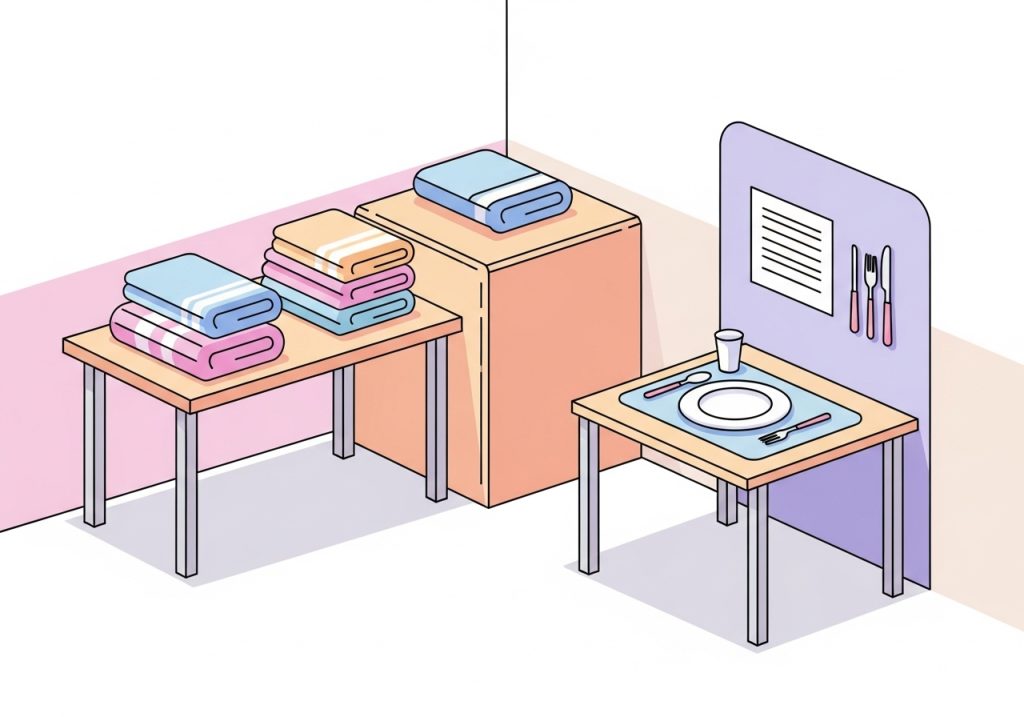
An independent living skills lab is a designated area in a classroom or therapy space that simulates a home environment. This hands-on learning center allows students to practice daily living activities in a safe, controlled setting before applying them at home or in the community. It removes the pressure of real-time performance and provides opportunities for repetition and direct instruction. This approach moves beyond worksheets and discussions, giving students tangible experience with the tools and sequences required for everyday tasks.
Your skills lab can be as simple or elaborate as your space allows. Key stations might include:
- A Kitchenette Area: A microwave, a small refrigerator, and a countertop can be used to practice simple meal prep like making a sandwich, pouring a drink, or heating up leftovers. Students can also practice washing dishes, wiping counters, and setting the table.
- A Bedroom/Laundry Station: Include a small cot or mattress for practicing bed-making skills. A laundry basket with clean clothes provides a chance to work on sorting colors, folding towels and shirts, and matching socks.
- A Personal Hygiene Station: A sink area with soap, a toothbrush, toothpaste, and a hairbrush (using props or real items for individual students) allows for practicing handwashing, tooth brushing, and grooming routines.
Breaking down these complex activities into manageable steps is key. For many learners, using a visual schedule to outline the steps for a task like making a bed can provide the structure needed for success. This hands-on practice builds motor skills, sequencing abilities, and the confidence needed to become more independent at home.
Use Community-Based Instruction Prep Activities
Community-based instruction (CBI) is an invaluable method for teaching skills in the actual environments where they will be used. However, successful outings often depend on thorough preparation. In-class prep activities can demystify community settings, reduce anxiety, and equip students with the specific skills they need before they even leave the school building. These simulations and role-playing exercises build a bridge between the classroom and the community.
Effective CBI prep activities can include:
- Restaurant Role-Playing: Use real or printed menus from local restaurants. Have students practice reading the menu, deciding on an order, and calculating the potential cost. Role-play the entire interaction, from greeting the host to ordering from a server and paying the bill.
- Grocery Shopping Simulation: Create a shopping list based on a recipe or weekly needs. Have students use grocery store flyers or websites to find items, compare prices, and stay within a set budget. This activity builds skills in planning, budgeting, and literacy.
- Public Transportation Planning: Use local bus or train schedules (print or online versions) to plan a trip to a familiar location like the library or a park. Students can identify departure and arrival times, locate the correct bus number, and calculate the fare.
By rehearsing these situations in a low-stakes environment, students can build confidence and troubleshoot potential problems. This preparation ensures that when they do go out into the community, they are more likely to have a positive and successful learning experience.
Create a Classroom ‘Store’ for Financial Literacy
Understanding money management is a critical life skill, and a classroom store provides a concrete, motivating way to teach it. This system, often part of a token economy, allows students to earn “money” for completing assignments, demonstrating positive behaviors, or doing classroom jobs. They can then use their earnings to “purchase” desired items or privileges from the store, providing immediate, hands-on experience with financial concepts.
Setting up a classroom store involves a few key components:
- Earning System: Clearly define how students can earn classroom currency. This could be a set “salary” for a weekly classroom job or “bonuses” for meeting specific academic or behavioral goals.
- The Store: Stock the store with a mix of items at different price points. Include small tangible rewards (stickers, special pencils), as well as intangible privileges (extra computer time, lunch with the teacher).
- “Shopping” Day: Designate a specific time, perhaps once a week, for the store to be open. This creates anticipation and encourages students to save and plan their purchases.
This ongoing activity teaches more than just basic math. Students learn about budgeting, as they must decide whether to spend their money immediately or save for a more expensive item. They practice delayed gratification and make choices based on value. Managing their own “bank account” (even if it’s just a simple ledger in a notebook) introduces foundational concepts of financial responsibility in a fun and engaging way.

Practice Digital Literacy for Job Readiness
In nearly every modern workplace, basic digital literacy is a non-negotiable skill. Preparing students for future employment means equipping them with the ability to use common digital tools confidently and professionally. These OCS ideas focus on the practical technology skills that employers expect, moving beyond general computer use to job-specific applications.
Incorporate targeted lessons on essential digital tasks:
- Professional Email Communication: Teach the structure of a professional email, including a clear subject line, a proper salutation, a concise body, and a closing. Provide templates and have students practice writing emails for different scenarios, such as requesting information from a supervisor or confirming they have completed a task.
- Digital Calendar Management: Use a free tool like Google Calendar to teach students how to schedule appointments, set reminders for deadlines, and manage their time. This skill is crucial for organization and time management in both academic and professional settings.
- Online Information Searching: Guide students on how to use search engines effectively to find specific information. Teach them how to identify credible sources, synthesize information from a webpage, and avoid common online safety risks.
By integrating these activities into your instruction, you are providing students with a direct link to the skills required in today’s job market. Proficiency with these tools not only enhances their employability but also boosts their confidence in navigating a digitally-driven world.
Role-Play Social Scenarios for the Workplace
Technical skills are only one part of job readiness. Social skills, or “soft skills,” are equally important for success and long-term employment. Role-playing is a powerful tool for teaching and practicing appropriate social interactions in a supportive environment. It allows students to rehearse conversations, navigate potential conflicts, and learn the unwritten social rules of a professional setting.
Create structured scenarios that reflect common workplace situations. According to UNESCO, the ability to express thoughts clearly and persuasively is a key competency. You can focus on scenarios like:
- Greeting Coworkers and Supervisors: Practice different greetings for different people, such as a formal “Good morning, Ms. Smith” versus a more casual “Hi, Alex.”
- Asking for Help: Role-play how to politely interrupt a coworker to ask for clarification on a task. Help students formulate clear questions, such as, “Excuse me, could you show me where the extra supplies are kept?”
- Responding to Feedback: Practice receiving constructive criticism gracefully. A scenario could involve a supervisor pointing out an error and the student practicing responding with, “Thank you for letting me know. I will fix that now.”
- Making Small Talk: Simple conversations during a break are important for building rapport. Practice asking and answering common questions like, “How was your weekend?” or “Do you have any plans for the holiday?”
Using scripts, social stories, or video modeling can provide extra support for students who need more structure. Repeated practice helps these interactions become more natural and automatic, reducing social anxiety and building the interpersonal skills necessary for workplace success.
Build Self-Advocacy Toolkits and Scripts
Empowering students to advocate for their own needs is one of the most important goals of any life skills program. Self-advocacy is the ability to understand your strengths and challenges and to effectively communicate your needs to others. Creating a personalized self-advocacy toolkit gives students tangible tools they can use to express themselves in school, at a job, and in the community.
A toolkit can be a physical binder, a digital folder, or a small set of laminated cards. The contents should be tailored to the individual student but might include:
- “All About Me” Page: A simple, positive summary of the student’s strengths, interests, and goals.
- Accommodation Cards: Small, discreet cards that state a specific need, such as “I need written instructions” or “I need a quiet space to work.”
- Problem-Solving Scripts: Pre-written sentences or scripts to help students navigate common challenges. Examples include, “I don’t understand. Can you explain it another way?” or “I need to take a short break, please.”
- Visual Supports: A feelings chart or a visual scale to help them communicate their emotional state if they have difficulty with verbal expression.
The process of creating the toolkit is as important as the final product. It involves working with the student to identify their needs and practicing how and when to use these tools. This preparation builds their confidence and provides them with a sense of control, fostering the independence needed to navigate future challenges successfully.
Integrating these practical OCS ideas into your curriculum provides learners with the foundational skills they need for greater independence and success. By focusing on hands-on, real-world activities, we can empower students to confidently apply their knowledge in vocational, home, and community settings. Each strategy helps build not just a specific skill, but also the underlying confidence and problem-solving abilities that last a lifetime.
Ready to put these ideas into action? Finding the right materials can make all the difference. The Inspiring OT offers a wide range of practical, low-prep printable resources designed by an experienced occupational therapist to support skill development. From fine motor activities to life skills worksheets, these tools are crafted to engage learners and simplify your planning. Explore the shop to find evidence-informed resources that help you build skills effectively in your therapy sessions, classroom, or at home. Visit The Inspiring OT on Teachers Pay Teachers to discover your next great activity.
Leave a Reply