
Crafting an effective Individualized Education Program (IEP) can feel like a complex puzzle. For therapists, educators, and parents, the goal is always to create a clear, actionable document that truly supports a student’s unique needs. A well-written IEP serves as a roadmap for the entire school year, but getting the language right is essential. This guide breaks down the process into manageable steps, providing clear IEP examples to help you translate a student’s needs into measurable goals and meaningful supports.
Step 1: Documenting Present Levels of Performance (PLOP/PLAAFP)
Before you can write a goal, you must establish a clear starting point. The Present Level of Academic Achievement and Functional Performance (PLAAFP), sometimes called the Present Level of Performance (PLOP), is the foundation of the entire IEP. This section paints a detailed picture of the student’s current abilities, strengths, and challenges. A strong PLAAFP is objective and data-driven, providing the “why” behind every goal, service, and accommodation that follows.
To write an effective PLAAFP, you should gather information from multiple sources, including:
- Standardized assessment results
- Classroom-based assessments and work samples
- Direct observations in various settings (e.g., classroom, playground, therapy room)
- Input from parents, teachers, and other related service providers
The key is to connect the data to the student’s ability to participate and progress in the general education curriculum. Instead of making broad statements, use specific, quantifiable information. For instance, rather than saying a student “has trouble with writing,” a stronger statement would be, “Based on classroom work samples, Alex forms 40% of uppercase letters with correct top-to-bottom strokes, which impacts the legibility of his writing and his ability to complete written assignments in the time allotted.” This clear baseline makes it possible to write a meaningful goal. You can find more support for this with practical formative assessment examples to guide data collection.

Step 2: Writing SMART Annual Goals with IEP Examples
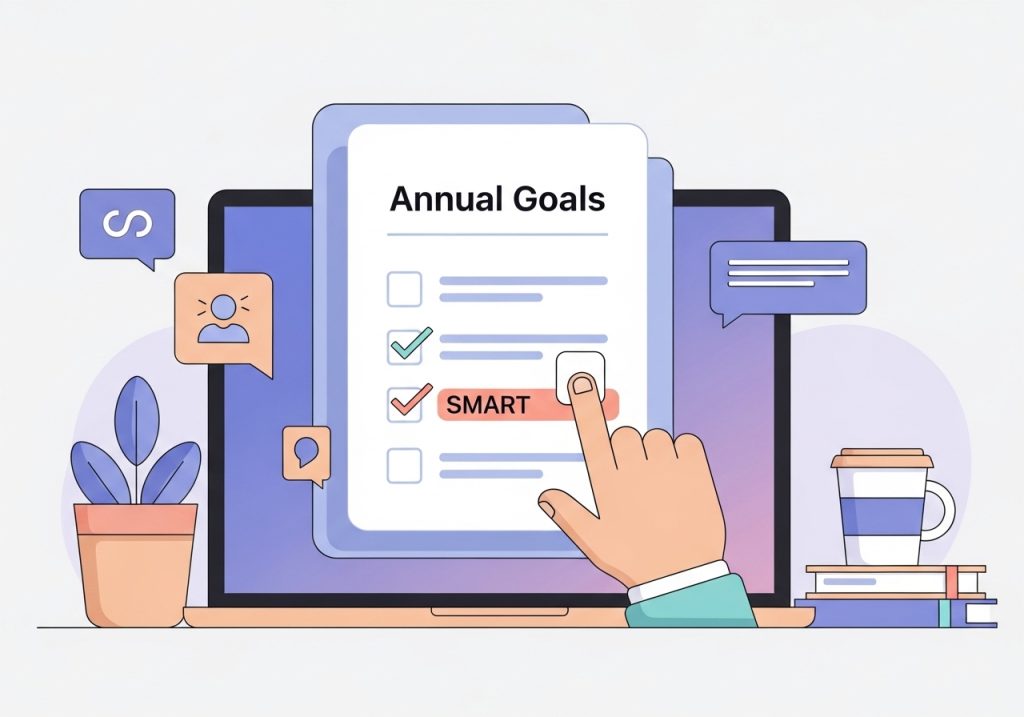
Once you have a solid PLAAFP, you can develop annual goals. The most effective goals follow the SMART framework: Specific, Measurable, Achievable, Relevant, and Time-bound. This structure removes ambiguity and ensures everyone on the IEP team understands the target and how to measure success.
What Makes a Goal SMART?
- Specific: The goal targets a precise skill or behavior. What exactly do you want the student to be able to do?
- Measurable: The goal includes criteria for success. How will you know when the goal has been met? Use numbers, percentages, or frequencies.
- Achievable: The goal is realistic for the student to accomplish within one year, given their present levels.
- Relevant: The goal is directly related to the student’s needs as identified in the PLAAFP and will help them progress in their education.
- Time-bound: The goal specifies a timeframe, which is typically one school year for an annual IEP.
IEP Examples Across Different Domains
Let’s look at how to apply the SMART framework. Here are some examples of moving from a vague concept to a strong, data-driven goal.
Fine Motor Goal Example (Handwriting)
- Vague Goal: “Maria will improve her handwriting.”
- SMART Goal: “By the end of the school year, when given a sentence to copy, Maria will write all lowercase letters on the baseline with correct formation for 90% of letters in 4 out of 5 consecutive trials, as measured by weekly writing samples collected by the OT.” For students needing support in this area, you can explore targeted strategies for improving handwriting legibility and consistency.
Sensory Regulation Goal Example
- Vague Goal: “Leo will use coping skills.”
- SMART Goal: “By the end of the second marking period, when presented with a non-preferred academic task, Leo will independently choose and use a tool from his sensory kit (e.g., fidget tool, weighted lap pad) to remain seated and engaged for 10 minutes, reducing instances of task avoidance to one or fewer per session in 3 of 4 observations by the teacher.” Understanding the ‘why’ behind these actions can be explored further by learning about common sensory seeking behaviors.
Activities of Daily Living (ADL) Goal Example
- Vague Goal: “Sam will be more independent with dressing.”
- SMART Goal: “By May 2025, after recess, Sam will independently fasten the top three buttons on his collared shirt within two minutes without verbal prompts, achieving this in 4 out of 5 opportunities each week as recorded on a staff data chart.”
Step 3: Defining Services, Accommodations, and Modifications
With goals in place, the next step is to detail the supports the student needs to achieve them. It is important to distinguish between services, accommodations, and modifications, as they play different roles.
- Services: This describes the specialized instruction or therapies the student will receive. It must be specific about the frequency, duration, and location. For example, “Occupational therapy will be provided one time per week for 30 minutes in a small group setting outside the general education classroom.”
- Accommodations: These are changes to *how* a student accesses the curriculum and demonstrates learning. They do not change the content or expectations. Examples include extended time on tests, preferential seating, use of a slant board for writing, or access to text-to-speech software.
- Modifications: These are changes to *what* a student is expected to learn. Modifications alter the curriculum or the performance expectations. Examples could be a shorter assignment, answering fewer questions on a test, or working on grade-level content with reduced complexity.
Every support listed in the IEP should be justified by the information in the PLAAFP and directly link to helping the student achieve their annual goals.
Step 4: Planning for Progress Monitoring and Reporting
An IEP is a living document. The final step in creating it is to establish a clear plan for how progress will be monitored and when it will be reported to parents and the rest of the team. This component ensures accountability and allows for adjustments if the student is not making expected progress.
The “Measurable” aspect of a SMART goal sets the stage for progress monitoring. Your goals should already state how they will be measured (e.g., “as measured by data logs,” “work sample analysis,” “therapist observation checklist”). In this section of the IEP, you will specify the frequency of monitoring and reporting.
For example, you might state: “Progress on all annual goals will be measured bi-weekly through data collection by the special education teacher and occupational therapist. A written report of progress will be provided to the parents quarterly, concurrent with the school’s report card schedule.” This practice ensures that the team can make timely, data-informed decisions about the student’s program.
Writing a comprehensive IEP requires careful thought and collaboration. By starting with a detailed PLAAFP, creating SMART goals using clear IEP examples, defining appropriate supports, and establishing a consistent monitoring plan, you build a powerful tool for student success. This systematic approach transforms the IEP from a document of compliance into a meaningful plan that guides effective instruction and intervention.
Ready to Put Your Goals into Action?
Crafting the perfect IEP goal is the first step. The next is having engaging, effective resources to help your learners achieve them. The Inspiring OT shop offers a wide range of practical, OT-designed printable activities and tools to support skill development in fine motor, sensory processing, handwriting, and more. Simplify your planning and find low-prep resources to make every session a success. Explore the shop today to find the perfect materials to bring your IEP goals to life.
Leave a Reply