
ASD early intervention provides specialized, therapeutic support for children from birth to age three to improve developmental outcomes and build foundational skills. This system of services is designed for infants and toddlers who show signs of or have been diagnosed with autism spectrum disorder (ASD). It focuses on helping young children learn important abilities that typically develop during the first few years of life, and research shows that starting support early is more likely to have major, long-term positive effects.
What is ASD Early Intervention?
Early intervention for autism spectrum disorder is a comprehensive set of services aimed at addressing developmental delays associated with ASD as early as possible. In the United States, these services are often provided through programs established under Part C of the Individuals with Disabilities Education Act (IDEA). The core idea is that providing support during the brain’s most rapid period of development can have a significant and lasting impact.
Services are family-centered, recognizing that parents and caregivers are a child’s first and most important teachers. A team of professionals, which may include occupational therapists, speech-language pathologists, special educators, and psychologists, works together with the family to create an Individualized Family Service Plan (IFSP). This plan outlines specific goals for the child and the family and details the types of services that will be provided to meet those goals. Intervention can happen in various settings, including the home, a clinic, or a specialized center.
Core Goals of Early Intervention for Autism Spectrum Disorder
The objectives of ASD early intervention are individualized to each child’s unique strengths and needs. Certain core areas are consistently targeted to promote healthy development. While every child’s plan is different, most focus on a few key areas to help build a strong foundation. These goals often target the most common examples of developmental skills seen in early childhood.
- Communication Skills: Many interventions focus on developing both verbal and nonverbal communication. This can include teaching a child to make eye contact, use gestures like pointing, respond to their name, or use words and phrases to make requests. For children who are non-speaking, it may involve introducing alternative communication methods.
- Social Interaction: Support is provided to help children learn to play with others, share toys, take turns, and understand social cues. The goal is to build the foundation for meaningful relationships and reciprocal interactions. This type of structured social skills training is adapted for a young child’s developmental level.
- Cognitive Skills: This area includes thinking skills like imitation, matching, and problem-solving. Play-based activities are often used to make learning these concepts engaging. Therapists work on attention, memory, and the ability to follow simple directions.
- Adaptive and Daily Living Skills: Early intervention helps children learn practical skills needed for everyday life, such as eating with a utensil, drinking from a cup, and beginning to help with dressing. These skills increase a child’s independence and participation in family routines.
Key Therapeutic Approaches in ASD Early Intervention
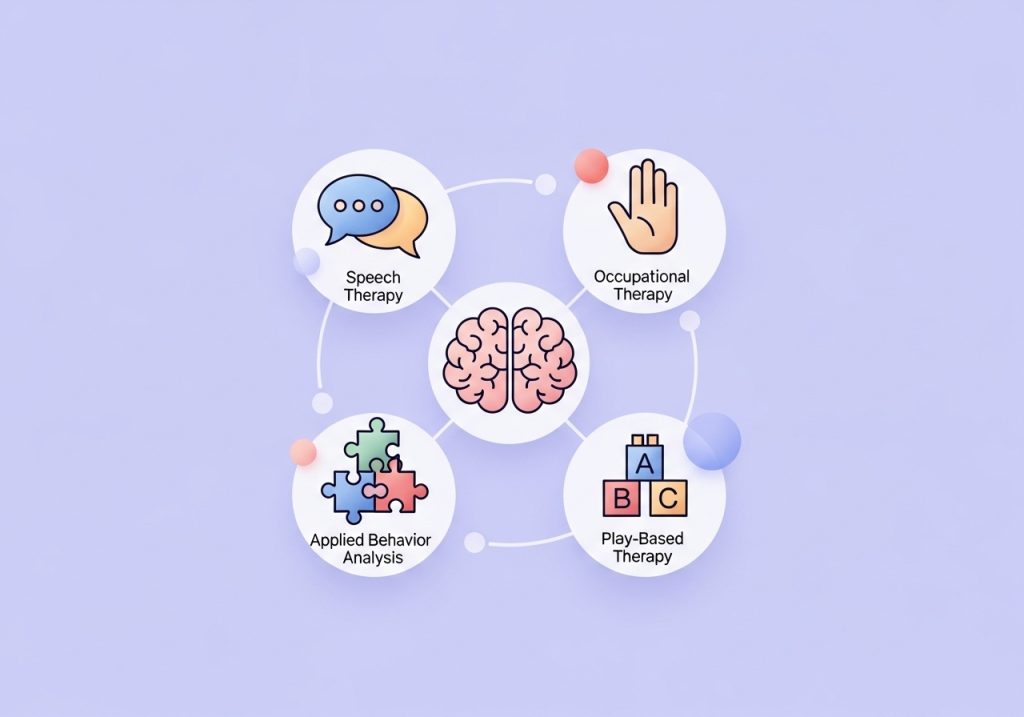
Several evidence-based models are used in early intervention for ASD. A child’s IFSP will often incorporate elements from different approaches to create a program that best fits their learning style and goals. According to the Centers for Disease Control and Prevention (CDC), treatments aim to reduce symptoms that interfere with daily functioning and quality of life. The most effective programs are tailored to the individual.
Occupational Therapy (OT)
OT helps children develop the skills needed for the “occupations” of childhood, such as playing, learning, and self-care. Therapists focus on fine motor skills, visual motor integration, sensory processing, and daily routines.
Speech-Language Therapy
This therapy addresses challenges with understanding and using language. A speech-language pathologist works on everything from producing sounds and words to understanding nonverbal cues and engaging in conversation.
Applied Behavior Analysis (ABA)
ABA uses principles of learning and motivation to teach new skills and reduce challenging behaviors. It often involves breaking down complex skills into small, manageable steps and using positive reinforcement to encourage progress.
The Vital Role of Occupational Therapy
For many young children with ASD, occupational therapy is a key component of their intervention plan. OTs have a unique perspective on how sensory processing differences can affect a child’s ability to participate in daily activities. They help identify if a child is over-responsive or under-responsive to sensory input, like sounds, textures, or movement. An occupational therapist can help with sensory issues by designing a “sensory diet” with activities that help a child stay calm and focused throughout the day.

OTs also work on fine motor skills, which are essential for tasks like holding a crayon, using scissors, or buttoning a coat. They use play-based activities to strengthen small hand muscles and improve hand-eye coordination. An OT can also help families establish predictable routines for dressing, mealtimes, and bedtime. By breaking down these tasks into simple steps and using visual supports, therapists empower children to become more independent in their daily lives. This practical, hands-on support is fundamental to building a child’s confidence and competence.
Practical Steps for Parents and Educators
If you have concerns about a child’s development, the first step is to seek a professional evaluation. You can speak with your pediatrician or contact your state’s early intervention program directly for a free assessment. The American Academy of Pediatrics has consistently emphasized that early intervention is critical for children with ASD to achieve the best possible outcomes.
Once services are in place, collaboration is essential. Parents, therapists, and any childcare providers or teachers should communicate regularly to ensure everyone is working toward the same goals. Consistency between home and other environments helps children learn and generalize new skills more effectively. Using targeted worksheets, activities, and visual aids can reinforce therapeutic goals during everyday routines, making skill-building a natural part of the child’s day.
Building a Foundation for Lifelong Growth
ASD early intervention is not about changing who a child is. It is about providing them with the tools and support they need to learn, communicate, and interact with the world in a confident and successful way. By addressing developmental needs during a critical period of growth, these services build a strong foundation for future learning and independence. The most effective approach is one that is individualized, family-centered, and started as early as possible.
Looking for practical, low-prep resources to support skill development? The Inspiring OT offers a collection of printable activities and guides designed by an experienced occupational therapist. Enhance your therapy sessions, classroom centers, or at-home learning with engaging materials that make building skills easier. Explore the shop today to find the right tools for your learners.
Leave a Reply